


Page 115 - Review of Medical Microbiology and Immunology ( PDFDrive )
P. 115
mebooksfree.com
                                                                            mebooksfree.com
 mebooksfree.com

            mebooksfree.com
                                                                            mebooksfree.com
                                            mebooksfree.com
 mebooksfree.com  mebooksfree.com           mebooksfree.com          heat-resistant endotoxin in the cell walls of the dead gram-          mebooksfree.com
                                                                                                                                           mebooksfree.com
                                                                                                            mebooksfree.com
                       PART I  Basic Bacteriology
                 104
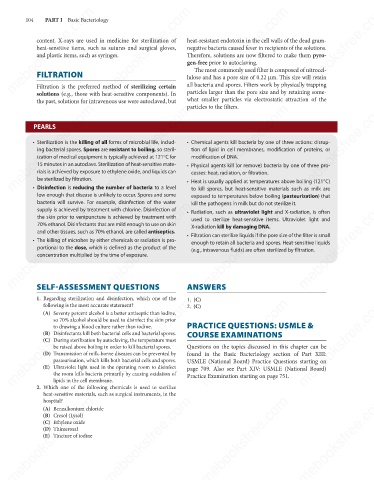
                    content. X-rays are used in medicine for sterilization of
                    heat-sensitive items, such as sutures and surgical gloves,
                                                                     negative bacteria caused fever in recipients of the solutions.
                    and plastic items, such as syringes.
                                                                     Therefore, solutions are now filtered to make them pyro-
                                                                     gen-free prior to autoclaving.
                                                                        The most commonly used filter is composed of nitrocel-
                    FILTRATION
                                                                     all bacteria and spores. Filters work by physically trapping
                    Filtration is the preferred method of  sterilizing  certain
                                                                     particles larger than the pore size and by retaining some-
                    solutions (e.g., those with heat-sensitive components). In
                                                                     what smaller particles via electrostatic attraction of the
                    the past, solutions for intravenous use were autoclaved, but   lulose and has a pore size of 0.22 μm. This size will retain
                                                                            mebooksfree.com
                                                                                                            mebooksfree.com
 mebooksfree.com  mebooksfree.com           mebooksfree.com          •  Chemical agents kill bacteria by one of three actions: disrup-     mebooksfree.com
                                                                     particles to the filters.
                   PEARLS
                   •  Sterilization is the killing of all forms of microbial life, includ-
                    ing bacterial spores. Spores are resistant to boiling, so steril-
                                                                       tion of lipid in cell membranes, modification of proteins, or
                                                                       modification of DNA.
                    ization of medical equipment is typically achieved at 121°C for
                    15 minutes in an autoclave. Sterilization of heat-sensitive mate-
                                                                     •  Physical agents kill (or remove) bacteria by one of three pro-
                    rials is achieved by exposure to ethylene oxide, and liquids can
                                                                       cesses: heat, radiation, or filtration.
                    be sterilized by filtration.
                   •  Disinfection is reducing the number of bacteria to a level
                                                                       to kill spores, but heat-sensitive materials such as milk are
                    low enough that disease is unlikely to occur. Spores and some   •  Heat is usually applied at temperatures above boiling (121°C)
                                                                       exposed to temperatures below boiling (pasteurization) that
                    bacteria will survive. For example, disinfection of the water
                                                                       kill the pathogens in milk but do not sterilize it.
                                                                                                            mebooksfree.com
                                                                            mebooksfree.com
 mebooksfree.com  mebooksfree.com           mebooksfree.com          •  Filtration can sterilize liquids if the pore size of the filter is small   mebooksfree.com
                    supply is achieved by treatment with chlorine. Disinfection of
                                                                     •  Radiation, such as  ultraviolet light and X-radiation, is often
                    the skin prior to venipuncture is achieved by treatment with
                                                                       used to sterilize heat-sensitive items. Ultraviolet light and
                    70% ethanol. Disinfectants that are mild enough to use on skin
                                                                       X-radiation kill by damaging DNA.
                    and other tissues, such as 70% ethanol, are called antiseptics.
                   •  The killing of microbes by either chemicals or radiation is pro-
                                                                       enough to retain all bacteria and spores. Heat-sensitive liquids
                    portional to the dose, which is defined as the product of the
                                                                       (e.g., intravenous fluids) are often sterilized by filtration.
                    concentration multiplied by the time of exposure.
                    SELF-ASSESSMENT QUESTIONS
                                                                     ANSWERS
                    1.  Regarding  sterilization  and  disinfection,  which  one  of  the
 mebooksfree.com  mebooksfree.com           mebooksfree.com          1.  (C) mebooksfree.com                mebooksfree.com                mebooksfree.com
                      following is the most accurate statement?
                                                                     2.  (C)
                      (A)  Seventy percent alcohol is a better antiseptic than iodine,
                          so 70% alcohol should be used to disinfect the skin prior
                                                                     PRACTICE QUESTIONS: USMLE &
                          to drawing a blood culture rather than iodine.
                                                                     COURSE EXAMINATIONS
                      (B)  Disinfectants kill both bacterial cells and bacterial spores.
                      (C)  During sterilization by autoclaving, the temperature must
                                                                     Questions on the topics discussed in this chapter can be
                          be raised above boiling in order to kill bacterial spores.
                      (D)  Transmission of milk-borne diseases can be prevented by
                                                                     found in the Basic Bacteriology section of Part XIII:
                          pasteurization, which kills both bacterial cells and spores.
                                                                     USMLE (National Board) Practice Questions starting on
                      (E)  Ultraviolet light used in the operating room to disinfect
                                                                     page 709. Also see Part XIV: USMLE (National Board)
                          the room kills bacteria primarily by causing oxidation of
                          lipids in the cell membrane.
                    2.  Which one of the following chemicals is used to sterilize
                      heat-sensitive materials, such as surgical instruments, in the   Practice Examination starting on page 751.
 mebooksfree.com  mebooksfree.com           mebooksfree.com                 mebooksfree.com                 mebooksfree.com                mebooksfree.com
                      hospital?
                      (A)  Benzalkonium chloride
                      (B)  Cresol (Lysol)
                      (C)  Ethylene oxide
                      (D)  Thimerosal
                      (E)  Tincture of iodine


 mebooksfree.com  mebooksfree.com           mebooksfree.com                 mebooksfree.com                 mebooksfree.com                mebooksfree.com

