


Page 120 - Review of Medical Microbiology and Immunology ( PDFDrive )
P. 120
mebooksfree.com


            mebooksfree.com
                                                                                                                                           mebooksfree.com
                                                                                                            mebooksfree.com
                                            mebooksfree.com
 mebooksfree.com  mebooksfree.com           mebooksfree.com                 mebooksfree.com         C   H   mebooksfree.com                mebooksfree.com
                                                                            mebooksfree.com
                                                                                                     15
                                                                                                                      E
                                                                                                               P
                                                                                                            A
                                                                                                                  T
                                                                                                                         R

                    Gram-Positive Cocci


 mebooksfree.com  mebooksfree.com           mebooksfree.com              Self-Assessment Questions          mebooksfree.com                mebooksfree.com
                                                                            mebooksfree.com
                       CHAPTER  C ONTENT S


                       Introduction
                                                                         Summaries of Organisms
                       Staphylococcus
                                                                         Practice Questions: USMLE & Course Examinations
                       Streptococcus
                       Streptococcus pneumoniae


                        INTRODUCTION
                        There are two medically important genera of gram-positive
 mebooksfree.com  mebooksfree.com           mebooksfree.com                 mebooksfree.com                 mebooksfree.com                mebooksfree.com
                        cocci:  Staphylococcus and  Streptococcus. Two of the most
                        important human pathogens,  Staphylococcus aureus and
                        Streptococcus pyogenes, are described in this chapter. Staph-
                        ylococci and streptococci are nonmotile and do not form
                        spores.
                          Both staphylococci and streptococci are gram-positive
                        cocci, but they are distinguished by two main criteria:
                          (1) Microscopically, staphylococci appear in grapelike
                        clusters, whereas streptococci are in chains.
                          (2) Biochemically, staphylococci produce catalase (i.e.,
                        they degrade hydrogen peroxide), whereas streptococci
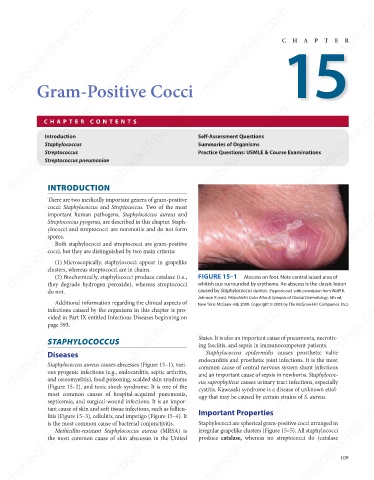
                                                                         whitish pus surrounded by erythema. An abscess is the classic lesion
                        do not.                                          FIGURE 15–1    Abscess on foot. Note central raised area of
                                                                         caused by Staphylococcus aureus. (Reproduced  with permission from Wolff K,
                                                                         Johnson R (eds): Fitzpatrick’s Color Atlas & Synopsis of Clinical Dermatology. 6th ed.
                                                                            mebooksfree.com
                                                                                                            mebooksfree.com
 mebooksfree.com  mebooksfree.com           mebooksfree.com              States. It is also an important cause of pneumonia, necrotiz-     mebooksfree.com
                          Additional information regarding the clinical aspects of
                                                                         New York: McGraw-Hill, 2009. Copyright © 2009 by The McGraw-Hill Companies, Inc.)
                        infections caused by the organisms in this chapter is pro-
                        vided in Part IX entitled Infectious Diseases beginning on
                        page 593.
                        STAPHYLOCOCCUS
                                                                         ing fasciitis, and sepsis in immunocompetent patients.
                                                                            Staphylococcus  epidermidis  causes  prosthetic  valve
                        Diseases
                                                                         endocarditis and prosthetic joint infections. It is the most
                        Staphylococcus aureus causes abscesses (Figure 15–1), vari-
                                                                         common cause of central nervous system shunt infections
                        ous pyogenic infections (e.g., endocarditis, septic arthritis,
                        and osteomyelitis), food poisoning, scalded skin syndrome
                                                                         cus saprophyticus causes urinary tract infections, especially
                        (Figure 15–2), and toxic shock syndrome. It is one of the
                                                                         cystitis. Kawasaki syndrome is a disease of unknown etiol-
                        most  common  causes  of  hospital-acquired  pneumonia,   and an important cause of sepsis in newborns. Staphylococ-
                                                                         ogy that may be caused by certain strains of S. aureus.
                                                                            mebooksfree.com
                                                                                                            mebooksfree.com
 mebooksfree.com  mebooksfree.com           mebooksfree.com              Staphylococci are spherical gram-positive cocci arranged in   109  mebooksfree.com
                        septicemia, and surgical-wound infections. It is an impor-
                        tant cause of skin and soft tissue infections, such as follicu-
                                                                         Important Properties
                        litis (Figure 15–3), cellulitis, and impetigo (Figure 15–4). It
                        is the most common cause of bacterial conjunctivitis.
                                                                         irregular grapelike clusters (Figure 15–5). All staphylococci
                          Methicillin-resistant  Staphylococcus  aureus (MRSA) is
                                                                         produce  catalase, whereas no streptococci do (catalase
                        the most common cause of skin abscesses in the United


 mebooksfree.com  mebooksfree.com           mebooksfree.com                 mebooksfree.com                 mebooksfree.com                mebooksfree.com

