


Page 129 - Review of Medical Microbiology and Immunology ( PDFDrive )
P. 129
mebooksfree.com
                                                                                                            mebooksfree.com
 mebooksfree.com

                                                                                                            mebooksfree.com
            mebooksfree.com
                                            mebooksfree.com
                                                                            mebooksfree.com
 mebooksfree.com  mebooksfree.com           mebooksfree.com          tract of some women and can cause neonatal meningitis                 mebooksfree.com
                                                                                                                                           mebooksfree.com
                       PART II  Clinical Bacteriology
                 118
                                                                        Group B streptococci (S. agalactiae) colonize the genital
                                                                     and sepsis. They  are  usually  bacitracin-resistant.  They
                                                                     hydrolyze (break down) hippurate, an important diagnostic
                                                                     criterion.
                                                                        Group D streptococci include enterococci (e.g., E. faeca-
                                                                     lis and Enterococcus faecium) and nonenterococci (e.g.,
                                                                     S. bovis). Enterococci are members of the normal flora of
                                                                     the colon and are noted for their ability to cause urinary,
                                                                     biliary, and cardiovascular infections. They are very hardy
                                                                            mebooksfree.com
 mebooksfree.com  mebooksfree.com           mebooksfree.com          gistic combination of penicillin and an aminoglycoside                mebooksfree.com
                                                                                                            mebooksfree.com
                                                                     organisms; they can grow in hypertonic (6.5%) saline or in
                                                                     bile and are not killed by penicillin G. As a result, a syner-
                                                                     (e.g., gentamicin) is required to kill enterococci. Vancomy-
                                                                     cin can also be used, but vancomycin-resistant enterococci
                                                                     (VRE) have emerged and become an important and much
                                                                     feared cause of life-threatening nosocomial  infections.
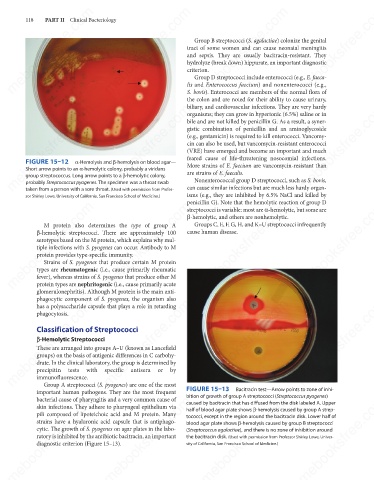
                 FIGURE 15–12
                                 α-Hemolysis and β-hemolysis on blood agar—
                                                                     More strains of E. faecium are vancomycin-resistant than
                 Short arrow points to an α-hemolytic colony, probably a viridans
                                                                     are strains of E. faecalis.
                 group streptococcus. Long arrow points to a β-hemolytic colony,
                                                                        Nonenterococcal group D streptococci, such as S. bovis,
                 probably Streptococcus pyogenes. The specimen was a throat swab
                 taken from a person with a sore throat. (Used with permission from Profes-
                                                                     isms (e.g., they are inhibited by 6.5% NaCl and killed by
                 sor Shirley Lowe, University of California, San Francisco School of Medicine.)  can cause similar infections but are much less hardy organ-
                                                                     penicillin G). Note that the hemolytic reaction of group D
 mebooksfree.com  mebooksfree.com           mebooksfree.com          cause human disease.                   mebooksfree.com                mebooksfree.com
                                                                            mebooksfree.com
                                                                     streptococci is variable: most are α-hemolytic, but some are
                                                                     β-hemolytic, and others are nonhemolytic.
                                                                        Groups C, E, F, G, H, and K–U streptococci infrequently
                       M protein also determines the  type of group A
                    β-hemolytic streptococci. There are approximately 100
                    serotypes based on the M protein, which explains why mul-
                    tiple infections with S. pyogenes can occur. Antibody to M
                    protein provides type-specific immunity.
                       Strains of  S. pyogenes that produce certain M protein
                    types are rheumatogenic (i.e., cause primarily rheumatic
                    fever), whereas strains of S. pyogenes that produce other M
                    protein types are nephritogenic (i.e., cause primarily acute
                    glomerulonephritis). Although M protein is the main anti-
                    phagocytic component of  S.  pyogenes, the organism also
 mebooksfree.com  mebooksfree.com           mebooksfree.com                 mebooksfree.com                 mebooksfree.com                mebooksfree.com
                    has a polysaccharide capsule that plays a role in retarding
                    phagocytosis.

                    Classification of Streptococci
                    a-Hemolytic Streptococci
                    These are arranged into groups A–U (known as Lancefield
                    groups) on the basis of antigenic differences in C carbohy-
                    drate. In the clinical laboratory, the group is determined by
                    precipitin tests with specific antisera or by
                    immunofluorescence.
                       Group A streptococci (S. pyogenes) are one of the most
                    important human pathogens. They are the most frequent   FIGURE 15–13   Bacitracin test—Arrow points to zone of inhi-
                                                                     bition of growth of group A streptococci (Streptococcus pyogenes)
 mebooksfree.com  mebooksfree.com           mebooksfree.com          tococci, except in the region around the bacitracin disk. Lower half of   mebooksfree.com
                                                                            mebooksfree.com
                                                                                                            mebooksfree.com
                    bacterial cause of pharyngitis and a very common cause of
                                                                     caused by bacitracin that has diffused from the disk labeled A. Upper
                    skin infections. They adhere to pharyngeal epithelium via
                                                                     half of blood agar plate shows β-hemolysis caused by group A strep-
                    pili composed of lipoteichoic acid and M protein. Many
                    strains  have a  hyaluronic  acid  capsule  that  is antiphago-
                                                                     blood agar plate shows β-hemolysis caused by group B streptococci
                    cytic. The growth of S. pyogenes on agar plates in the labo-
                                                                     (Streptococcus agalactiae), and there is no zone of inhibition around
                    ratory is inhibited by the antibiotic bacitracin, an important
                                                                     the bacitracin disk. (Used with permission from Professor Shirley Lowe, Univer-
                    diagnostic criterion (Figure 15–13).
                                                                     sity of California, San Francisco School of Medicine.)


 mebooksfree.com  mebooksfree.com           mebooksfree.com                 mebooksfree.com                 mebooksfree.com                mebooksfree.com

