


Page 127 - Review of Medical Microbiology and Immunology ( PDFDrive )
P. 127
mebooksfree.com
 mebooksfree.com


            mebooksfree.com
                                                                                                            mebooksfree.com
                    drug combinations (see Chapter 10). mebooksfree.com
                                                                                                                                           mebooksfree.com
 mebooksfree.com  mebooksfree.com           mebooksfree.com          Diseases mebooksfree.com               mebooksfree.com                mebooksfree.com
                       PART II  Clinical Bacteriology
                 116
                                                                     STREPTOCOCCUS
                       Some strains of staphylococci exhibit  tolerance (i.e.,
                    they can be inhibited by antibiotics but are not killed).
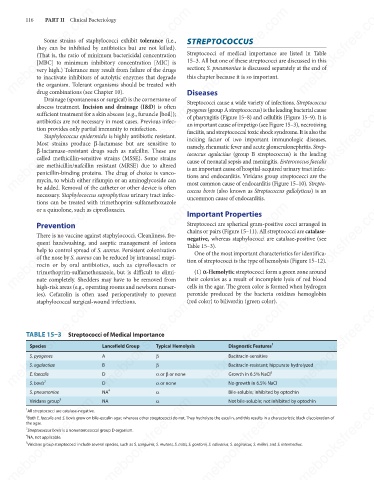
                                                                     Streptococci of medical importance are listed in Table
                    (That is, the ratio of minimum bactericidal concentration
                                                                     15–3. All but one of these streptococci are discussed in this
                    [MBC] to minimum inhibitory concentration [MIC] is
                                                                     section; S. pneumoniae is discussed separately at the end of
                    very high.) Tolerance may result from failure of the drugs
                    to inactivate inhibitors of autolytic enzymes that degrade
                    the organism. Tolerant organisms should be treated with
                       Drainage (spontaneous or surgical) is the cornerstone of   this chapter because it is so important.
                                                                     Streptococci cause a wide variety of infections. Streptococcus
 mebooksfree.com  mebooksfree.com           mebooksfree.com          an important cause of impetigo (see Figure 15–3), necrotizing         mebooksfree.com
                    abscess treatment. Incision and drainage (I&D) is often
                                                                                                            mebooksfree.com
                                                                            mebooksfree.com
                                                                     pyogenes (group A streptococcus) is the leading bacterial cause
                    sufficient treatment for a skin abscess (e.g., furuncle [boil]);
                                                                     of pharyngitis (Figure 15–8) and cellulitis (Figure 15–9). It is
                    antibiotics are not necessary in most cases. Previous infec-
                    tion provides only partial immunity to reinfection.
                                                                     fasciitis, and streptococcal toxic shock syndrome. It is also the
                       Staphylococcus epidermidis is highly antibiotic resistant.
                                                                     inciting factor of two important  immunologic  diseases,
                    Most strains produce  β-lactamase but are sensitive to
                                                                     namely, rheumatic fever and acute glomerulonephritis. Strep-
                    β-lactamase–resistant drugs such as nafcillin. These  are
                                                                     tococcus agalactiae (group B streptococcus) is the leading
                    called  methicillin-sensitive  strains  (MSSE).  Some  strains
                                                                     cause of neonatal sepsis and meningitis. Enterococcus faecalis
                    are methicillin/nafcillin resistant (MRSE) due to altered
                                                                     is an important cause of hospital-acquired urinary tract infec-
                    penicillin-binding proteins. The drug of choice is vanco-
                    mycin, to which either rifampin or an aminoglycoside can
                                                                     most common cause of endocarditis (Figure 15–10). Strepto-
                    be added. Removal of the catheter or other device is often
                                                                     coccus bovis (also known as Streptococcus gallolyticus) is an
                    necessary. Staphylococcus saprophyticus urinary tract infec-  tions and endocarditis. Viridans group streptococci are the
                                                                     uncommon cause of endocarditis.
                    tions can be treated with trimethoprim-sulfamethoxazole
 mebooksfree.com  mebooksfree.com           mebooksfree.com          Streptococci are spherical gram-positive cocci arranged in            mebooksfree.com
                                                                            mebooksfree.com
                                                                                                            mebooksfree.com
                    or a quinolone, such as ciprofloxacin.
                                                                     Important Properties
                    Prevention
                                                                     chains or pairs (Figure 15–11). All streptococci are catalase-
                    There is no vaccine against staphylococci. Cleanliness, fre-
                                                                     negative, whereas staphylococci are catalase-positive (see
                    quent handwashing, and aseptic management of lesions
                                                                     Table 15–3).
                    help to control spread of S. aureus. Persistent colonization
                                                                        One of the most important characteristics for identifica-
                    of the nose by S. aureus can be reduced by intranasal mupi-
                                                                     tion of streptococci is the type of hemolysis (Figure 15–12).
                    rocin or by oral antibiotics, such as ciprofloxacin or
                                                                        (1) `-Hemolytic streptococci form a green zone around
                    trimethoprim-sulfamethoxazole,  but is  difficult  to  elimi-
                    nate completely. Shedders may have to be removed from
                                                                     cells in the agar. The green color is formed when hydrogen
                    high-risk areas (e.g., operating rooms and newborn nurser-
                                                                     peroxide produced by the bacteria  oxidizes hemoglobin
                    ies). Cefazolin is often used perioperatively to prevent   their colonies as a result of incomplete lysis of red blood
 mebooksfree.com  mebooksfree.com         Lancefield Group  Typical Hemolysis mebooksfree.com               mebooksfree.com                mebooksfree.com
                                            mebooksfree.com
                    staphylococcal surgical-wound infections.
                                                                     (red color) to biliverdin (green color).
                 TABLE 15–3  Streptococci of Medical Importance
                                                                                                 1
                                                                                   Diagnostic Features
                  Species
                  S. pyogenes
                                                                                   Bacitracin-sensitive
                                                           β
                                          A
                                          B
                  S. agalactiae
                                                           β
                                                                                   Bacitracin-resistant; hippurate hydrolyzed
                  E. faecalis
                       3
                                                           α or none
                                          D
                  S. bovis
                                                                                   No growth in 6.5% NaCl
                                                           α
                                                                                   Bile-soluble; inhibited by optochin
                  S. pneumoniae 5         D  4             α or β or none          Growth in 6.5% NaCl 2
                                          NA
 mebooksfree.com  mebooksfree.com           mebooksfree.com                 mebooksfree.com                 mebooksfree.com                mebooksfree.com
                                          NA
                  Viridans group
                                                           α
                                                                                   Not bile-soluble; not inhibited by optochin
                 1
                 All streptococci are catalase-negative.
                 2
                 Both E. faecalis and S. bovis grow on bile-esculin agar, whereas other streptococci do not. They hydrolyze the esculin, and this results in a characteristic black discoloration of
                 the agar.
                 3
                 Streptococcus bovis is a nonenterococcal group D organism.
                 4
                 NA, not applicable.
                 5
                 Viridans group streptococci include several species, such as S. sanguinis, S. mutans, S. mitis, S. gordonii, S. salivarius, S. anginosus, S. milleri, and S. intermedius.
 mebooksfree.com  mebooksfree.com           mebooksfree.com                 mebooksfree.com                 mebooksfree.com                mebooksfree.com

