


Page 149 - Review of Medical Microbiology and Immunology ( PDFDrive )
P. 149
mebooksfree.com
mebooksfree.com
mebooksfree.com
mebooksfree.com
mebooksfree.com
mebooksfree.com
mebooksfree.com mebooksfree.com mebooksfree.com the neurons. mebooksfree.com mebooksfree.com mebooksfree.com
PART II Clinical Bacteriology
138
carried intra-axonally (retrograde) to the central nervous
system, where it binds to ganglioside receptors and blocks
release of inhibitory mediators (e.g., glycine and
γ-aminobutyric acid [GABA]) at spinal synapses.
Tetanus toxin and botulinum toxin (see later) are among
the most toxic substances known. They are both proteases
that cleave the proteins involved in mediator release from
Tetanus toxin has one antigenic type, unlike botuli-
num toxin, which has eight. There is therefore only one
mebooksfree.com mebooksfree.com mebooksfree.com Clinical Findings mebooksfree.com mebooksfree.com
mebooksfree.com
antigenic type of tetanus toxoid in the vaccine against
tetanus.
Tetanus is characterized by strong muscle spasms (spastic
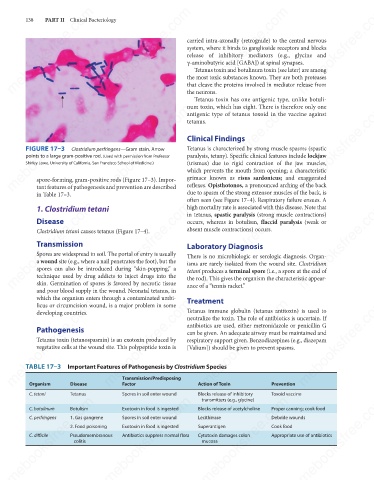
FIGURE 17–3
Clostridium perfringens—Gram stain. Arrow
paralysis, tetany). Specific clinical features include lockjaw
points to a large gram-positive rod. (Used with permission from Professor
(trismus) due to rigid contraction of the jaw muscles,
Shirley Lowe, University of California, San Francisco School of Medicine.)
which prevents the mouth from opening; a characteristic
spore-forming, gram-positive rods (Figure 17–3). Impor-
reflexes. Opisthotonos, a pronounced arching of the back
tant features of pathogenesis and prevention are described
due to spasm of the strong extensor muscles of the back, is
in Table 17–3. grimace known as risus sardonicus; and exaggerated
often seen (see Figure 17–4). Respiratory failure ensues. A
mebooksfree.com
mebooksfree.com
mebooksfree.com mebooksfree.com mebooksfree.com occurs, whereas in botulism, flaccid paralysis (weak or mebooksfree.com
high mortality rate is associated with this disease. Note that
1. Clostridium tetani
in tetanus, spastic paralysis (strong muscle contractions)
Disease
absent muscle contractions) occurs.
Clostridium tetani causes tetanus (Figure 17–4).
Transmission
Laboratory Diagnosis
Spores are widespread in soil. The portal of entry is usually
There is no microbiologic or serologic diagnosis. Organ-
a wound site (e.g., where a nail penetrates the foot), but the
isms are rarely isolated from the wound site. Clostridium
spores can also be introduced during “skin-popping,” a
tetani produces a terminal spore (i.e., a spore at the end of
technique used by drug addicts to inject drugs into the
skin. Germination of spores is favored by necrotic tissue
ance of a “tennis racket.”
and poor blood supply in the wound. Neonatal tetanus, in
which the organism enters through a contaminated umbi- the rod). This gives the organism the characteristic appear-
Treatment
mebooksfree.com
mebooksfree.com mebooksfree.com mebooksfree.com antibiotics are used, either metronidazole or penicillin G mebooksfree.com
mebooksfree.com
licus or circumcision wound, is a major problem in some
Tetanus immune globulin (tetanus antitoxin) is used to
developing countries.
neutralize the toxin. The role of antibiotics is uncertain. If
Pathogenesis
can be given. An adequate airway must be maintained and
Tetanus toxin (tetanospasmin) is an exotoxin produced by
respiratory support given. Benzodiazepines (e.g., diazepam
vegetative cells at the wound site. This polypeptide toxin is
[Valium]) should be given to prevent spasms.
TABLE 17–3 Important Features of Pathogenesis by Clostridium Species
Factor
Organism
Toxoid vaccine
Tetanus
C. tetani Disease Transmission/Predisposing Action of Toxin Prevention
Spores in soil enter wound
Blocks release of inhibitory
mebooksfree.com mebooksfree.com mebooksfree.com Lecithinase Debride wounds mebooksfree.com mebooksfree.com
mebooksfree.com
transmitters (e.g., glycine)
Blocks release of acetylcholine
C. botulinum
Botulism
Proper canning; cook food
Exotoxin in food is ingested
C. perfringens
Spores in soil enter wound
1. Gas gangrene
Cook food
Exotoxin in food is ingested
2. Food poisoning
Superantigen
Pseudomembranous
Appropriate use of antibiotics
Antibiotics suppress normal flora
Cytotoxin damages colon
C. difficile
mucosa
colitis
mebooksfree.com mebooksfree.com mebooksfree.com mebooksfree.com mebooksfree.com mebooksfree.com

