


Page 151 - Review of Medical Microbiology and Immunology ( PDFDrive )
P. 151
mebooksfree.com
 mebooksfree.com


                                            mebooksfree.com
                                                                            mebooksfree.com
            mebooksfree.com
 mebooksfree.com  mebooksfree.com           mebooksfree.com          Transmission                           mebooksfree.com                mebooksfree.com
                                                                                                                                           mebooksfree.com
                                                                                                            mebooksfree.com
                 140
                       PART II  Clinical Bacteriology
                    Prevention
                    Proper sterilization of all canned and vacuum-packed
                                                                     Spores are located in the soil; vegetative cells are members
                                                                     of the normal flora of the colon and vagina. Gas gangrene
                    foods is essential. Food must be adequately cooked to inac-
                                                                     is associated with war wounds, automobile and motorcycle
                    tivate the toxin. Swollen cans must be discarded (clostridial
                    proteolytic enzymes form gas, which swells cans).
                                                                     accidents, and septic abortions (endometritis).
                    3. Clostridium perfringens
                                                                     Organisms grow in traumatized tissue (especially muscle)
                    Clostridium perfringens causes two distinct diseases, gas   Pathogenesis
                                                                     and produce a variety of toxins. The most important is
                                                                            mebooksfree.com
 mebooksfree.com  mebooksfree.com           mebooksfree.com          Degradative enzymes produce gas in tissues. mebooksfree.com           mebooksfree.com
                    gangrene and food poisoning, depending on the route of
                                                                     alpha toxin (lecithinase), which damages cell membranes,
                    entry into the body.
                                                                     including those of erythrocytes, resulting in hemolysis.
                    Disease: Gas Gangrene
                                                                     Clinical Findings
                    Gas gangrene (myonecrosis, necrotizing fasciitis) is one
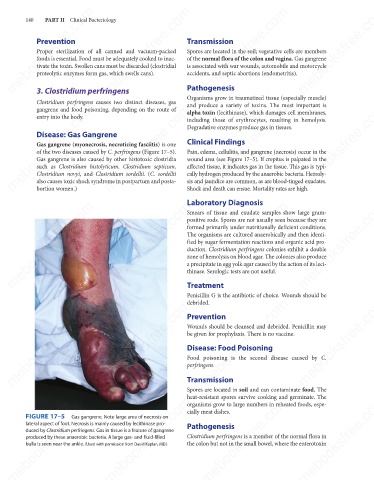
                    of the two diseases caused by C. perfringens (Figure 17–5).
                                                                     Pain, edema, cellulitis, and gangrene (necrosis) occur in the
                                                                     wound area (see Figure 17–5). If crepitus is palpated in the
                    Gas gangrene is also caused by other histotoxic clostridia
                                                                     affected tissue, it indicates gas in the tissue. This gas is typi-
                    such as  Clostridium histolyticum, Clostridium septicum,
                    Clostridium novyi, and  Clostridium sordellii. (C. sordellii
                                                                     cally hydrogen produced by the anaerobic bacteria. Hemoly-
                    also causes toxic shock syndrome in postpartum and posta-
                                                                     sis and jaundice are common, as are blood-tinged exudates.
                    bortion women.)
                                                                     Shock and death can ensue. Mortality rates are high.
                                                                            mebooksfree.com
 mebooksfree.com  mebooksfree.com           mebooksfree.com          Laboratory Diagnosis                   mebooksfree.com                mebooksfree.com
                                                                     Smears  of tissue and exudate samples show  large  gram-
                                                                     positive rods. Spores are not usually seen because they are
                                                                     formed primarily under nutritionally deficient conditions.
                                                                     The organisms are cultured anaerobically and then identi-
                                                                     fied by sugar fermentation reactions and organic acid pro-
                                                                     duction. Clostridium perfringens colonies exhibit a double
                                                                     zone of hemolysis on blood agar. The colonies also produce
                                                                     a precipitate in egg yolk agar caused by the action of its leci-
                                                                     thinase. Serologic tests are not useful.

                                                                     Treatment
                                                                     Penicillin G is the antibiotic of choice. Wounds should be
                                                                                                            mebooksfree.com
                                                                            mebooksfree.com
 mebooksfree.com  mebooksfree.com           mebooksfree.com          Wounds should be cleansed and debrided. Penicillin may                mebooksfree.com
                                                                     debrided.
                                                                     Prevention

                                                                     be given for prophylaxis. There is no vaccine.
                                                                     Disease: Food Poisoning

                                                                     Food poisoning is the second disease caused by  C.
                                                                     perfringens.

                                                                     Transmission
                                                                     Spores are located in soil and can contaminate food. The
                                                                     heat-resistant spores survive cooking and germinate. The
                                                                            mebooksfree.com
 mebooksfree.com  mebooksfree.com           mebooksfree.com          Pathogenesis                           mebooksfree.com                mebooksfree.com
                                                                     organisms grow to large numbers in reheated foods, espe-
                                                                     cially meat dishes.
                 FIGURE 17–5
                                Gas gangrene. Note large area of necrosis on
                 lateral aspect of foot. Necrosis is mainly caused by lecithinase pro-
                 duced by Clostridium perfringens. Gas in tissue is a feature of gangrene
                                                                     Clostridium perfringens is a member of the normal flora in
                 produced by these anaerobic bacteria. A large gas- and fluid-filled
                                                                     the colon but not in the small bowel, where the enterotoxin
                 bulla is seen near the ankle. (Used with permission from David Kaplan, MD.)


 mebooksfree.com  mebooksfree.com           mebooksfree.com                 mebooksfree.com                 mebooksfree.com                mebooksfree.com

