


Page 147 - Review of Medical Microbiology and Immunology ( PDFDrive )
P. 147
mebooksfree.com
 mebooksfree.com


                                                                                                            mebooksfree.com
            mebooksfree.com
                                                                            mebooksfree.com
 mebooksfree.com  mebooksfree.com          Transmission/      Action of Toxin mebooksfree.com        Prevention mebooksfree.com            mebooksfree.com
                                            mebooksfree.com
                                                                                                                                           mebooksfree.com
                 136
                       PART II  Clinical Bacteriology
                 TABLE 17–2  Important Features of Pathogenesis by Bacillus Species
                  Organism
                             Disease
                                           Predisposing Factor
                                           1.   Cutaneous anthrax:
                             Anthrax
                                                              Exotoxin has three components: protective antigen
                  B. anthracis
                                                                                                     Vaccine contains protec-
                                                                                                      tive antigen as the
                                             spores in soil enter
                                                               binds to cells; edema factor is an adenylate cyclase;


                                                               lethal factor is a protease that inhibits cell growth
                                                                                                      immunogen
                                             wound
                                           2.   Pulmonary anthrax:
                                                               resulting in cell death (necrosis)
                                             spores are inhaled
                                             into lung          Two exotoxins (enterotoxins):          No vaccine
 mebooksfree.com  mebooksfree.com           mebooksfree.com          mediastinal lymph nodes, where it causes hemorrhagic                  mebooksfree.com
                                                                                                            mebooksfree.com
                                                                            mebooksfree.com
                                           Spores germinate in
                             Food poisoning
                  B. cereus
                                            reheated rice, then
                                                              1.   Similar to cholera toxin, it increases cyclic AMP
                                            bacteria produce exo-
                                                              2.   Similar to staphylococcal enterotoxin, it is a
                                            toxins, which are
                                                                superantigen
                                            ingested
                    (This is unique—capsules of other bacteria are polysac-
                                                                     mediastinitis. Because it leaves the lung so rapidly, it is not
                    charides.) It is nonmotile, whereas other members of the
                    genus are motile. Anthrax toxin is encoded on one plas-
                                                                     transmitted by the respiratory route to others.
                    mid, and the polyglutamate capsule is encoded on a dif-
                    ferent plasmid.
                                                                     Pathogenesis  is  based  primarily  on  the  production  of
                    Transmission                                     Pathogenesis
                                                                     two exotoxins, collectively known as anthrax toxin. The
                                                                            mebooksfree.com
                                                                                                            mebooksfree.com
 mebooksfree.com  mebooksfree.com           mebooksfree.com          The B, or binding, subunit in each of the two exotoxins               mebooksfree.com
                    Spores of the organism persist in soil for years. Humans are
                                                                     two exotoxins,  edema factor and  lethal factor, each
                                                                     consist of two proteins in an A–B subunit configuration.
                    most often infected cutaneously at the time of trauma to
                    the skin, which allows the  spores on animal products,
                                                                     is protective antigen. The A, or active, subunit has enzy-
                    such as hides, bristles, and wool, to enter. Spores can also be
                    inhaled into the respiratory tract. Pulmonary (inhalation)
                                                                     matic activity.
                                                                        Edema factor, an exotoxin, is an adenylate cyclase that
                    anthrax occurs when spores are inhaled into the lungs.
                                                                     causes an increase in the intracellular concentration of
                    Gastrointestinal anthrax occurs when contaminated meat
                                                                     cyclic adenosine monophosphate (AMP). This causes an
                    is ingested.
                       Inhalation anthrax is not communicable from person to
                                                                     outpouring of fluid from the cell into the extracellular
                                                                     space, which manifests as edema. (Note the similarity of
                    person, despite the severity of the infection. After being
                                                                     action to that of cholera toxin.)
                    inhaled into the lung, the organism moves rapidly to the
 mebooksfree.com  mebooksfree.com           mebooksfree.com                 mebooksfree.com                 mebooksfree.com                mebooksfree.com
                                                                            mebooksfree.com
                                                                                                            mebooksfree.com
 mebooksfree.com  mebooksfree.com           mebooksfree.com          FIGURE 17–2    Bacillus anthracis—Gram stain. Arrow points            mebooksfree.com
                 FIGURE 17–1
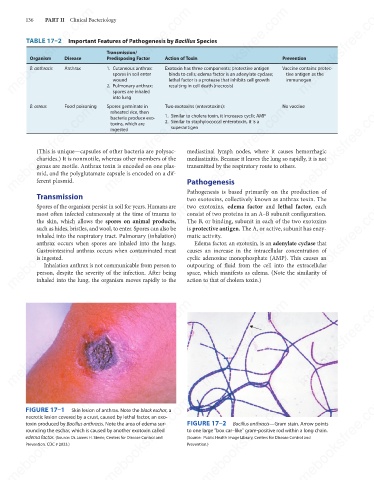
                                Skin lesion of anthrax. Note the black eschar, a
                 necrotic lesion covered by a crust, caused by lethal factor, an exo-
                 toxin produced by Bacillus anthracis. Note the area of edema sur-
                                                                     to one large "box car–like" gram-positive rod within a long chain.
                 rounding the eschar, which is caused by another exotoxin called
                                                                     (Source:  Public Health Image Library, Centers for Disease Control and
                 edema factor. (Source: Dr. James H. Steele, Centers for Disease Control and
                 Prevention. CDC # 2033.)
                                                                     Prevention.)


 mebooksfree.com  mebooksfree.com           mebooksfree.com                 mebooksfree.com                 mebooksfree.com                mebooksfree.com

