


Page 152 - Review of Medical Microbiology and Immunology ( PDFDrive )
P. 152
mebooksfree.com
                                                                                                            mebooksfree.com
 mebooksfree.com

                                                                                                                                           mebooksfree.com
                                                                            mebooksfree.com
            mebooksfree.com
 mebooksfree.com  mebooksfree.com           mebooksfree.com              as a cause of pseudomembranous colitis, but many antibi-  141     mebooksfree.com
                                                                                                            mebooksfree.com
                                            mebooksfree.com
                                                                                         CHAPTER 17  Gram-Positive Rods
                        acts to cause diarrhea. The mode of action of the entero-
                                                                           Clindamycin was the first antibiotic to be recognized
                        toxin is the same as that of the enterotoxin of Staphylococ-
                                                                         otics are known to cause this disease. At present, third-
                        cus aureus (i.e., it acts as a superantigen).
                                                                         generation cephalosporins are the most common cause
                                                                         because they are so frequently used. Ampicillin and fluoro-
                        Clinical Findings
                                                                         quinolones are also commonly implicated. In addition to
                        The disease has an 8- to 16-hour incubation period and is
                                                                         antibiotics, cancer chemotherapy also predisposes to pseu-
                        characterized by watery diarrhea with cramps and little
                                                                         domembranous colitis. Clostridium difficile rarely invades
                        vomiting. It resolves in 24 hours.
                                                                         the intestinal mucosa.
 mebooksfree.com  mebooksfree.com           mebooksfree.com              Clostridium difficile causes diarrhea associated with pseu-       mebooksfree.com
                                                                                                            mebooksfree.com
                                                                            mebooksfree.com
                        Laboratory Diagnosis
                                                                         Clinical Findings
                        This is not usually done. There is no assay for the toxin.
                        Large numbers of the organisms can be isolated from
                                                                         domembranes (yellow-white plaques) on the colonic
                        uneaten food.
                                                                         mucosa (see Figure 17–6). (The term pseudomembrane is
                                                                         defined in Chapter 7 on page 39). The diarrhea is usually
                        Treatment
                                                                         not bloody, and neutrophils are found in the stool in about
                                                                         half of the cases. Fever and abdominal pain often occur.
                        Symptomatic treatment is given; no antimicrobial drugs are
                                                                         The organism rarely enters the blood stream and rarely
                        administered.
                                                                           The pseudomembranes are visualized by sigmoidos-
                        Prevention
                                                                         copy. Toxic megacolon can occur, and surgical resection
                        There are no specific preventive measures. Food should be   causes metastatic infection.
                                                                         of the colon may be necessary. Pseudomembranous colitis
 mebooksfree.com  mebooksfree.com           mebooksfree.com              quate treatment, the organism may not be eradicated               mebooksfree.com
                                                                                                            mebooksfree.com
                        adequately cooked to kill the organism.
                                                                            mebooksfree.com
                                                                         can be distinguished from the transient diarrhea that
                                                                         occurs as a side effect of many oral antibiotics by testing
                        4. Clostridium difficile
                                                                         for the presence of the toxin in the stool. Even with ade-
                        Disease
                                                                         from the colon and recurrences occur at a rate of approxi-
                                                                         mately 15% to 20%.
                        Clostridium difficile causes antibiotic-associated pseudo-
                                                                           In 2005, a new, more virulent strain of  C. difficile
                        membranous colitis (Figure 17–6). Clostridium difficile
                                                                         emerged. This hypervirulent strain causes more severe dis-
                        is the most common nosocomial (hospital-acquired)
                                                                         ease, is more likely to cause recurrences, and responds less
                        cause of diarrhea. It is the leading infectious cause of
                        gastrointestinal-associated deaths in the United States.
                        Transmission
                        The organism colonizes the  large intestine of approxi-
 mebooksfree.com  mebooksfree.com           mebooksfree.com                 mebooksfree.com                 mebooksfree.com                mebooksfree.com
                        mately  3%  of  the  general  population  and  up  to  30%  of
                        hospitalized patients. Note that most people are not colo-
                        nized, which explains why most people who take antibiot-
                        ics do not get pseudomembranous colitis. It is transmitted
                        by the fecal–oral route. Either the spores or the bacterial
                        organism itself can be transmitted.
                          The majority of cases occur in hospitalized patients but
                        about one-third of cases are community-acquired. The
                        hands of hospital personnel are important intermediaries.
                        Pathogenesis

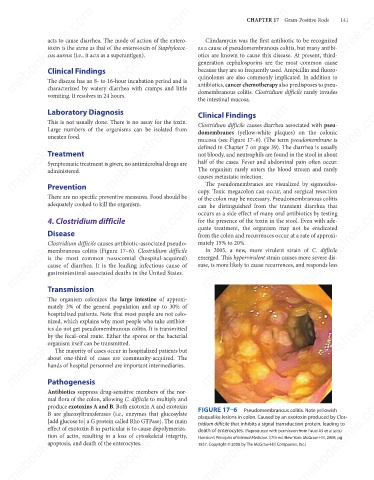
                        Antibiotics suppress drug-sensitive members of the nor-  FIGURE 17–6   Pseudomembranous colitis. Note yellowish
                        mal flora of the colon, allowing C. difficile to multiply and
                                                                            mebooksfree.com
                                                                                                            mebooksfree.com
 mebooksfree.com  mebooksfree.com           mebooksfree.com              plaquelike lesions in colon. Caused by an exotoxin produced by Clos-  mebooksfree.com
                        produce exotoxins A and B. Both exotoxin A and exotoxin
                        B are glucosyltransferases (i.e., enzymes that glucosylate
                        [add glucose to] a G protein called Rho GTPase). The main
                                                                         tridium difficile that inhibits a signal transduction protein, leading to
                        effect of exotoxin B in particular is to cause depolymeriza-
                                                                         death of enterocytes. (Reproduced with permission from Fauci AS et al (eds):
                        tion of actin, resulting in a loss of cytoskeletal integrity,
                                                                         Harrison's Principles of Internal Medicine. 17th ed. New York: McGraw-Hill, 2008, pg
                        apoptosis, and death of the enterocytes.
                                                                         1837. Copyright © 2008 by The McGraw-Hill Companies, Inc.)


 mebooksfree.com  mebooksfree.com           mebooksfree.com                 mebooksfree.com                 mebooksfree.com                mebooksfree.com

