Page 157 - Review of Medical Microbiology and Immunology ( PDFDrive )
P. 157
mebooksfree.com
                                                                            mebooksfree.com
 mebooksfree.com

 mebooksfree.com  mebooksfree.com           mebooksfree.com           4.  Disease caused by which one of the following sets of bacteria can   mebooksfree.com
            mebooksfree.com
                                                                            mebooksfree.com
                                                                                                                                           mebooksfree.com
                                            mebooksfree.com
                                                                                                            mebooksfree.com
                       PART II  Clinical Bacteriology
                 146
                                                                        be prevented by a toxoid vaccine?
                                                                        (A)  Bacillus anthracis and Clostridium botulinum
                                                                        (B)  Bacillus anthracis and Clostridium perfringens
                                                                        (C)  Bacillus cereus and Clostridium tetani
                                                                        (D)  Corynebacterium diphtheriae and Clostridium tetani
                                                                        (E)  Corynebacterium diphtheriae and Listeria monocytogenes
                                                                      5.  Your patient in the pediatric intensive care unit is a 2-week-old
                                                                        boy with a high fever and the signs of meningitis. Gram stain
                                                                        of the spinal fluid reveals small gram-positive rods. Colonies on
 mebooksfree.com  mebooksfree.com           mebooksfree.com           6.  Regarding the patient in Question 5, which one of the following   mebooksfree.com
                                                                            mebooksfree.com
                                                                                                            mebooksfree.com
                                                                        blood agar show a narrow zone of β-hemolysis. Which one of the
                                                                        following is the most likely cause of his neonatal meningitis?
                                                                        (A)  Bacillus anthracis
                                                                        (B)  Bacillus cereus
                                                                        (C)  Clostridium perfringens
                                                                        (D)  Corynebacterium diphtheriae
                                                                        (E)  Listeria monocytogenes

                                                                        is the best antibiotic to treat the infection?
                                                                        (A)  Doxycycline
                                                                        (B)  Gentamicin
                                                                        (C)  Metronidazole
                                                                        (D)  Trimethoprim-sulfamethoxazole
                                                                        (E)  Vancomycin
                                                                            mebooksfree.com
                                                                                                            mebooksfree.com
 mebooksfree.com  mebooksfree.com           mebooksfree.com             fond of her preserved string beans, which is what she ate uncooked   mebooksfree.com
                                                                      7.  Your patient is a 40-year-old woman with diplopia and other signs of
                                                                        cranial nerve weakness. History reveals she grows her own vegetables
                                                                        and likes to preserve them in jars that she prepares at home. She is
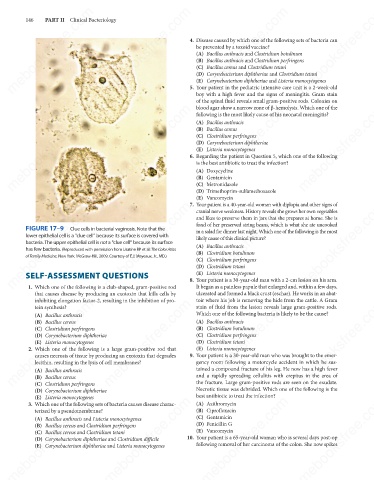
                 FIGURE 17–9
                               Clue cells in bacterial vaginosis. Note that the
                                                                        in a salad for dinner last night. Which one of the following is the most
                 lower epithelial cell is a "clue cell" because its surface is covered with
                                                                        likely cause of this clinical picture?
                 bacteria. The upper epithelial cell is not a "clue cell" because its surface
                                                                        (A)  Bacillus anthracis
                 has few bacteria. (Reproduced with permission from Usatine RP et al: The Color Atlas
                                                                        (B)  Clostridium botulinum
                 of Family Medicine, New York: McGraw-Hill, 2009. Courtesy of E.J. Mayeaux, Jr., MD.)
                                                                        (C)  Clostridium perfringens
                                                                        (D)  Clostridium tetani
                                                                        (E)  Listeria monocytogenes
                 SELF-ASSESSMENT QUESTIONS
                                                                        It began as a painless papule that enlarged and, within a few days,
                 1.  Which one of the following is a club-shaped, gram-positive rod
                                                                        ulcerated and formed a black crust (eschar). He works in an abat-
                    that causes disease by producing an exotoxin that kills cells by   8.  Your patient is a 30-year-old man with a 2-cm lesion on his arm.
                    inhibiting elongation factor-2, resulting in the inhibition of pro-
                                                                        toir where his job is removing the hide from the cattle. A Gram
                                                                                                            mebooksfree.com
                                                                            mebooksfree.com
 mebooksfree.com  mebooksfree.com           mebooksfree.com           9.  Your patient is a 30-year-old man who was brought to the emer-   mebooksfree.com
                                                                        stain of fluid from the lesion reveals large gram-positive rods.
                    tein synthesis?
                                                                        Which one of the following bacteria is likely to be the cause?
                    (A)  Bacillus anthracis
                    (B)  Bacillus cereus
                                                                        (A)  Bacillus anthracis
                                                                        (B)  Clostridium botulinum
                    (C)  Clostridium perfringens
                                                                        (C)  Clostridium perfringens
                    (D)  Corynebacterium diphtheriae
                    (E)  Listeria monocytogenes
                                                                        (D)  Clostridium tetani
                 2.  Which one of the following is a large gram-positive rod that
                                                                        (E)  Listeria monocytogenes
                    causes necrosis of tissue by producing an exotoxin that degrades
                                                                        gency room following a motorcycle accident in which he sus-
                    lecithin, resulting in the lysis of cell membranes?
                    (A)  Bacillus anthracis
                                                                        and a rapidly spreading cellulitis with crepitus in the area of
                    (B)  Bacillus cereus
                                                                        the fracture. Large gram-positive rods are seen on the exudate.
                    (C)  Clostridium perfringens
                                                                        Necrotic tissue was debrided. Which one of the following is the
                    (D)  Corynebacterium diphtheriae                    tained a compound fracture of his leg. He now has a high fever
                                                                        best antibiotic to treat the infection?
                    (E)  Listeria monocytogenes
                                                                            mebooksfree.com
                                                                                                            mebooksfree.com
 mebooksfree.com  mebooksfree.com           mebooksfree.com          10.  Your patient is a 65-year-old woman who is several days post-op   mebooksfree.com
                                                                        (A)  Azithromycin
                 3.  Which one of the following sets of bacteria causes disease charac-
                    terized by a pseudomembrane?
                                                                        (B)  Ciprofloxacin
                                                                        (C)  Gentamicin
                    (A)  Bacillus anthracis and Listeria monocytogenes
                                                                        (D)  Penicillin G
                    (B)  Bacillus cereus and Clostridium perfringens
                                                                        (E)  Vancomycin
                    (C)  Bacillus cereus and Clostridium tetani
                    (D)  Corynebacterium diphtheriae and Clostridium difficile
                                                                        following removal of her carcinoma of the colon. She now spikes
                    (E)  Corynebacterium diphtheriae and Listeria monocytogenes
 mebooksfree.com  mebooksfree.com           mebooksfree.com                 mebooksfree.com                 mebooksfree.com                mebooksfree.com
   152   153   154   155   156   157   158   159   160   161   162