


Page 176 - Review of Medical Microbiology and Immunology ( PDFDrive )
P. 176
mebooksfree.com
                                                                            mebooksfree.com
 mebooksfree.com

            mebooksfree.com
                                                                            mebooksfree.com
                                            mebooksfree.com
                                                                                                                                           mebooksfree.com
 mebooksfree.com  mebooksfree.com           mebooksfree.com         CHAPTER 18  Gram-Negative Rods Related to the Enteric Tract  165       mebooksfree.com
                                                                                                            mebooksfree.com


                                                                            mebooksfree.com
                                                                                                            mebooksfree.com
 mebooksfree.com  mebooksfree.com           mebooksfree.com              FIGURE 18–6    Pseudomonas aeruginosa—blue-green pigment.         mebooksfree.com


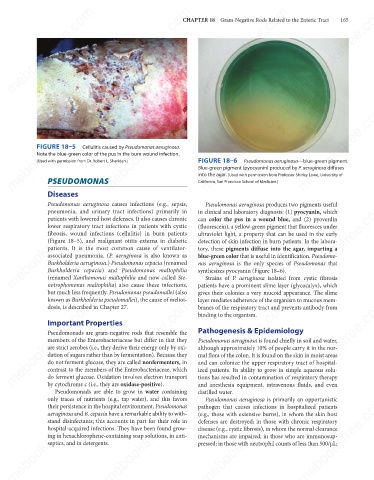
                    FIGURE 18–5
                                   Cellulitis caused by Pseudomonas aeruginosa.
                    Note the blue-green color of the pus in the burn wound infection.
                    (Used with permission from Dr. Robert L. Sheridan.)
                                                                         Blue-green pigment (pyocyanin) produced by P. aeruginosa diffuses
                        PSEUDOMONAS
                                                                         California, San Francisco School of Medicine.)
                        Diseases                                         into the agar. (Used with permission from Professor Shirley Lowe, University of
                                                                                                            mebooksfree.com
 mebooksfree.com  mebooksfree.com           mebooksfree.com              (fluorescein), a yellow-green pigment that fluoresces under       mebooksfree.com
                                                                            mebooksfree.com
                        Pseudomonas aeruginosa causes infections (e.g., sepsis,
                                                                           Pseudomonas aeruginosa produces two pigments useful
                        pneumonia, and urinary tract infections) primarily in
                                                                         in clinical and laboratory diagnosis: (1) pyocyanin, which
                        patients with lowered host defenses. It also causes chronic
                                                                         can  color  the  pus  in  a  wound blue,  and (2) pyoverdin
                        lower respiratory tract infections in patients with cystic
                        fibrosis, wound infections (cellulitis) in burn patients
                                                                         ultraviolet light, a property that can be used in the early
                        (Figure 18–5), and malignant otitis externa in diabetic
                                                                         detection of skin infection in burn patients. In the labora-
                                                                         tory, these  pigments diffuse  into the agar, imparting  a
                        patients. It is the most common cause of ventilator-
                        associated  pneumonia.  (P. aeruginosa  is also  known  as
                                                                         blue-green color that is useful in identification. Pseudomo-
                        Burkholderia aeruginosa.) Pseudomonas cepacia (renamed
                                                                         nas aeruginosa is the only species of  Pseudomonas that
                        Burkholderia  cepacia)  and  Pseudomonas  maltophilia
                        (renamed Xanthomonas maltophilia and now called Ste-
                                                                           Strains of  P. aeruginosa isolated from cystic fibrosis
                        notrophomonas maltophilia) also cause these infections,
                                                                         patients have a prominent slime layer (glycocalyx), which
                        but much less frequently. Pseudomonas pseudomallei (also   synthesizes pyocyanin (Figure 18–6).
                                                                         gives their colonies a very mucoid appearance. The slime
                        known as Burkholderia pseudomallei), the cause of melioi-
                                                                         layer mediates adherence of the organism to mucous mem-
 mebooksfree.com  mebooksfree.com           mebooksfree.com              Pathogenesis & Epidemiology        mebooksfree.com                mebooksfree.com
                                                                            mebooksfree.com
                        dosis, is described in Chapter 27.
                                                                         branes of the respiratory tract and prevents antibody from
                                                                         binding to the organism.
                        Important Properties
                        Pseudomonads are gram-negative rods that resemble the
                        members of the Enterobacteriaceae but differ in that they
                                                                         Pseudomonas aeruginosa is found chiefly in soil and water,
                        are strict aerobes (i.e., they derive their energy only by oxi-
                                                                         although approximately 10% of people carry it in the nor-
                        dation of sugars rather than by fermentation). Because they
                                                                         mal flora of the colon. It is found on the skin in moist areas
                        do not ferment glucose, they are called nonfermenters, in
                                                                         and can colonize the upper respiratory tract of hospital-
                        contrast to the members of the Enterobacteriaceae, which
                        do ferment glucose. Oxidation involves electron transport
                                                                         tions has resulted in contamination of respiratory therapy
                        by cytochrome c (i.e., they are oxidase-positive).
                                                                         and anesthesia equipment, intravenous fluids, and even
                          Pseudomonads are able to grow in  water containing   ized patients. Its ability to grow in simple aqueous solu-
                                                                         distilled water.
                        only traces of nutrients (e.g., tap water), and this favors
 mebooksfree.com  mebooksfree.com           mebooksfree.com              defenses are destroyed; in those with chronic respiratory         mebooksfree.com
                                                                            mebooksfree.com
                                                                                                            mebooksfree.com
                                                                           Pseudomonas aeruginosa is primarily an opportunistic
                        their persistence in the hospital environment. Pseudomonas
                                                                         pathogen that causes infections in hospitalized patients
                        aeruginosa and B. cepacia have a remarkable ability to with-
                                                                         (e.g., those with extensive burns), in whom the skin host
                        stand disinfectants; this accounts in part for their role in
                        hospital-acquired infections. They have been found grow-
                                                                         disease (e.g., cystic fibrosis), in whom the normal clearance
                        ing in hexachlorophene-containing soap solutions, in anti-
                                                                         mechanisms are impaired; in those who are immunosup-
                        septics, and in detergents.
                                                                         pressed; in those with neutrophil counts of less than 500/μL;
 mebooksfree.com  mebooksfree.com           mebooksfree.com                 mebooksfree.com                 mebooksfree.com                mebooksfree.com

