


Page 177 - Review of Medical Microbiology and Immunology ( PDFDrive )
P. 177
mebooksfree.com


                                                                                                            mebooksfree.com
                                                                                                                                           mebooksfree.com
            mebooksfree.com
 mebooksfree.com  mebooksfree.com           mebooksfree.com                 mebooksfree.com                 mebooksfree.com                mebooksfree.com
                                            mebooksfree.com
                                                                            mebooksfree.com
                 166
                       PART II  Clinical Bacteriology
                    and in those with indwelling catheters. It causes 10% to
                    20% of hospital-acquired infections and, in many hospitals,
                    is the most common cause of gram-negative nosocomial
                    pneumonia, especially ventilator-associated pneumonia.
                       Pathogenesis is based on multiple virulence factors:
                    endotoxin, exotoxins, and enzymes. Its endotoxin, like that
                    of other gram-negative bacteria, causes the symptoms of
                    sepsis and septic shock. The best known of the exotoxins is
                    exotoxin A, which causes tissue necrosis. It inhibits eukary-
                                                                                                            mebooksfree.com
                                                                            mebooksfree.com
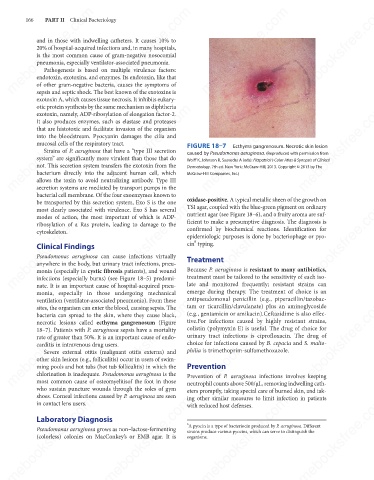
 mebooksfree.com  mebooksfree.com           mebooksfree.com          FIGURE 18–7    Ecthyma gangrenosum. Necrotic skin lesion              mebooksfree.com
                    otic protein synthesis by the same mechanism as diphtheria
                    exotoxin, namely, ADP-ribosylation of elongation factor-2.
                    It  also  produces  enzymes,  such  as  elastase  and  proteases
                    that are histotoxic and facilitate invasion of the organism
                    into the bloodstream. Pyocyanin damages the cilia and
                    mucosal cells of the respiratory tract.
                       Strains of P. aeruginosa that have a “type III secretion
                                                                     caused by Pseudomonas aeruginosa. (Reproduced with permission from
                    system” are significantly more virulent than those that do
                                                                     Wolff K, Johnson R, Saavedra A (eds): Fitzpatrick’s Color Atlas & Synopsis of Clinical
                    not. This secretion system transfers the exotoxin from the
                                                                     Dermatology. 7th ed. New York: McGraw-Hill, 2013. Copyright © 2013 by The
                    bacterium directly into the adjacent human cell, which
                    allows the  toxin to avoid  neutralizing antibody. Type  III
                    secretion systems are mediated by transport pumps in the
                    bacterial cell membrane. Of the four exoenzymes known to   McGraw-Hill Companies, Inc.)
                                                                     oxidase-positive. A typical metallic sheen of the growth on
                    be transported by this secretion system, Exo S is the one
                                                                                                            mebooksfree.com
 mebooksfree.com  mebooksfree.com           mebooksfree.com          ficient to make a presumptive diagnosis. The diagnosis is             mebooksfree.com
                                                                            mebooksfree.com
                                                                     TSI agar, coupled with the blue-green pigment on ordinary
                    most clearly associated with virulence. Exo S has several
                                                                     nutrient agar (see Figure 18–6), and a fruity aroma are suf-
                    modes of action, the most important of which is ADP-
                    ribosylation of a Ras protein, leading to damage to the
                                                                     confirmed by biochemical reactions. Identification for
                    cytoskeleton.
                                                                     epidemiologic purposes is done by bacteriophage or pyo-
                                                                        6
                                                                     cin  typing.
                    Clinical Findings
                    Pseudomonas aeruginosa  can cause infections virtually
                                                                     Treatment
                    anywhere in the body, but urinary tract infections, pneu-
                                                                     Because P. aeruginosa is resistant to many antibiotics,
                    monia (especially in cystic fibrosis patients), and wound
                    infections (especially burns) (see Figure 18–5) predomi-
                                                                     late and monitored frequently; resistant strains can
                    nate. It is an important cause of hospital-acquired pneu-
                                                                     emerge during therapy. The treatment of choice is an
                    monia, especially in those undergoing mechanical   treatment must be tailored to the sensitivity of each iso-
                                                                     antipseudomonal penicillin  (e.g.,  piperacillin/tazobac-
                    ventilation (ventilator-associated pneumonia). From these
                                                                                                            mebooksfree.com
 mebooksfree.com  mebooksfree.com           mebooksfree.com          tive.For infections caused by highly resistant strains,               mebooksfree.com
                                                                            mebooksfree.com
                                                                     tam or ticarcillin/clavulanate) plus an aminoglycoside
                    sites, the organism can enter the blood, causing sepsis. The
                                                                     (e.g., gentamicin or amikacin).Ceftazidime is also effec-
                    bacteria can spread to the skin, where they cause black,
                    necrotic  lesions  called  ecthyma gangrenosum  (Figure
                                                                     colistin (polymyxin E) is useful. The drug of choice for
                    18–7). Patients with P. aeruginosa sepsis have a mortality
                                                                     urinary tract infections is ciprofloxacin. The drug of
                    rate of greater than 50%. It is an important cause of endo-
                                                                     choice for infections caused by B. cepacia and S. malto-
                    carditis in intravenous drug users.
                                                                     philia is trimethoprim-sulfamethoxazole.
                       Severe external otitis (malignant otitis externa) and
                    other skin lesions (e.g., folliculitis) occur in users of swim-
                                                                     Prevention
                    ming pools and hot tubs (hot tub folliculitis) in which the
                    chlorination is inadequate. Pseudomonas aeruginosa is the
                                                                     Prevention of  P. aeruginosa infections involves keeping
                    most common cause of osteomyelitisof the foot in those
                                                                     neutrophil counts above 500/μL, removing indwelling cath-
                    who sustain puncture wounds through the soles of gym
                                                                     eters promptly, taking special care of burned skin, and tak-
                    shoes. Corneal infections caused by P. aeruginosa are seen
 mebooksfree.com  mebooksfree.com           mebooksfree.com          ing  other  similar  measures  to  limit  infection  in  patients     mebooksfree.com
                                                                            mebooksfree.com
                                                                                                            mebooksfree.com
                    in contact lens users.
                                                                     with reduced host defenses.
                    Laboratory Diagnosis
                                                                     6
                                                                      A pyocin is a type of bacteriocin produced by P. aeruginosa. Different
                    Pseudomonas aeruginosa grows as non–lactose-fermenting
                                                                     strains produce various pyocins, which can serve to distinguish the
                    (colorless) colonies on MacConkey’s or EMB agar. It is
                                                                     organisms.
 mebooksfree.com  mebooksfree.com           mebooksfree.com                 mebooksfree.com                 mebooksfree.com                mebooksfree.com

