


Page 175 - Review of Medical Microbiology and Immunology ( PDFDrive )
P. 175
mebooksfree.com
                                                                            mebooksfree.com
 mebooksfree.com

            mebooksfree.com
                                            mebooksfree.com
                                                                            mebooksfree.com
                                                                                                                                           mebooksfree.com
                                                                                                            mebooksfree.com
 mebooksfree.com  mebooksfree.com           mebooksfree.com          the formation of stones (calculi) called “struvite” composed          mebooksfree.com
                       PART II  Clinical Bacteriology
                 164
                                                                     of magnesium ammonium phosphate. Struvite stones often
                                                                     manifest, as staghorn calculi in the renal  pelvis. They
                                                                     obstruct urine flow, damage urinary epithelium, and serve as
                                                                     a nidus for recurrent infection by trapping bacteria within
                                                                     the stone. Because alkaline urine also favors growth of the
                                                                     organisms and more extensive renal damage, treatment
                                                                     involves keeping the urine at a low pH.

 mebooksfree.com  mebooksfree.com           mebooksfree.com          Clinical Findings                      mebooksfree.com                mebooksfree.com
                                                                            mebooksfree.com
                                                                     The signs and symptoms of urinary tract infections caused
                                                                     by these organisms cannot be distinguished from those
                                                                     caused by E. coli or other members of the Enterobacteria-
                                                                     ceae.  Proteus species can also cause pneumonia, wound
                                                                     infections, and septicemia. Proteus mirabilis is the species
                                                                     of  Proteus that causes most community- and hospital-
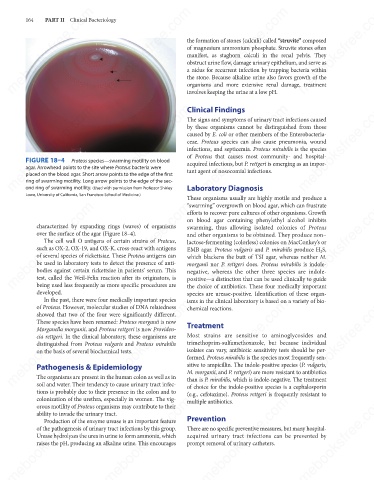
                 FIGURE 18–4
                                Proteus species—swarming motility on blood
                                                                     acquired infections, but P. rettgeri is emerging as an impor-
                 agar. Arrowhead points to the site where Proteus bacteria were
                                                                     tant agent of nosocomial infections.
                 placed on the blood agar. Short arrow points to the edge of the first
                 ring of swarming motility. Long arrow points to the edge of the sec-
                 ond ring of swarming motility. (Used with permission from Professor Shirley
                 Lowe, University of California, San Francisco School of Medicine.)  Laboratory Diagnosis
                                                                     These organisms usually are highly motile and produce a
                                                                                                            mebooksfree.com
                                                                            mebooksfree.com
 mebooksfree.com  mebooksfree.com           mebooksfree.com          swarming, thus allowing isolated colonies of  Proteus                 mebooksfree.com
                                                                     “swarming” overgrowth on blood agar, which can frustrate
                                                                     efforts to recover pure cultures of other organisms. Growth
                                                                     on blood agar containing phenylethyl alcohol inhibits
                    characterized by expanding rings (waves) of organisms
                    over the surface of the agar (Figure 18–4).
                                                                     and other organisms to be obtained. They produce non–
                       The cell wall O antigens of certain strains of Proteus,
                                                                     lactose-fermenting (colorless) colonies on MacConkey’s or
                    such as OX-2, OX-19, and OX-K, cross-react with antigens
                                                                     EMB agar. Proteus vulgaris and P. mirabilis produce H S,
                                                                                                                 2
                    of several species of rickettsiae. These Proteus antigens can
                                                                     which blackens the butt of TSI agar, whereas neither M.
                    be used in laboratory tests to detect the presence of anti-
                                                                     morganii nor  P. rettgeri does.  Proteus mirabilis is indole-
                    bodies against certain rickettsiae in patients’ serum. This
                    test, called the Weil-Felix reaction after its originators, is
                                                                     positive—a distinction that can be used clinically to guide
                    being used less frequently as more specific procedures are
                                                                     the choice of antibiotics. These four medically important
                    developed.                                       negative, whereas the other three species are indole-
                                                                     species are urease-positive. Identification of these organ-
                       In the past, there were four medically important species
                                                                     isms in the clinical laboratory is based on a variety of bio-
                                                                            mebooksfree.com
 mebooksfree.com  mebooksfree.com           mebooksfree.com          Treatment                              mebooksfree.com                mebooksfree.com
                    of Proteus. However, molecular studies of DNA relatedness
                                                                     chemical reactions.
                    showed that two of the four were significantly different.
                    These species have been renamed: Proteus morganii is now
                    Morganella morganii, and Proteus rettgeri is now Providen-

                                                                     Most strains are sensitive to aminoglycosides and
                    cia rettgeri. In the clinical laboratory, these organisms are
                                                                     trimethoprim-sulfamethoxazole, but because individual
                    distinguished from Proteus vulgaris and Proteus mirabilis
                                                                     isolates can vary, antibiotic sensitivity tests should be per-
                    on the basis of several biochemical tests.
                                                                     formed. Proteus mirabilis is the species most frequently sen-
                                                                     sitive to ampicillin. The indole-positive species (P. vulgaris,
                    Pathogenesis & Epidemiology
                    The organisms are present in the human colon as well as in
                                                                     than is P. mirabilis, which is indole-negative. The treatment
                    soil and water. Their tendency to cause urinary tract infec-
                                                                     of choice for the indole-positive species is a cephalosporin
                    tions is probably due to their presence in the colon and to   M. morganii, and P. rettgeri) are more resistant to antibiotics
                                                                     (e.g., cefotaxime). Proteus rettgeri is frequently resistant to
 mebooksfree.com  mebooksfree.com           mebooksfree.com          Prevention                             mebooksfree.com                mebooksfree.com
                    colonization of the urethra, especially in women. The vig-
                                                                            mebooksfree.com
                                                                     multiple antibiotics.
                    orous motility of Proteus organisms may contribute to their
                    ability to invade the urinary tract.
                       Production of the enzyme urease is an important feature
                    of the pathogenesis of urinary tract infections by this group.
                                                                     There are no specific preventive measures, but many hospital-
                    Urease hydrolyzes the urea in urine to form ammonia, which
                                                                     acquired  urinary  tract  infections  can be  prevented  by
                    raises the pH, producing an alkaline urine. This encourages
                                                                     prompt removal of urinary catheters.
 mebooksfree.com  mebooksfree.com           mebooksfree.com                 mebooksfree.com                 mebooksfree.com                mebooksfree.com

