


Page 178 - Review of Medical Microbiology and Immunology ( PDFDrive )
P. 178
mebooksfree.com
                                                                                                            mebooksfree.com
 mebooksfree.com

            mebooksfree.com
                                                                            mebooksfree.com
                                                                                                            mebooksfree.com
 mebooksfree.com  mebooksfree.com           mebooksfree.com         CHAPTER 18  Gram-Negative Rods Related to the Enteric Tract  167       mebooksfree.com
                                            mebooksfree.com
                                                                                                                                           mebooksfree.com
                                                                           Enzymes such as hyaluronidase, collagenase, and phos-
                        BACTEROIDES & PREVOTELLA
                                                                         pholipase are produced and contribute to tissue damage.
                        Diseases
                                                                         Enterotoxin-producing strain of B. fragilis can cause diar-
                                                                         rhea in both children and adults.
                        Members of the genus Bacteroides are the most common
                        cause of serious anaerobic infections (e.g., sepsis, perito-
                        nitis, and abscesses). Bacteroides fragilis is the most fre-
                        quent pathogen.  Prevotella melaninogenica is also an
                                                                         The B. fragilis group of organisms is most frequently associ-
                        important pathogen. It was formerly known as Bacteroi-
                                                                         ated with intra-abdominal infections, either peritonitis or
                        des melaninogenicus, and both names are still    Clinical Findings
                                                                         localized abscesses. Pelvic abscesses, necrotizing fasciitis,
                                                                                                            mebooksfree.com
 mebooksfree.com  mebooksfree.com           mebooksfree.com              P. melaninogenica, a member of the normal oral flora, but         mebooksfree.com
                                                                            mebooksfree.com
                        encountered.
                                                                         and bacteremia occur as well. Abscesses of the mouth,
                                                                         pharynx, brain, and lung are more commonly caused by
                        Important Properties
                                                                         B. fragilis is found in about 25% of lung abscesses. In gen-
                        Bacteroides and Prevotella organisms are anaerobic, non–
                                                                         eral, B. fragilis causes disease below the diaphragm, whereas
                        spore-forming, gram-negative rods. Of the many species of
                                                                         P.  melaninogenica causes disease above the diaphragm.
                                                              7
                        Bacteroides, two are human pathogens: B. fragilis  and Bac-
                                                                         Prevotella intermedia is  an important cause of  gingivitis,
                        teroides corrodens.
                                                                         periodontitis, and dental abscess.
                          Members of the B. fragilis group are the predominant
                        organisms in the human colon, numbering approximately
                          11
                                                                         Laboratory Diagnosis
                        10 /g of feces, and are found in the vagina of approxi-
                        mately  60%  of women.  Prevotella melaninogenica  and
                                                                         Bacteroides species can be isolated anaerobically on blood
                        B. corrodens occur primarily in the oral cavity.
                                                                         agar plates containing kanamycin and vancomycin to inhibit
                                                                            mebooksfree.com
 mebooksfree.com  mebooksfree.com           mebooksfree.com              unwanted organisms. They are identified by biochemical            mebooksfree.com
                                                                                                            mebooksfree.com
                        Pathogenesis & Epidemiology
                                                                         reactions (e.g., sugar fermentations) and by production of
                        Because Bacteroides and Prevotella species are part of the
                                                                         certain organic acids (e.g., formic, acetic, and propionic
                        normal flora,  infections are endogenous, usually arising
                                                                         acids), which are detected by gas chromatography. Prevotella
                        from a break in a mucosal surface, and are not communi-
                                                                         melaninogenica produces characteristic black colonies
                        cable. These organisms cause a variety of infections, such as
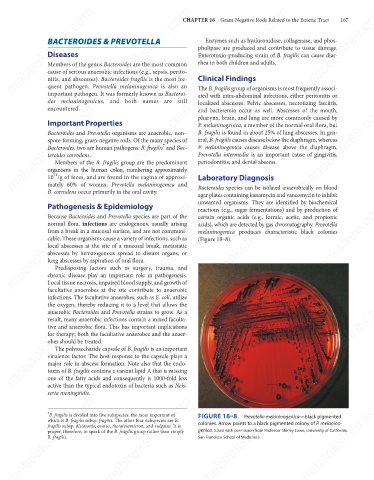
                                                                         (Figure 18–8).
                        local abscesses at the site of a mucosal break, metastatic
                        abscesses  by  hematogenous  spread  to  distant  organs,  or
                        lung abscesses by aspiration of oral flora.
                          Predisposing factors such as surgery, trauma, and
                        chronic disease play an important role in pathogenesis.
                        Local tissue necrosis, impaired blood supply, and growth of
                        facultative anaerobes at the site contribute to anaerobic
                        infections. The facultative anaerobes, such as E. coli, utilize
 mebooksfree.com  mebooksfree.com           mebooksfree.com                 mebooksfree.com                 mebooksfree.com                mebooksfree.com
                        the oxygen, thereby reducing it to a level that allows the
                        anaerobic Bacteroides and Prevotella strains to grow. As a
                        result, many anaerobic infections contain a mixed faculta-
                        tive and anaerobic flora. This has important implications
                        for therapy; both the facultative anaerobes and the anaer-
                        obes should be treated.
                          The polysaccharide capsule of B. fragilis is an important
                        virulence factor. The host response to the capsule plays a
                        major role in abscess formation. Note also that the endo-
                        toxin of B. fragilis contains a variant lipid A that is missing
                        one of the fatty acids and consequently is 1000-fold less
                        active than the typical endotoxin of bacteria such as Neis-
                        seria meningitidis.                              FIGURE 18–8    Prevotella melaninogenica—black pigmented
                                                                            mebooksfree.com
 mebooksfree.com  mebooksfree.com           mebooksfree.com              colonies. Arrow points to a black pigmented colony of P. melanino-  mebooksfree.com
                                                                                                            mebooksfree.com
                        7
                        B. fragilis is divided into five subspecies, the most important of
                        which is B. fragilis subsp. fragilis. The other four subspecies are B.
                        fragilis subsp. distasonis, ovatus, thetaiotamicron, and vulgatus. It is
                                                                         genica. (Used with permission from Professor Shirley Lowe, University of California,
                        proper, therefore, to speak of the B. fragilis group rather than simply
                        B. fragilis.
                                                                         San Francisco School of Medicine.)


 mebooksfree.com  mebooksfree.com           mebooksfree.com                 mebooksfree.com                 mebooksfree.com                mebooksfree.com

