


Page 183 - Review of Medical Microbiology and Immunology ( PDFDrive )
P. 183
mebooksfree.com
mebooksfree.com
mebooksfree.com mebooksfree.com mebooksfree.com Clinical Findings mebooksfree.com mebooksfree.com
mebooksfree.com
mebooksfree.com
mebooksfree.com
mebooksfree.com
mebooksfree.com
172
PART II Clinical Bacteriology
Meningitis caused by H. influenzae cannot be distinguished
on clinical grounds from that caused by other bacterial
pathogens (e.g., pneumococci or meningococci). The rapid
onset of fever, headache, and stiff neck, along with drowsi-
ness, is typical. Sinusitis and otitis media cause pain in the
affected area, opacification of the infected sinus, and red-
ness with bulging of the tympanic membrane. Hemophilus
influenzae is second only to the pneumococcus as a cause
mebooksfree.com
mebooksfree.com
mebooksfree.com mebooksfree.com mebooksfree.com especially in splenectomized patients. Rarely, epiglottitis, mebooksfree.com
of these two infections.
Other serious infections caused by this organism include
septic arthritis, cellulitis, and sepsis, the latter occurring
which can obstruct the airway, occurs. A swollen “cherry-
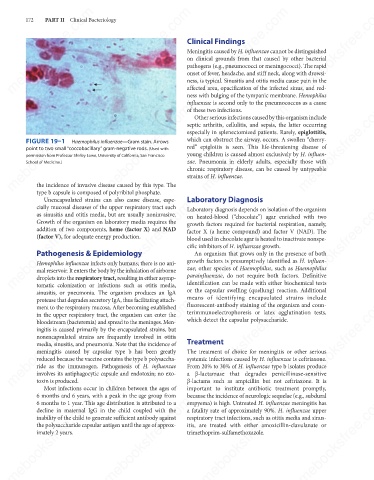
FIGURE 19–1
Haemophilus influenzae—Gram stain. Arrows
red” epiglottis is seen. This life-threatening disease of
point to two small “coccobacillary” gram-negative rods. (Used with
young children is caused almost exclusively by H. influen-
permission from Professor Shirley Lowe, University of California, San Francisco
zae. Pneumonia in elderly adults, especially those with
School of Medicine.)
chronic respiratory disease, can be caused by untypeable
the incidence of invasive disease caused by this type. The
type b capsule is composed of polyribitol phosphate.
Laboratory Diagnosis
Unencapsulated strains can also cause disease, espe- strains of H. influenzae.
mebooksfree.com
mebooksfree.com
mebooksfree.com mebooksfree.com mebooksfree.com growth factors required for bacterial respiration, namely, mebooksfree.com
cially mucosal diseases of the upper respiratory tract such
Laboratory diagnosis depends on isolation of the organism
as sinusitis and otitis media, but are usually noninvasive.
on heated-blood (“chocolate”) agar enriched with two
Growth of the organism on laboratory media requires the
addition of two components, heme (factor X) and NAD
factor X (a heme compound) and factor V (NAD). The
(factor V), for adequate energy production.
blood used in chocolate agar is heated to inactivate nonspe-
cific inhibitors of H. influenzae growth.
Pathogenesis & Epidemiology
An organism that grows only in the presence of both
growth factors is presumptively identified as H. influen-
Hemophilus influenzae infects only humans; there is no ani-
zae; other species of Haemophilus, such as Haemophilus
mal reservoir. It enters the body by the inhalation of airborne
droplets into the respiratory tract, resulting in either asymp-
identification can be made with either biochemical tests
tomatic colonization or infections such as otitis media,
or the capsular swelling (quellung) reaction. Additional
sinusitis, or pneumonia. The organism produces an IgA parainfluenzae, do not require both factors. Definitive
means of identifying encapsulated strains include
protease that degrades secretory IgA, thus facilitating attach-
mebooksfree.com
mebooksfree.com mebooksfree.com mebooksfree.com which detect the capsular polysaccharide. mebooksfree.com mebooksfree.com
fluorescent-antibody staining of the organism and coun-
ment to the respiratory mucosa. After becoming established
terimmunoelectrophoresis or latex agglutination tests,
in the upper respiratory tract, the organism can enter the
bloodstream (bacteremia) and spread to the meninges. Men-
ingitis is caused primarily by the encapsulated strains, but
nonencapsulated strains are frequently involved in otitis
Treatment
media, sinusitis, and pneumonia. Note that the incidence of
meningitis caused by capsular type b has been greatly
The treatment of choice for meningitis or other serious
systemic infections caused by H. influenzae is ceftriaxone.
reduced because the vaccine contains the type b polysaccha-
From 20% to 30% of H. influenzae type b isolates produce
ride as the immunogen. Pathogenesis of H. influenzae
involves its antiphagocytic capsule and endotoxin; no exo-
a β-lactamase that degrades penicillinase-sensitive
toxin is produced.
β-lactams such as ampicillin but not ceftriaxone. It is
Most infections occur in children between the ages of
important to institute antibiotic treatment promptly,
6 months and 6 years, with a peak in the age group from
mebooksfree.com mebooksfree.com mebooksfree.com because the incidence of neurologic sequelae (e.g., subdural mebooksfree.com
mebooksfree.com
mebooksfree.com
6 months to 1 year. This age distribution is attributed to a
empyema) is high. Untreated H. influenzae meningitis has
a fatality rate of approximately 90%. H. influenzae upper
decline in maternal IgG in the child coupled with the
respiratory tract infections, such as otitis media and sinus-
inability of the child to generate sufficient antibody against
itis, are treated with either amoxicillin-clavulanate or
the polysaccharide capsular antigen until the age of approx-
trimethoprim-sulfamethoxazole.
imately 2 years.
mebooksfree.com mebooksfree.com mebooksfree.com mebooksfree.com mebooksfree.com mebooksfree.com

