


Page 220 - Review of Medical Microbiology and Immunology ( PDFDrive )
P. 220
mebooksfree.com
 mebooksfree.com


                                                                                                            mebooksfree.com
            mebooksfree.com
                                            mebooksfree.com
                                                                            mebooksfree.com
 mebooksfree.com  mebooksfree.com     Extracellular infectious  Attachment and mebooksfree.com              mebooksfree.com                mebooksfree.com
                                                                                                                                           mebooksfree.com
                                                                                               CHAPTER 25  Chlamydiae
                                                                                                                        209
                                                             entry of elementary body
                                                                             Cell nucleus
                                      elementary body

                                                                                              Formation of
                                                                                              reticulate body
                                        Release

 mebooksfree.com  mebooksfree.com      Elementary bodies                    mebooksfree.com                 mebooksfree.com                mebooksfree.com
                                            mebooksfree.com


                                                                                          Multiplication of reticulate
                                   Multiplication
                                                                                          bodies by binary fission
                                   ceases

                                                                                         Reticulate bodies


                                       Development of a
                                                            Reorganization of
                                       large cytoplasmic
                                                            reticulate bodies into elementary bodies
                                       inclusion
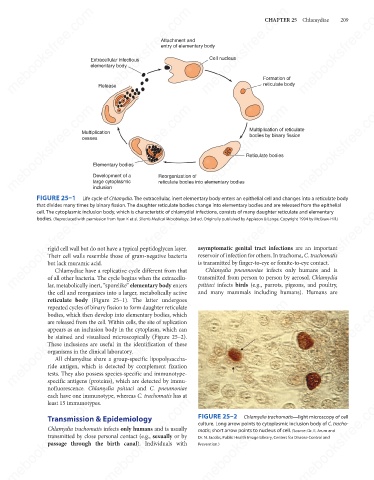
                    FIGURE 25–1    Life cycle of Chlamydia. The extracellular, inert elementary body enters an epithelial cell and changes into a reticulate body
                                                                            mebooksfree.com
                                                                                                            mebooksfree.com
 mebooksfree.com  mebooksfree.com           mebooksfree.com              asymptomatic genital tract infections are an important            mebooksfree.com
                    that divides many times by binary fission. The daughter reticulate bodies change into elementary bodies and are released from the epithelial
                    cell. The cytoplasmic inclusion body, which is characteristic of chlamydial infections, consists of many daughter reticulate and elementary
                    bodies. (Reproduced with permission from Ryan K et al. Sherris Medical Microbiology. 3rd ed. Originally published by Appleton & Lange. Copyright 1994 by McGraw-Hill.)

                        rigid cell wall but do not have a typical peptidoglycan layer.
                                                                         reservoir of infection for others. In trachoma, C. trachomatis
                        Their cell walls resemble those of gram-negative bacteria
                                                                         is transmitted by finger-to-eye or fomite-to-eye contact.
                        but lack muramic acid.
                                                                           Chlamydia  pneumoniae  infects  only  humans  and  is
                          Chlamydiae have a replicative cycle different from that
                        of all other bacteria. The cycle begins when the extracellu-
                                                                         psittaci infects  birds (e.g., parrots, pigeons, and poultry,
                        lar, metabolically inert, “sporelike” elementary body enters
                                                                         and  many mammals including humans). Humans are
                        the cell and reorganizes into a larger, metabolically active   transmitted from person to person by aerosol. Chlamydia
                        reticulate body (Figure 25–1). The latter undergoes
 mebooksfree.com  mebooksfree.com           mebooksfree.com                 mebooksfree.com                 mebooksfree.com                mebooksfree.com
                        repeated cycles of binary fission to form daughter reticulate
                        bodies, which then develop into elementary bodies, which
                        are released from the cell. Within cells, the site of replication
                        appears as an inclusion body in the cytoplasm, which can
                        be stained and visualized microscopically (Figure 25–2).
                        These inclusions are useful in the identification of these
                        organisms in the clinical laboratory.
                          All chlamydiae share a group-specific lipopolysaccha-
                        ride antigen, which is detected by complement fixation
                        tests. They also possess species-specific and immunotype-
                        specific antigens (proteins), which are detected by immu-
                        nofluorescence.  Chlamydia psittaci and  C. pneumoniae
                        each have one immunotype, whereas C. trachomatis has at
                                                                            mebooksfree.com
 mebooksfree.com  mebooksfree.com           mebooksfree.com              FIGURE 25–2    Chlamydia trachomatis—light microscopy of cell     mebooksfree.com
                                                                                                            mebooksfree.com
                        least 15 immunotypes.
                        Transmission & Epidemiology
                                                                         culture. Long arrow points to cytoplasmic inclusion body of C. tracho-
                        Chlamydia trachomatis infects only humans and is usually
                                                                         matis; short arrow points to nucleus of cell. (Source: Dr. E. Arum and
                        transmitted by close personal contact (e.g., sexually or by
                                                                         Dr. N. Jacobs, Public Health Image Library, Centers for Disease Control and
                        passage through the birth canal). Individuals with
                                                                         Prevention.)


 mebooksfree.com  mebooksfree.com           mebooksfree.com                 mebooksfree.com                 mebooksfree.com                mebooksfree.com

