


Page 19 - Review of Medical Microbiology and Immunology ( PDFDrive )
P. 19
mebooksfree.com
 mebooksfree.com


                                                                            mebooksfree.com
            mebooksfree.com
                                                                                                            mebooksfree.com
 mebooksfree.com  mebooksfree.com           mebooksfree.com          The Gram stain is useful in two ways:  mebooksfree.com                mebooksfree.com
                                            mebooksfree.com
                                                                                                                                           mebooksfree.com
                     PART I  Basic Bacteriology
                 8
                   GRAM STAIN
                   This staining procedure, developed in 1884 by the Danish
                   physician Christian Gram, is the most important procedure
                                                                        (1) In the identification of many bacteria.
                   in microbiology. It separates most bacteria into two groups:
                                                                        (2) In influencing the choice of antibiotic because, in gen-
                   the gram-positive bacteria, which stain blue, and the gram-
                   negative bacteria, which stain red. The Gram stain involves
                                                                     G than are gram-negative bacteria.
                   the following four-step procedure:                eral, gram-positive bacteria are more susceptible to penicillin
                                                                            mebooksfree.com
 mebooksfree.com  mebooksfree.com           mebooksfree.com          be seen and describes the reason why. The alternative micro-          mebooksfree.com
                                                                                                            mebooksfree.com
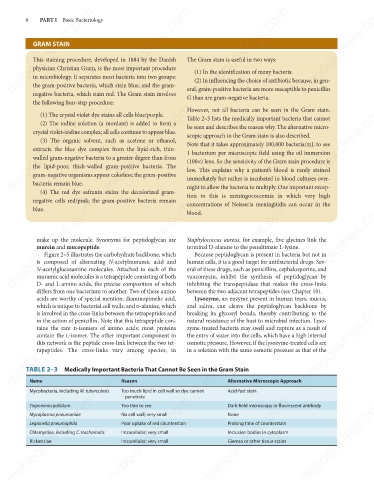
                                                                     However, not all bacteria can be seen in the Gram stain.
                     (1) The crystal violet dye stains all cells blue/purple.
                                                                     Table 2–3 lists the medically important bacteria that cannot
                     (2) The iodine solution (a mordant) is added to form a
                   crystal violet–iodine complex; all cells continue to appear blue.
                                                                     scopic approach to the Gram stain is also described.
                     (3) The organic solvent, such as acetone or ethanol,
                                                                     Note that it takes approximately 100,000 bacteria/mL to see
                   extracts  the  blue  dye  complex from  the  lipid-rich, thin-
                                                                     1 bacterium per microscopic field using the oil immersion
                   walled gram-negative bacteria to a greater degree than from
                                                                     (100×) lens. So the sensitivity of the Gram stain procedure is
                   the lipid-poor,  thick-walled  gram-positive  bacteria.  The
                                                                     low. This explains why a patient’s blood is rarely stained
                   gram-negative organisms appear colorless; the gram-positive
                   bacteria remain blue.
                                                                     night to allow the bacteria to multiply. One important excep-
                     (4)  The  red  dye  safranin  stains  the  decolorized  gram-
                                                                     tion to this is meningococcemia in which very high
                   negative cells red/pink; the gram-positive bacteria remain   immediately but rather is incubated in blood cultures over-
 mebooksfree.com  mebooksfree.com           mebooksfree.com          Staphylococcus aureus, for example, five glycines link the            mebooksfree.com
                                                                                                            mebooksfree.com
                                                                            mebooksfree.com
                                                                     concentrations of Neisseria meningitidis can occur in the
                   blue.
                                                                     blood.
                    make up the molecule. Synonyms for peptidoglycan are
                    murein and mucopeptide.
                                                                     terminal D-alanine to the penultimate L-lysine.
                                                                        Because peptidoglycan is present in bacteria but not in
                       Figure 2–5 illustrates the carbohydrate backbone, which
                                                                     human cells, it is a good target for antibacterial drugs. Sev-
                    is composed of alternating  N-acetylmuramic acid and
                    N-acetylglucosamine molecules. Attached to each of the
                                                                     eral of these drugs, such as penicillins, cephalosporins, and
                                                                     vancomycin, inhibit the synthesis of peptidoglycan by
                    muramic acid molecules is a tetrapeptide consisting of both
                                                                     inhibiting the transpeptidase that makes the cross-links
                    D- and L-amino acids, the precise composition of which
                    differs from one bacterium to another. Two of these amino
                                                                     between the two adjacent tetrapeptides (see Chapter 10).
                    acids are worthy of special mention: diaminopimelic acid,
                                                                        Lysozyme, an enzyme present in human tears, mucus,
 mebooksfree.com  mebooksfree.com           mebooksfree.com          and  saliva,  can  cleave  the  peptidoglycan  backbone  by           mebooksfree.com
                                                                            mebooksfree.com
                                                                                                            mebooksfree.com
                    which is unique to bacterial cell walls, and d-alanine, which
                    is involved in the cross-links between the tetrapeptides and
                                                                     breaking its glycosyl bonds, thereby contributing to the
                    in the action of penicillin. Note that this tetrapeptide con-
                                                                     natural resistance of the host to microbial infection. Lyso-
                                                                     zyme-treated bacteria may swell and rupture as a result of
                    tains the rare  d-isomers of amino acids; most proteins
                    contain the l-isomer. The other important component in
                                                                     the entry of water into the cells, which have a high internal
                    this network is the peptide cross-link between the two tet-
                                                                     osmotic pressure. However, if the lysozyme-treated cells are
                                                                     in a solution with the same osmotic pressure as that of the
                    rapeptides. The cross-links vary among species; in
                 TABLE 2–3  Medically Important Bacteria That Cannot Be Seen in the Gram Stain
                  Name
                  Mycobacteria, including M. tuberculosis  Reason                  Alternative Microscopic Approach
                                                                                   Acid-fast stain
                                                Too much lipid in cell wall so dye cannot
                                                 penetrate
 mebooksfree.com  mebooksfree.com           mebooksfree.com                 mebooksfree.com                 mebooksfree.com                mebooksfree.com
                                                                                   Dark-field microscopy or fluorescent antibody
                                                Too thin to see
                  Treponema pallidum
                  Mycoplasma pneumoniae
                                                                                   None
                                                No cell wall; very small
                                                Poor uptake of red counterstain
                  Legionella pneumophila
                                                                                   Prolong time of counterstain
                                                Intracellular; very small
                  Chlamydiae, including C. trachomatis
                                                                                   Inclusion bodies in cytoplasm
                                                Intracellular; very small
                                                                                   Giemsa or other tissue stains
                  Rickettsiae
 mebooksfree.com  mebooksfree.com           mebooksfree.com                 mebooksfree.com                 mebooksfree.com                mebooksfree.com

