Page 20 - Review of Medical Microbiology and Immunology ( PDFDrive )
P. 20
mebooksfree.com
                                                                            mebooksfree.com
 mebooksfree.com

                                                                            mebooksfree.com
            mebooksfree.com
                                                                                                            mebooksfree.com
 mebooksfree.com  mebooksfree.com           mebooksfree.com              are called lipoteichoic acid; others anchor to the muramic        mebooksfree.com
                                            mebooksfree.com
                                                                                                                                           mebooksfree.com
                                                                                       CHAPTER 2  Structure of Bacterial Cells     9
                        bacterial interior, they will survive as spherical forms,
                        called  protoplasts, surrounded only by a cytoplasmic
                                                                         acid of the peptidoglycan.
                        membrane.
                                                                           The medical importance of teichoic acids lies in their
                                                                         ability to  induce inflammation and septic shock when
                        Lipopolysaccharide
                                                                         caused by certain gram-positive bacteria; that  is, they
                        The lipopolysaccharide (LPS) of the outer membrane of the
                        cell wall of gram-negative bacteria is endotoxin. It is respon-
                                                                         gram-negative bacteria. Teichoic acids also mediate the
                        sible for many of the features of disease, such as fever and
                                                                         attachment of staphylococci to mucosal cells. Gram-nega-
                        shock (especially hypotension), caused by these organisms   activate the same pathways as does endotoxin (LPS) in
                                                                         tive bacteria do not have teichoic acids.
                        (see page 44). It is called endotoxin because it is an integral
                                                                                                            mebooksfree.com
 mebooksfree.com  mebooksfree.com           mebooksfree.com              cytoplasmic membrane, which is composed of a phospho-             mebooksfree.com
                                                                            mebooksfree.com
                                                                         Cytoplasmic Membrane
                        part of the cell wall, in contrast to exotoxins, which are
                        actively  secreted  from  the  bacteria.  The  constellation  of
                                                                         Just inside the peptidoglycan layer of the cell wall lies the
                        symptoms caused by the endotoxin of one gram-negative
                        bacterium is similar to another, but the severity of the symp-
                                                                         lipid bilayer similar in microscopic appearance to that in
                        toms can differ greatly. In contrast, the symptoms caused by
                                                                         eukaryotic cells. They are chemically similar, but eukary-
                        exotoxins of different bacteria are usually quite different.
                                                                         otic membranes contain sterols, whereas prokaryotes gen-
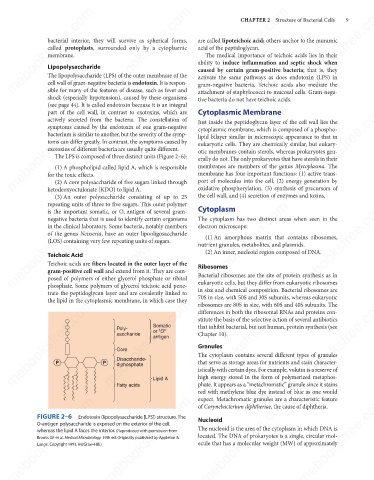
                          The LPS is composed of three distinct units (Figure 2–6):
                                                                         erally do not. The only prokaryotes that have sterols in their
                                                                         membranes  are  members  of  the  genus  Mycoplasma.  The
                          (1) A phospholipid called lipid A, which is responsible
                        for the toxic effects.
                                                                         port of molecules into the cell, (2) energy generation by
                          (2) A core polysaccharide of five sugars linked through
                                                                         oxidative phosphorylation, (3) synthesis of precursors of
                        ketodeoxyoctulonate (KDO) to lipid A.
                                                                         the cell wall, and (4) secretion of enzymes and toxins.
                          (3) An outer polysaccharide consisting of up to 25   membrane has four important functions: (1) active trans-
 mebooksfree.com  mebooksfree.com           mebooksfree.com              electron microscope:               mebooksfree.com                mebooksfree.com
                                                                            mebooksfree.com
                        repeating units of three to five sugars. This outer polymer
                                                                         Cytoplasm
                        is the important somatic, or O, antigen of several gram-
                                                                         The  cytoplasm  has  two  distinct  areas  when  seen  in  the
                        negative bacteria that is used to identify certain organisms
                        in the clinical laboratory. Some bacteria, notably members
                        of the genus Neisseria, have an outer lipooligosaccharide
                                                                           (1) An amorphous matrix that contains ribosomes,
                        (LOS) containing very few repeating units of sugars.
                                                                         nutrient granules, metabolites, and plasmids.
                                                                           (2) An inner, nucleoid region composed of DNA.
                        Teichoic Acid
                        Teichoic acids are fibers located in the outer layer of the
                                                                         Ribosomes
                        gram-positive cell wall and extend from it. They are com-
                        posed of polymers of either glycerol phosphate or ribitol
                                                                         eukaryotic cells, but they differ from eukaryotic ribosomes
                        phosphate. Some polymers of glycerol teichoic acid pene-
                                                                         in size and chemical composition. Bacterial ribosomes are
                        trate the peptidoglycan layer and are covalently linked to   Bacterial ribosomes are the site of protein synthesis as in
                                                                         70S in size, with 50S and 30S subunits, whereas eukaryotic
                        the lipid in the cytoplasmic membrane, in which case they
                                                                            mebooksfree.com
                                                                                                            mebooksfree.com
 mebooksfree.com  mebooksfree.com         P mebooksfree.com              stitute the basis of the selective action of several antibiotics   mebooksfree.com
                                                                         ribosomes are 80S in size, with 60S and 40S subunits. The
                                                                         differences in both the ribosomal RNAs and proteins con-
                                                                         that inhibit bacterial, but not human, protein synthesis (see
                                                          Somatic
                                              Poly-
                                                          or "O"
                                                                         Chapter 10).
                                              saccharide
                                                          antigen
                                                                         Granules
                                              Core
                                                                         The cytoplasm contains several different types of granules
                                              Disaccharide-
                                                                         that serve as storage areas for nutrients and stain character-
                          P
                                              diphosphate
                                                                         istically with certain dyes. For example, volutin is a reserve of
                                                                         high energy stored in the form of polymerized metaphos-
                                                          Lipid A
                                                                         phate. It appears as a “metachromatic” granule since it stains
                                              Fatty acids
                                                                         red with methylene blue dye instead of blue as one would
                                                                            mebooksfree.com
                                                                         expect. Metachromatic granules are a characteristic feature
 mebooksfree.com  mebooksfree.com           mebooksfree.com              Nucleoid                           mebooksfree.com                mebooksfree.com
                                                                         of Corynebacterium diphtheriae, the cause of diphtheria.
                    FIGURE 2–6
                                  Endotoxin (lipopolysaccharide [LPS]) structure. The
                    O-antigen polysaccharide is exposed on the exterior of the cell,
                                                                         The nucleoid is the area of the cytoplasm in which DNA is
                    whereas the lipid A faces the interior. (Reproduced with permission from
                                                                         located. The DNA of prokaryotes is a single, circular mol-
                    Brooks GF et al. Medical Microbiology. 19th ed. Originally published by Appleton &
                                                                         ecule that has a molecular weight (MW) of approximately
                    Lange. Copyright 1991, McGraw-Hill.)
 mebooksfree.com  mebooksfree.com           mebooksfree.com                 mebooksfree.com                 mebooksfree.com                mebooksfree.com
   15   16   17   18   19   20   21   22   23   24   25