


Page 243 - Review of Medical Microbiology and Immunology ( PDFDrive )
P. 243
mebooksfree.com


                                            mebooksfree.com
                                                                            mebooksfree.com
                                                                                                                                           mebooksfree.com
 mebooksfree.com  mebooksfree.com           mebooksfree.com                 mebooksfree.com         H   A  P mebooksfree.com               mebooksfree.com
                                                                                                            mebooksfree.com
            mebooksfree.com
                                                                                               29
                                                                                                               T
                                                                                                                  E
                                                                                                                     R
                                                                                                 C


                 Replication


                                                                            mebooksfree.com
 mebooksfree.com  mebooksfree.com           mebooksfree.com          Lysogeny                               mebooksfree.com                mebooksfree.com

                   CHAPTER  C ONTENT S

                   Introduction
                                                                         Relationship of Lysogeny in Bacteria to Latency in
                   Viral Growth Curve
                                                                         Human Cells
                   Specific Events During the Growth Cycle
                                                                     Pearls
                       Attachment, Penetration, & Uncoating
                                                                     Self-Assessment Questions
                       Gene Expression & Genome Replication
                                                                     Practice Questions: USMLE & Course Examinations
                       Assembly & Release
                                                                          Virions/cell (        ) mebooksfree.com
                                                                                                            mebooksfree.com
 mebooksfree.com  mebooksfree.com           mebooksfree.com          latent period. This cytopathic effect (CPE) culminates in             mebooksfree.com
                    INTRODUCTION
                                                                     the lysis and death of cells. CPE can be seen in the light
                    The viral replication cycle is described in this chapter in
                                                                     microscope and, when observed, is an important initial
                    two different ways. The first approach is a growth curve,
                                                                     step in the laboratory diagnosis of viral infection. Not all
                    which shows the amount of virus produced at different
                    times after infection. The second is a stepwise description
                    of the specific events within the cell during virus growth.
                                                                           1000

                    VIRAL GROWTH CURVE
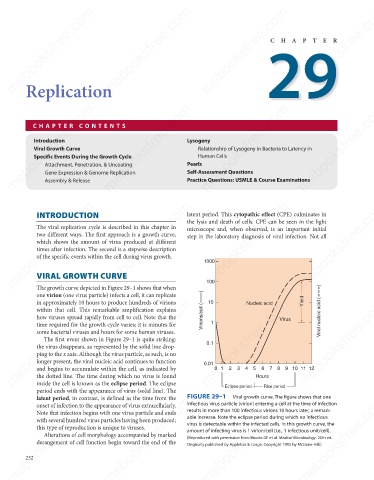
                    The growth curve depicted in Figure 29–1 shows that when
                    one virion (one virus particle) infects a cell, it can replicate   100  Nucleic acid   Yield  Viral nucleic acid (        )
 mebooksfree.com  mebooksfree.com           mebooksfree.com                0.01 1                   Virus   mebooksfree.com                mebooksfree.com
                                                                            mebooksfree.com
                    in approximately 10 hours to produce hundreds of virions
                                                                            10
                    within that cell. This remarkable amplification explains
                    how viruses spread rapidly from cell to cell. Note that the
                    time required for the growth cycle varies; it is minutes for
                    some bacterial viruses and hours for some human viruses.
                       The first event shown in Figure 29–1 is quite striking:
                                                                            0.1
                    the virus disappears, as represented by the solid line drop-
                    ping to the x axis. Although the virus particle, as such, is no
                    longer present, the viral nucleic acid continues to function
                    and begins to accumulate within the cell, as indicated by
                                                                                        4
                                                                                   2
                                                                                      3
                                                                              0 1
                                                                                              6
                    the dotted line. The time during which no virus is found
                    inside the cell is known as the eclipse period. The eclipse
                                                                                              Rise period
                    period ends with the appearance of virus (solid line). The   FIGURE 29–1  Eclipse period  5 Hours 7  8  9101112
                                                                                    Viral growth curve. The figure shows that one
                    latent period, in contrast, is defined as the time from the
 mebooksfree.com  mebooksfree.com           mebooksfree.com          able increase. Note the eclipse period during which no infectious     mebooksfree.com
                                                                            mebooksfree.com
                                                                                                            mebooksfree.com
                                                                     infectious virus particle (virion) entering a cell at the time of infection
                    onset of infection to the appearance of virus extracellularly.
                                                                     results in more than 100 infectious virions 10 hours later, a remark-
                    Note that infection begins with one virus particle and ends
                    with several hundred virus particles having been produced;
                                                                     virus is detectable within the infected cells. In this growth curve, the
                    this type of reproduction is unique to viruses.
                                                                     amount of infecting virus is 1 virion/cell (i.e., 1 infectious unit/cell).
                       Alterations of cell morphology accompanied by marked
                                                                     (Reproduced with permission from Brooks GF et al. Medical Microbiology. 20th ed.
                    derangement of cell function begin toward the end of the
                                                                     Originally published by Appleton & Lange. Copyright 1995 by McGraw-Hill.)
                 232
 mebooksfree.com  mebooksfree.com           mebooksfree.com                 mebooksfree.com                 mebooksfree.com                mebooksfree.com

