


Page 244 - Review of Medical Microbiology and Immunology ( PDFDrive )
P. 244
mebooksfree.com
mebooksfree.com
mebooksfree.com
mebooksfree.com
mebooksfree.com
mebooksfree.com
mebooksfree.com
mebooksfree.com mebooksfree.com mebooksfree.com Attachment, Penetration, & Uncoating 233 mebooksfree.com
mebooksfree.com
CHAPTER 29 Replication
viruses cause CPE; some can replicate while causing little
morphologic or functional change in the cell.
The proteins on the surface of the virion attach to specific
receptor proteins on the cell surface through weak, nonco-
valent bonding. The specificity of attachment determines
SPECIFIC EVENTS DURING THE
the host range of the virus. Some viruses have a narrow
GROWTH CYCLE
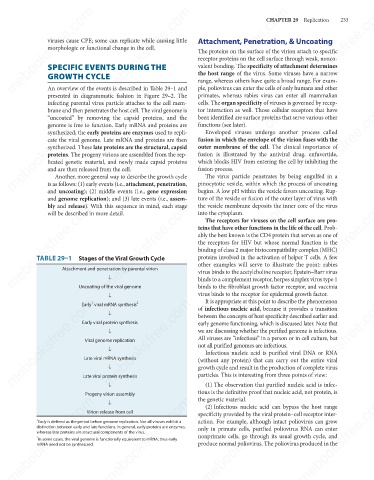
An overview of the events is described in Table 29–1 and
ple, poliovirus can enter the cells of only humans and other
presented in diagrammatic fashion in Figure 29–2. The
primates, whereas rabies virus can enter all mammalian
cells. The organ specificity of viruses is governed by recep-
infecting parental virus particle attaches to the cell mem- range, whereas others have quite a broad range. For exam-
mebooksfree.com
mebooksfree.com
mebooksfree.com mebooksfree.com mebooksfree.com fusion in which the envelope of the virion fuses with the mebooksfree.com
tor interaction as well. Those cellular receptors that have
brane and then penetrates the host cell. The viral genome is
been identified are surface proteins that serve various other
“uncoated” by removing the capsid proteins, and the
genome is free to function. Early mRNA and proteins are
functions (see later).
synthesized; the early proteins are enzymes used to repli-
Enveloped viruses undergo another process called
cate the viral genome. Late mRNA and proteins are then
outer membrane of the cell. The clinical importance of
synthesized. These late proteins are the structural, capsid
fusion is illustrated by the antiviral drug, enfuvertide,
proteins. The progeny virions are assembled from the rep-
licated genetic material, and newly made capsid proteins
which blocks HIV from entering the cell by inhibiting the
fusion process.
and are then released from the cell.
The virus particle penetrates by being engulfed in a
Another, more general way to describe the growth cycle
is as follows: (1) early events (i.e., attachment, penetration,
begins. A low pH within the vesicle favors uncoating. Rup-
and uncoating); (2) middle events (i.e., gene expression
ture of the vesicle or fusion of the outer layer of virus with
and genome replication); and (3) late events (i.e., assem- pinocytotic vesicle, within which the process of uncoating
mebooksfree.com mebooksfree.com mebooksfree.com teins that have other functions in the life of the cell. Prob- mebooksfree.com
mebooksfree.com
mebooksfree.com
bly and release). With this sequence in mind, each stage
the vesicle membrane deposits the inner core of the virus
will be described in more detail.
into the cytoplasm.
The receptors for viruses on the cell surface are pro-
ably the best known is the CD4 protein that serves as one of
the receptors for HIV but whose normal function is the
binding of class 2 major histocompatibility complex (MHC)
proteins involved in the activation of helper T cells. A few
TABLE 29–1 Stages of the Viral Growth Cycle
other examples will serve to illustrate the point: rabies
Attachment and penetration by parental virion
binds to a complement receptor, herpes simplex virus type 1
binds to the fibroblast growth factor receptor, and vaccinia
Uncoating of the viral genome
virus binds to the receptor for epidermal growth factor.
↓ ↓ ↓ 2 virus binds to the acetylcholine receptor, Epstein–Barr virus
↓mebooksfree.com
mebooksfree.com
mebooksfree.com mebooksfree.com Viral genome replication early genome functioning, which is discussed later. Note that mebooksfree.com
It is appropriate at this point to describe the phenomenon
mebooksfree.com
1
Early viral mRNA synthesis
of infectious nucleic acid, because it provides a transition
between the concepts of host specificity described earlier and
Early viral protein synthesis
we are discussing whether the purified genome is infectious.
↓
All viruses are “infectious” in a person or in cell culture, but
not all purified genomes are infectious.
↓
Infectious nucleic acid is purified viral DNA or RNA
Late viral mRNA synthesis
(without any protein) that can carry out the entire viral
growth cycle and result in the production of complete virus
↓
Late viral protein synthesis
(1) The observation that purified nucleic acid is infec-
tious is the definitive proof that nucleic acid, not protein, is
Progeny virion assembly particles. This is interesting from three points of view:
mebooksfree.com
mebooksfree.com mebooksfree.com mebooksfree.com action. For example, although intact poliovirus can grow mebooksfree.com
mebooksfree.com
the genetic material.
↓
(2) Infectious nucleic acid can bypass the host range
Virion release from cell
specificity provided by the viral protein–cell receptor inter-
1
Early is defined as the period before genome replication. Not all viruses exhibit a
distinction between early and late functions. In general, early proteins are enzymes,
only in primate cells, purified poliovirus RNA can enter
whereas late proteins are structural components of the virus.
nonprimate cells, go through its usual growth cycle, and
2
In some cases, the viral genome is functionally equivalent to mRNA; thus early
produce normal poliovirus. The poliovirus produced in the
mRNA need not be synthesized.
mebooksfree.com mebooksfree.com mebooksfree.com mebooksfree.com mebooksfree.com mebooksfree.com

