


Page 297 - Review of Medical Microbiology and Immunology ( PDFDrive )
P. 297
mebooksfree.com


                                                                                                                                           mebooksfree.com
                                                                            mebooksfree.com
                                            mebooksfree.com
            mebooksfree.com
 mebooksfree.com  mebooksfree.com      Viruses mebooksfree.com              mebooksfree.com                 mebooksfree.com                mebooksfree.com
                                                                                                            mebooksfree.com
                 286
                       PART IV  Clinical Virology
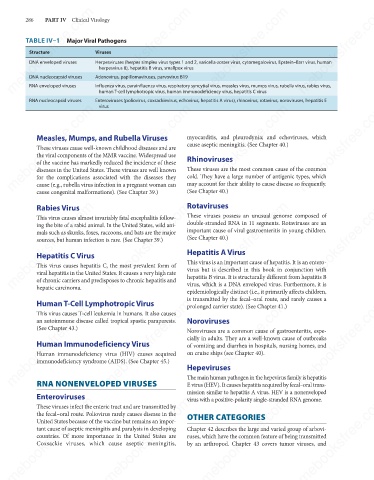
                 TABLE IV–1  Major Viral Pathogens
                  Structure
                                       Herpesviruses (herpes simplex virus types 1 and 2, varicella-zoster virus, cytomegalovirus, Epstein–Barr virus, human
                  DNA enveloped viruses
                                         herpesvirus 8), hepatitis B virus, smallpox virus
                  DNA nucleocapsid viruses
                  RNA enveloped viruses
                                       Influenza virus, parainfluenza virus, respiratory syncytial virus, measles virus, mumps virus, rubella virus, rabies virus,
                                         human T-cell lymphotropic virus, human immunodeficiency virus, hepatitis C virus
                  RNA nucleocapsid viruses  Adenovirus, papillomaviruses, parvovirus B19
                                       Enteroviruses (poliovirus, coxsackievirus, echovirus, hepatitis A virus), rhinovirus, rotavirus, noroviruses, hepatitis E
                                                                            mebooksfree.com
                                                                                                            mebooksfree.com
 mebooksfree.com  mebooksfree.com           mebooksfree.com          myocarditis, and pleurodynia; and echoviruses, which                  mebooksfree.com
                                         virus

                    Measles, Mumps, and Rubella Viruses
                                                                     cause aseptic meningitis. (See Chapter 40.)
                    These viruses cause well-known childhood diseases and are
                    the viral components of the MMR vaccine. Widespread use
                                                                     Rhinoviruses
                    of the vaccine has markedly reduced the incidence of these
                                                                     These viruses are the most common cause of the common
                    diseases in the United States. These viruses are well known
                                                                     cold. They have a large number of antigenic types, which
                    for the complications associated with the diseases they
                                                                     may account for their ability to cause disease so frequently.
                    cause (e.g., rubella virus infection in a pregnant woman can
                                                                     (See Chapter 40.)
                    cause congenital malformations). (See Chapter 39.)
 mebooksfree.com  mebooksfree.com           mebooksfree.com          Rotaviruses                            mebooksfree.com                mebooksfree.com
                                                                            mebooksfree.com
                    Rabies Virus
                                                                     These viruses possess an unusual genome composed of
                    This virus causes almost invariably fatal encephalitis follow-
                                                                     double-stranded RNA in 11 segments. Rotaviruses are an
                    ing the bite of a rabid animal. In the United States, wild ani-
                                                                     important cause of viral gastroenteritis in young children.
                    mals such as skunks, foxes, raccoons, and bats are the major
                                                                     (See Chapter 40.)
                    sources, but human infection is rare. (See Chapter 39.)
                                                                     Hepatitis A Virus
                    Hepatitis C Virus
                                                                     This virus is an important cause of hepatitis. It is an entero-
                    This virus causes hepatitis C, the most prevalent form of
                                                                     virus but is described in this book in conjunction with
                    viral hepatitis in the United States. It causes a very high rate
                                                                     hepatitis B virus. It is structurally different from hepatitis B
                    of chronic carriers and predisposes to chronic hepatitis and
                                                                     virus, which is a DNA enveloped virus. Furthermore, it is
                    hepatic carcinoma.
                                                                     epidemiologically distinct (i.e., it primarily affects children,
                                                                     is transmitted by the fecal–oral route, and rarely causes a
 mebooksfree.com  mebooksfree.com           mebooksfree.com          Noroviruses                            mebooksfree.com                mebooksfree.com
                                                                            mebooksfree.com
                    Human T-Cell Lymphotropic Virus
                                                                     prolonged carrier state). (See Chapter 41.)
                    This virus causes T-cell leukemia in humans. It also causes
                    an autoimmune disease called tropical spastic paraparesis.
                    (See Chapter 43.)
                                                                     Noroviruses are a common cause of gastroenteritis, espe-
                                                                     cially in adults. They are a well-known cause of outbreaks
                    Human Immunodeficiency Virus
                                                                     of vomiting and diarrhea in hospitals, nursing homes, and
                                                                     on cruise ships (see Chapter 40).
                    Human immunodeficiency virus (HIV) causes acquired
                    immunodeficiency syndrome (AIDS). (See Chapter 45.)
                                                                     Hepeviruses
                                                                     The main human pathogen in the hepevirus family is hepatitis
                    RNA NONENVELOPED VIRUSES
                                                                     E virus (HEV). It causes hepatitis acquired by fecal–oral trans-
                                                                     mission similar to hepatitis A virus. HEV is a nonenveloped
                    Enteroviruses
 mebooksfree.com  mebooksfree.com           mebooksfree.com          OTHER CATEGORIES                       mebooksfree.com                mebooksfree.com
                                                                            mebooksfree.com
                                                                     virus with a positive-polarity single-stranded RNA genome.
                    These viruses infect the enteric tract and are transmitted by
                    the fecal–oral route. Poliovirus rarely causes disease in the
                    United States because of the vaccine but remains an impor-
                    tant cause of aseptic meningitis and paralysis in developing
                                                                     Chapter 42 describes the large and varied group of arbovi-
                                                                     ruses, which have the common feature of being transmitted
                    countries. Of more importance in the United States are
                    Coxsackie viruses, which cause aseptic meningitis,
                                                                     by an arthropod. Chapter 43 covers tumor viruses, and


 mebooksfree.com  mebooksfree.com           mebooksfree.com                 mebooksfree.com                 mebooksfree.com                mebooksfree.com

