


Page 301 - Review of Medical Microbiology and Immunology ( PDFDrive )
P. 301
mebooksfree.com
mebooksfree.com
mebooksfree.com
mebooksfree.com
mebooksfree.com
3 mebooksfree.com
mebooksfree.com
mebooksfree.com mebooksfree.com mebooksfree.com mebooksfree.com Antiviral Therapy mebooksfree.com
PART IV Clinical Virology
290
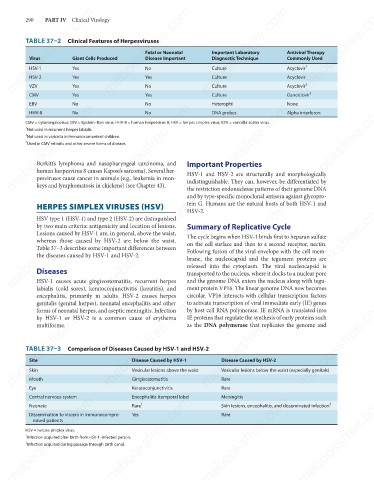
TABLE 37–2 Clinical Features of Herpesviruses
Important Laboratory
Fetal or Neonatal
Commonly Used
Disease Important
Virus
Diagnostic Technique
Giant Cells Produced
1
HSV-1
No
Yes
Culture
Acyclovir
Acyclovir
HSV-2
Culture
Yes
Yes
2
Yes
Acyclovir
No
Culture
VZV
Yes
Culture
Ganciclovir
Yes
CMV
No
Heterophil
EBV
No
mebooksfree.com mebooksfree.com mebooksfree.com Important Properties None mebooksfree.com mebooksfree.com
mebooksfree.com
No
No
HHV-8
DNA probes
Alpha interferon
CMV = cytomegalovirus; EBV = Epstein–Barr virus; HHV-8 = human herpesvirus 8; HSV = herpes simplex virus; VZV = varicella-zoster virus.
1
Not used in recurrent herpes labialis.
2
Not used in varicella in immunocompetent children.
3
Used in CMV retinitis and other severe forms of disease.
Burkitt’s lymphoma and nasopharyngeal carcinoma, and
human herpesvirus 8 causes Kaposi’s sarcoma). Several her-
HSV-1 and HSV-2 are structurally and morphologically
pesviruses cause cancer in animals (e.g., leukemia in mon-
indistinguishable. They can, however, be differentiated by
keys and lymphomatosis in chickens) (see Chapter 43).
the restriction endonuclease patterns of their genome DNA
and by type-specific monoclonal antisera against glycopro-
tein G. Humans are the natural hosts of both HSV-1 and
mebooksfree.com mebooksfree.com mebooksfree.com Summary of Replicative Cycle mebooksfree.com mebooksfree.com
mebooksfree.com
HERPES SIMPLEX VIRUSES (HSV)
HSV-2.
HSV type 1 (HSV-1) and type 2 (HSV-2) are distinguished
by two main criteria: antigenicity and location of lesions.
Lesions caused by HSV-1 are, in general, above the waist,
The cycle begins when HSV-1 binds first to heparan sulfate
whereas those caused by HSV-2 are below the waist.
on the cell surface and then to a second receptor, nectin.
Table 37–3 describes some important differences between
Following fusion of the viral envelope with the cell mem-
the diseases caused by HSV-1 and HSV-2.
brane, the nucleocapsid and the tegument proteins are
released into the cytoplasm. The viral nucleocapsid is
Diseases
and the genome DNA enters the nucleus along with tegu-
HSV-1 causes acute gingivostomatitis, recurrent herpes
ment protein VP16. The linear genome DNA now becomes
labialis (cold sores), keratoconjunctivitis (keratitis), and
circular. VP16 interacts with cellular transcription factors
encephalitis, primarily in adults. HSV-2 causes herpes transported to the nucleus, where it docks to a nuclear pore
mebooksfree.com
mebooksfree.com
mebooksfree.com mebooksfree.com mebooksfree.com as the DNA polymerase that replicates the genome and mebooksfree.com
to activate transcription of viral immediate early (IE) genes
genitalis (genital herpes), neonatal encephalitis and other
by host cell RNA polymerase. IE mRNA is translated into
forms of neonatal herpes, and aseptic meningitis. Infection
IE proteins that regulate the synthesis of early proteins such
by HSV-1 or HSV-2 is a common cause of erythema
multiforme.
TABLE 37–3 Comparison of Diseases Caused by HSV-1 and HSV-2
Site
Disease Caused by HSV-1
Disease Caused by HSV-2
Skin
Vesicular lesions above the waist
Vesicular lesions below the waist (especially genitals)
Rare
Gingivostomatitis
Mouth
Keratoconjunctivitis
Eye
Rare
Central nervous system
Meningitis
Encephalitis (temporal lobe)
mebooksfree.com mebooksfree.com mebooksfree.com mebooksfree.com mebooksfree.com mebooksfree.com
2
1
Rare
Skin lesions, encephalitis, and disseminated infection
Neonate
Rare
Yes
Dissemination to viscera in immunocompro-
mised patients
HSV = herpes simplex virus.
1
Infection acquired after birth from HSV-1–infected person.
2
Infection acquired during passage through birth canal.
mebooksfree.com mebooksfree.com mebooksfree.com mebooksfree.com mebooksfree.com mebooksfree.com

