


Page 302 - Review of Medical Microbiology and Immunology ( PDFDrive )
P. 302
mebooksfree.com
                                                                            mebooksfree.com
 mebooksfree.com

            mebooksfree.com
                                                                                                            mebooksfree.com
                                                                            mebooksfree.com
                                                                                                                                           mebooksfree.com
 mebooksfree.com  mebooksfree.com           mebooksfree.com              the latent state by a variety of inducers (e.g., sunlight, hor-  291  mebooksfree.com
                                            mebooksfree.com
                                                                                      CHAPTER 37  DNA Enveloped Viruses
                        thymidine kinase. These two proteins are important
                        because they are involved in the action of acyclovir, which
                                                                         monal changes, trauma, stress, and fever), at which time it
                        is the most important drug effective against HSV.
                                                                         migrates down the neuron and replicates in the skin, caus-
                                                                         ing lesions.
                          Note that early protein synthesis by HSV can be subdi-
                                                                           The typical skin lesion is a vesicle that contains serous
                        vided into two categories: immediate early and early. Imme-
                        diate early proteins are those whose mRNA synthesis is
                        activated by a protein brought in by the incoming parental
                                                                         vesicle ruptures, virus is liberated and can be transmitted to
                        virion (i.e., no new viral protein synthesis is required for
                                                                         other individuals. Multinucleated giant cells are typically
                                                                         found at the base of herpesvirus lesions.
                        the production of the five immediate early proteins). The   fluid filled with virus particles and cell debris. When the
                                                                           Immunity is type-specific, but some cross-protection
 mebooksfree.com  mebooksfree.com           mebooksfree.com              IgG.  Cell-mediated immunity is  important  in limiting           mebooksfree.com
                        early proteins, on the other hand, do require the synthesis
                                                                                                            mebooksfree.com
                                                                            mebooksfree.com
                        of new viral regulatory proteins to activate the transcrip-
                                                                         exists. However, immunity is incomplete, and both reinfec-
                                                                         tion and reactivation occur in the presence of circulating
                        tion of their mRNAs.
                          The viral DNA polymerase replicates the genome DNA,
                        at which time early protein synthesis is shut off and late
                                                                         herpesviruses, because its suppression often results in reac-
                        protein synthesis begins. These late, structural proteins are
                                                                         tivation, spread, and severe disease.
                        transported to the nucleus, where virion assembly occurs.
                        The virion obtains its envelope by budding through the
                                                                         Clinical Findings
                        nuclear membrane and exits the cell via tubules or vacuoles
                                                                         HSV-1  causes  several  forms  of  primary  and  recurrent
                        that communicate with the exterior.
                          In latently infected cells, such as HSV-infected neurons,
                                                                           (1) Gingivostomatitis occurs primarily in children and
                        circular HSV DNA resides in the nucleus and is not inte-
                        grated into cellular DNA. Transcription of HSV DNA is   disease:
                                                                         is characterized by fever, irritability, and vesicular lesions in
                        limited to a few  latency-associated transcripts (LATS).
                                                                         the mouth. The primary disease is more severe and lasts
 mebooksfree.com  mebooksfree.com           mebooksfree.com              infections.                        mebooksfree.com                mebooksfree.com
                                                                            mebooksfree.com
                        These noncoding, regulatory RNAs suppress viral replica-
                                                                         longer than recurrences. The lesions heal spontaneously in
                                                                         2 to 3 weeks. Many children have asymptomatic primary
                        tion. Reactivation of viral replication can occur at a later
                        time when the genes encoding LATS are excised.
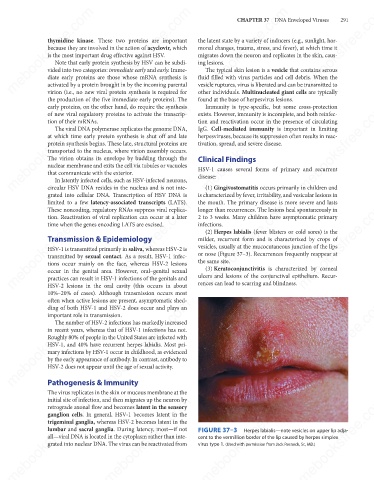
                                                                           (2) Herpes labialis (fever blisters or cold sores) is the
                        Transmission & Epidemiology
                                                                         milder, recurrent form and is characterized by crops of
                                                                         vesicles, usually at the mucocutaneous junction of the lips
                        HSV-1 is transmitted primarily in saliva, whereas HSV-2 is
                                                                         or nose (Figure 37–3). Recurrences frequently reappear at
                        transmitted by sexual contact. As a result, HSV-1 infec-
                                                                         the same site.
                        tions occur mainly on the face, whereas HSV-2 lesions
                                                                           (3) Keratoconjunctivitis is characterized by corneal
                        occur in the genital area. However, oral–genital sexual
                        practices can result in HSV-1 infections of the genitals and
                                                                         rences can lead to scarring and blindness.
                        HSV-2 lesions in the oral cavity (this occurs in about
                        10%–20% of cases).  Although transmission occurs most   ulcers and lesions of the conjunctival epithelium. Recur-
                        often when active lesions are present, asymptomatic shed-
 mebooksfree.com  mebooksfree.com           mebooksfree.com                 mebooksfree.com                 mebooksfree.com                mebooksfree.com
                        ding of both HSV-1 and HSV-2 does occur and plays an
                        important role in transmission.
                          The number of HSV-2 infections has markedly increased
                        in recent years, whereas that of HSV-1 infections has not.
                        Roughly 80% of people in the United States are infected with
                        HSV-1, and 40% have recurrent herpes labialis. Most pri-
                        mary infections by HSV-1 occur in childhood, as evidenced
                        by the early appearance of antibody. In contrast, antibody to
                        HSV-2 does not appear until the age of sexual activity.
                        Pathogenesis & Immunity
                        The virus replicates in the skin or mucous membrane at the
 mebooksfree.com  mebooksfree.com           mebooksfree.com              FIGURE 37–3    Herpes labialis—note vesicles on upper lip adja-   mebooksfree.com
                                                                            mebooksfree.com
                                                                                                            mebooksfree.com
                        initial site of infection, and then migrates up the neuron by
                        retrograde axonal flow and becomes latent in the sensory
                        ganglion cells.  In  general,  HSV-1  becomes  latent  in  the
                        trigeminal ganglia, whereas HSV-2 becomes latent in the
                        lumbar and sacral ganglia. During latency, most—if not
                        all—viral DNA is located in the cytoplasm rather than inte-
                                                                         cent to the vermillion border of the lip caused by herpes simplex
                        grated into nuclear DNA. The virus can be reactivated from
                                                                         virus type 1. (Used with permission from Jack Resneck, Sr., MD.)

 mebooksfree.com  mebooksfree.com           mebooksfree.com                 mebooksfree.com                 mebooksfree.com                mebooksfree.com

