


Page 303 - Review of Medical Microbiology and Immunology ( PDFDrive )
P. 303
mebooksfree.com


                                                                                                                                           mebooksfree.com
            mebooksfree.com
                                                                                                            mebooksfree.com
                                                                            mebooksfree.com
 mebooksfree.com  mebooksfree.com           mebooksfree.com                 mebooksfree.com                 mebooksfree.com                mebooksfree.com
                                            mebooksfree.com
                 292
                       PART IV  Clinical Virology
                       (4) Encephalitis caused by HSV-1 is characterized by a
                    necrotic lesion in one temporal lobe. Fever, headache, vom-
                    iting, seizures, and altered mental status are typical clinical
                    features. The onset may be acute or protracted over several
                    days.  The disease occurs  as a  result  of either a  primary
                    infection or a recurrence. Magnetic resonance imaging
                    often  reveals  the lesion.  Examination  of the spinal  fluid
                    typically shows a moderate increase of lymphocytes, a
                    moderate elevation in the amount of protein, and a normal
 mebooksfree.com  mebooksfree.com           mebooksfree.com                 mebooksfree.com                 mebooksfree.com                mebooksfree.com
                    amount of glucose. HSV-1 encephalitis has a high mortality
                    rate and causes severe neurologic sequelae in those who
                    survive.
                       (5) Herpetic whitlow is a pustular lesion of the skin of
                    the finger or hand. It can occur in medical personnel as a
                    result of contact with patient’s lesions.
                       (6) Herpes gladiatorum, as the name implies, occurs in
                    wrestlers and others who have close body contact. It is
                    caused primarily by HSV-1 and is characterized by vesicu-
                    lar lesions on the head, neck, and trunk.
                       (7) Eczema herpeticum (Kaposi’s varicelliform erup-
                    tion) is an infection of the skin of a patient with atopic
                    dermatitis. Vesicular lesions are seen at the site of the atopic
                    dermatitis (eczema). Most cases occur in children.
                                                                            mebooksfree.com
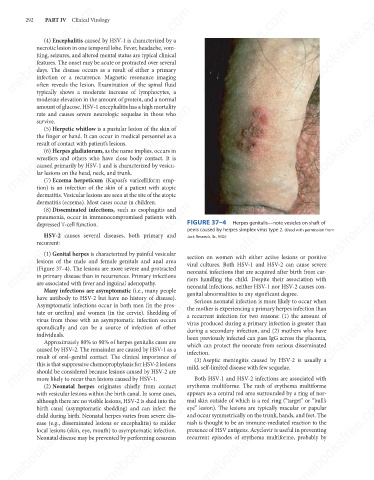
 mebooksfree.com  mebooksfree.com           mebooksfree.com          FIGURE 37–4    Herpes genitalis—note vesicles on shaft of             mebooksfree.com
                                                                                                            mebooksfree.com
                       (8) Disseminated infections, such as esophagitis and
                    pneumonia, occur in immunocompromised patients with
                    depressed T-cell function.
                                                                     penis caused by herpes simplex virus type 2. (Used with permission from
                       HSV-2 causes several diseases, both primary and
                                                                     Jack Resneck, Sr., MD.)
                    recurrent:
                       (1) Genital herpes is characterized by painful vesicular
                                                                     section on women with either active lesions or positive
                    lesions of the male and female genitals and anal area
                                                                     viral cultures. Both HSV-1 and HSV-2 can cause severe
                    (Figure 37–4). The lesions are more severe and protracted
                                                                     neonatal infections that are acquired after birth from car-
                    in primary disease than in recurrences. Primary infections
                    are associated with fever and inguinal adenopathy.
                                                                     neonatal infections, neither HSV-1 nor HSV-2 causes con-
                       Many infections are asymptomatic (i.e., many people
                                                                     genital abnormalities to any significant degree.
                    have antibody to HSV-2 but have no history of disease).   riers handling the child. Despite their association with
 mebooksfree.com  mebooksfree.com           mebooksfree.com          virus produced during a primary infection is greater than             mebooksfree.com
                                                                        Serious neonatal infection is more likely to occur when
                                                                            mebooksfree.com
                                                                                                            mebooksfree.com
                    Asymptomatic infections occur in both men (in the pros-
                                                                     the mother is experiencing a primary herpes infection than
                    tate or urethra) and women (in the cervix). Shedding of
                                                                     a recurrent infection for two reasons: (1) the amount of
                    virus from those with an asymptomatic infection occurs
                    sporadically  and  can  be  a  source  of  infection  of  other
                                                                     during a secondary infection, and (2) mothers who have
                    individuals.
                                                                     been previously infected can pass IgG across the placenta,
                       Approximately 80% to 90% of herpes genitalis cases are
                                                                     which can protect the neonate from serious disseminated
                    caused by HSV-2. The remainder are caused by HSV-1 as a
                                                                     infection.
                    result of oral–genital contact. The clinical importance of
                                                                        (3) Aseptic meningitis caused by HSV-2 is usually a
                    this is that suppressive chemoprophylaxis for HSV-2 lesions
                                                                     mild, self-limited disease with few sequelae.
                    should be considered because lesions caused by HSV-2 are
                    more likely to recur than lesions caused by HSV-1.
                                                                        Both HSV-1 and HSV-2 infections are associated with
                       (2) Neonatal herpes originates chiefly from contact
                    with vesicular lesions within the birth canal. In some cases,   erythema multiforme. The rash of erythema multiforme
                                                                     appears as a central red area surrounded by a ring of nor-
                                                                            mebooksfree.com
                                                                                                            mebooksfree.com
 mebooksfree.com  mebooksfree.com           mebooksfree.com          rash is thought to be an immune-mediated reaction to the              mebooksfree.com
                    although there are no visible lesions, HSV-2 is shed into the
                                                                     mal skin outside of which is a red ring (“target” or “bull’s
                                                                     eye” lesion). The lesions are typically macular or papular
                    birth canal (asymptomatic shedding) and can infect the
                    child during birth. Neonatal herpes varies from severe dis-
                                                                     and occur symmetrically on the trunk, hands, and feet. The
                    ease (e.g., disseminated lesions or encephalitis) to milder
                    local lesions (skin, eye, mouth) to asymptomatic infection.
                                                                     presence of HSV antigens. Acyclovir is useful in preventing
                                                                     recurrent episodes of erythema multiforme, probably by
                    Neonatal disease may be prevented by performing cesarean
 mebooksfree.com  mebooksfree.com           mebooksfree.com                 mebooksfree.com                 mebooksfree.com                mebooksfree.com

