


Page 37 - Review of Medical Microbiology and Immunology ( PDFDrive )
P. 37
mebooksfree.com
mebooksfree.com
mebooksfree.com
mebooksfree.com
mebooksfree.com
mebooksfree.com
mebooksfree.com mebooksfree.com mebooksfree.com mebooksfree.com H 6 E R mebooksfree.com
mebooksfree.com
A
C
P
T
Normal Flora
mebooksfree.com mebooksfree.com mebooksfree.com Normal Flora of the Genitourinary Tract mebooksfree.com mebooksfree.com
mebooksfree.com
CHAPTER C ONTENT S
Concept of Normal Flora
The Human Microbiome
Pearls
Normal Flora of the Skin
Self-Assessment Questions
Practice Questions: USMLE & Course Examinations
Normal Flora of the Respiratory Tract
Normal Flora of the Intestinal Tract
mebooksfree.com
mebooksfree.com
mebooksfree.com mebooksfree.com mebooksfree.com the normal flora, although they can be present in asymp- mebooksfree.com
CONCEPT OF NORMAL FLORA
tomatic individuals. The normal flora organisms are often
Normal flora is the term used to describe the various bac-
referred to as commensals. Commensals are organisms
teria and fungi that are permanent residents of certain
that derive benefit from another host but do not damage
body sites, especially the skin, oropharynx, colon, and
that host. The term human microbiome is often used to
vagina (Tables 6–1 and 6–2). Viruses and parasites (protozoa
describe the normal flora (see later).
and helminths), which are the other major groups of
The members of the normal flora vary in both number
microorganisms, are usually not considered members of
and kind from one site to another. Although the normal
flora extensively populates many areas of the body, the
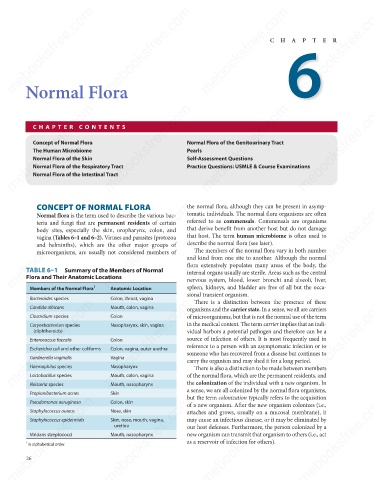
TABLE 6–1 Summary of the Members of Normal
internal organs usually are sterile. Areas such as the central
Flora and Their Anatomic Locations
nervous system, blood, lower bronchi and alveoli, liver,
spleen, kidneys, and bladder are free of all but the occa-
1
Anatomic Location
Members of the Normal Flora
sional transient organism.
Bacteroides species
Colon, throat, vagina
mebooksfree.com
mebooksfree.com mebooksfree.com mebooksfree.com in the medical context. The term carrier implies that an indi- mebooksfree.com
mebooksfree.com
There is a distinction between the presence of these
Mouth, colon, vagina
Candida albicans
organisms and the carrier state. In a sense, we all are carriers
of microorganisms, but that is not the normal use of the term
Clostridium species
Colon
Corynebacterium species
Nasopharynx, skin, vagina
vidual harbors a potential pathogen and therefore can be a
(diphtheroids)
source of infection of others. It is most frequently used in
Enterococcus faecalis
Colon
reference to a person with an asymptomatic infection or to
Escherichia coli and other coliforms
Colon, vagina, outer urethra
someone who has recovered from a disease but continues to
Gardnerella vaginalis
Vagina
carry the organism and may shed it for a long period.
Nasopharynx
Haemophilus species
There is also a distinction to be made between members
Lactobacillus species
the colonization of the individual with a new organism. In
Mouth, nasopharynx
Neisseria species
a sense, we are all colonized by the normal flora organisms,
Skin
Propionibacterium acnes Mouth, colon, vagina of the normal flora, which are the permanent residents, and
but the term colonization typically refers to the acquisition
mebooksfree.com
mebooksfree.com
mebooksfree.com mebooksfree.com mebooksfree.com may cause an infectious disease, or it may be eliminated by mebooksfree.com
Colon, skin
Pseudomonas aeruginosa
of a new organism. After the new organism colonizes (i.e.,
Staphylococcus aureus
Nose, skin
attaches and grows, usually on a mucosal membrane), it
Skin, nose, mouth, vagina,
Staphylococcus epidermidis
urethra
our host defenses. Furthermore, the person colonized by a
new organism can transmit that organism to others (i.e., act
Mouth, nasopharynx
Viridans streptococci
as a reservoir of infection for others).
1
In alphabetical order.
26
mebooksfree.com mebooksfree.com mebooksfree.com mebooksfree.com mebooksfree.com mebooksfree.com

