


Page 355 - Review of Medical Microbiology and Immunology ( PDFDrive )
P. 355
mebooksfree.com
mebooksfree.com
mebooksfree.com
mebooksfree.com
mebooksfree.com
mebooksfree.com mebooksfree.com mebooksfree.com 42 mebooksfree.com nm mebooksfree.com mebooksfree.com
mebooksfree.com
344
PART IV Clinical Virology
12 weeks. Most HAV infections are asymptomatic and are
detected solely by the presence of IgG antibody. No chronic
hepatitis or chronic carrier state occurs, and there is no
Coat protein
(HBsAg)
predisposition to hepatocellular carcinoma.
22
Core (HBcAg)
DNA genome
Laboratory Diagnosis
+
–
The detection of IgM antibody is the most important test.
A fourfold rise in IgG antibody titer can also be used. Isola-
Surface antigen
tion of the virus in cell culture is possible but not available nm Virus particle DNA polymerase
particles (HBsAg)
mebooksfree.com
mebooksfree.com
mebooksfree.com mebooksfree.com mebooksfree.com FIGURE 41–1 Hepatitis B virus (HBV). Left: Cross-section of mebooksfree.com
in the clinical laboratory.
Treatment & Prevention
No antiviral therapy is available. Active immunization
with a vaccine containing inactivated HAV is available. The
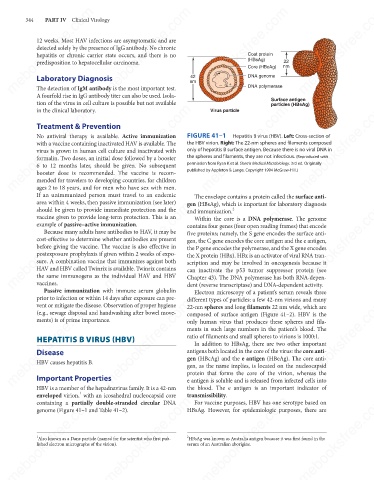
the HBV virion. Right: The 22-nm spheres and filaments composed
only of hepatitis B surface antigen. Because there is no viral DNA in
virus is grown in human cell culture and inactivated with
formalin. Two doses, an initial dose followed by a booster
the spheres and filaments, they are not infectious. (Reproduced with
permission from Ryan K et al. Sherris Medical Microbiology. 3rd ed. Originally
6 to 12 months later, should be given. No subsequent
published by Appleton & Lange. Copyright 1994 McGraw-Hill.)
booster dose is recommended. The vaccine is recom-
mended for travelers to developing countries, for children
ages 2 to 18 years, and for men who have sex with men.
If an unimmunized person must travel to an endemic gen (HBsAg), which is important for laboratory diagnosis
The envelope contains a protein called the surface anti-
area within 4 weeks, then passive immunization (see later)
mebooksfree.com mebooksfree.com mebooksfree.com contains four genes (four open reading frames) that encode mebooksfree.com
mebooksfree.com
mebooksfree.com
should be given to provide immediate protection and the
2
and immunization.
vaccine given to provide long-term protection. This is an
Within the core is a DNA polymerase. The genome
example of passive–active immunization.
Because many adults have antibodies to HAV, it may be
five proteins; namely, the S gene encodes the surface anti-
cost-effective to determine whether antibodies are present
gen, the C gene encodes the core antigen and the e antigen,
before giving the vaccine. The vaccine is also effective in
the P gene encodes the polymerase, and the X gene encodes
postexposure prophylaxis if given within 2 weeks of expo-
the X protein (HBx). HBx is an activator of viral RNA tran-
sure. A combination vaccine that immunizes against both
scription and may be involved in oncogenesis because it
HAV and HBV called Twinrix is available. Twinrix contains
can inactivate the p53 tumor suppressor protein (see
the same immunogens as the individual HAV and HBV
vaccines.
dent (reverse transcriptase) and DNA-dependent activity.
Passive immunization with immune serum globulin
Electron microscopy of a patient’s serum reveals three
prior to infection or within 14 days after exposure can pre- Chapter 43). The DNA polymerase has both RNA-depen-
different types of particles: a few 42-nm virions and many
mebooksfree.com
mebooksfree.com
mebooksfree.com mebooksfree.com mebooksfree.com only human virus that produces these spheres and fila- mebooksfree.com
vent or mitigate the disease. Observation of proper hygiene
22-nm spheres and long filaments 22 nm wide, which are
(e.g., sewage disposal and handwashing after bowel move-
composed of surface antigen (Figure 41–2). HBV is the
ments) is of prime importance.
ments in such large numbers in the patient’s blood. The
ratio of filaments and small spheres to virions is 1000:1.
HEPATITIS B VIRUS (HBV)
In addition to HBsAg, there are two other important
antigens both located in the core of the virus: the core anti-
Disease
gen (HBcAg) and the e antigen (HBeAg). The core anti-
HBV causes hepatitis B.
gen, as the name implies, is located on the nucleocapsid
Important Properties
e antigen is soluble and is released from infected cells into
the blood. The e antigen is an important indicator of
HBV is a member of the hepadnavirus family. It is a 42-nm
1
transmissibility.
enveloped virion, with an icosahedral nucleocapsid core protein that forms the core of the virion, whereas the
mebooksfree.com
mebooksfree.com mebooksfree.com mebooksfree.com 2 serum of an Australian aborigine. mebooksfree.com mebooksfree.com
containing a partially double-stranded circular DNA
For vaccine purposes, HBV has one serotype based on
genome (Figure 41–1 and Table 41–2).
HBsAg. However, for epidemiologic purposes, there are
1
Also known as a Dane particle (named for the scientist who first pub-
HBsAg was known as Australia antigen because it was first found in the
lished electron micrographs of the virion).
mebooksfree.com mebooksfree.com mebooksfree.com mebooksfree.com mebooksfree.com mebooksfree.com

