


Page 356 - Review of Medical Microbiology and Immunology ( PDFDrive )
P. 356
mebooksfree.com
                                                                                                            mebooksfree.com
 mebooksfree.com

                                            mebooksfree.com
            mebooksfree.com
                                                                            mebooksfree.com
 mebooksfree.com  mebooksfree.com           mebooksfree.com              animal reservoir.  CHAPTER 41  Hepatitis Viruses  345             mebooksfree.com
                                                                                                                                           mebooksfree.com
                                                                                                            mebooksfree.com
                                                                           Humans are the only natural hosts of HBV. There is no


                                                                         Summary of Replicative Cycle

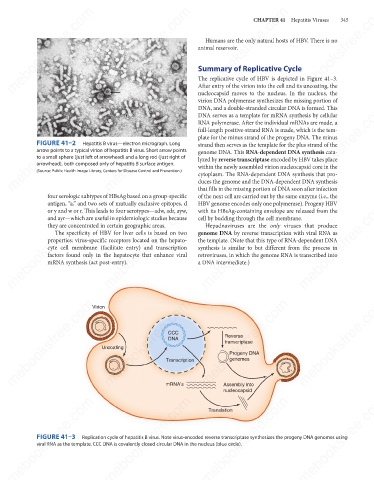
                                                                         The replicative cycle of HBV is depicted in Figure 41–3.
                                                                         After entry of the virion into the cell and its uncoating, the
                                                                         nucleocapsid moves to the nucleus. In the nucleus, the
                                                                         virion DNA polymerase synthesizes the missing portion of
                                                                                                            mebooksfree.com
                                                                            mebooksfree.com
 mebooksfree.com  mebooksfree.com           mebooksfree.com              full-length positive-strand RNA is made, which is the tem-        mebooksfree.com
                                                                         DNA, and a double-stranded circular DNA is formed. This
                                                                         DNA serves as a template for mRNA synthesis by cellular
                                                                         RNA polymerase. After the individual mRNAs are made, a
                                                                         plate for the minus strand of the progeny DNA. The minus
                    FIGURE 41–2
                                   Hepatitis B virus—electron micrograph. Long
                                                                         strand then serves as the template for the plus strand of the
                    arrow points to a typical virion of hepatitis B virus. Short arrow points
                                                                         genome DNA. This RNA-dependent DNA synthesis cata-
                    to a small sphere (just left of arrowhead) and a long rod (just right of
                                                                         lyzed by reverse transcriptase encoded by HBV takes place
                    arrowhead), both composed only of hepatitis B surface antigen.
                                                                         within the newly assembled virion nucleocapsid core in the
                    (Source: Public Health Image Library, Centers for Disease Control and Prevention.)
                                                                         duces the genome and the DNA-dependent DNA synthesis
                                                                         that fills in the missing portion of DNA soon after infection
                                                                         of the next cell are carried out by the same enzyme (i.e., the
                        four serologic subtypes of HBsAg based on a group-specific   cytoplasm. The RNA-dependent DNA synthesis that pro-
                                                                         HBV genome encodes only one polymerase). Progeny HBV
                        antigen, “a,” and two sets of mutually exclusive epitopes, d
                                                                                                            mebooksfree.com
 mebooksfree.com  mebooksfree.com           mebooksfree.com              genome DNA by reverse transcription with viral RNA as             mebooksfree.com
                                                                            mebooksfree.com
                                                                         with its HBsAg-containing envelope are released from the
                        or y and w or r. This leads to four serotypes—adw, adr, ayw,
                                                                         cell by budding through the cell membrane.
                        and ayr—which are useful in epidemiologic studies because
                                                                           Hepadnaviruses are the  only viruses that produce
                        they are concentrated in certain geographic areas.
                          The specificity of HBV for liver cells is based on two
                                                                         the template. (Note that this type of RNA-dependent DNA
                        properties: virus-specific receptors located on the hepato-
                                                                         synthesis is similar to but different from the process in
                        cyte cell membrane (facilitate entry) and transcription
                        factors found only in the hepatocyte that enhance viral
                                                                         retroviruses, in which the genome RNA is transcribed into
                                                                         a DNA intermediate.)
                        mRNA synthesis (act post-entry).
 mebooksfree.com  mebooksfree.com     Virion + mebooksfree.com              mebooksfree.com                 mebooksfree.com                mebooksfree.com


                                        –
                                                               CCC
                                                                                  Reverse
                                                               DNA
                                                                                  transcriptase
                                         U Uncoating
                                         Unc
                                         Unc
                                         Uncoating
                                                                                   Progeny DNA
                                                                                   genomes
                                                              Transcription
                                             –
                                               +
                                                              mRNA’s
                                                                                 Assembly into
                                                                                 nucleocapsid        –  +
 mebooksfree.com  mebooksfree.com           mebooksfree.com                 mebooksfree.com                 mebooksfree.com                mebooksfree.com
                                                                            Translation


                    FIGURE 41–3
                                   Replication cycle of hepatitis B virus. Note virus-encoded reverse transcriptase synthesizes the progeny DNA genomes using
                    viral RNA as the template. CCC DNA is covalently closed circular DNA in the nucleus (blue circle).


 mebooksfree.com  mebooksfree.com           mebooksfree.com                 mebooksfree.com                 mebooksfree.com                mebooksfree.com

