


Page 358 - Review of Medical Microbiology and Immunology ( PDFDrive )
P. 358
mebooksfree.com
mebooksfree.com
mebooksfree.com
mebooksfree.com
mebooksfree.com mebooksfree.com mebooksfree.com HBcAb is present in those with acute infection and 347 mebooksfree.com
mebooksfree.com
mebooksfree.com
mebooksfree.com
mebooksfree.com
CHAPTER 41 Hepatitis Viruses
Clinical Findings
chronic infection, as well as in those who have recovered
Many HBV infections are asymptomatic and are detected
from acute infection. Therefore, it cannot be used to dis-
only by the presence of antibody to HBsAg. The mean
tinguish between acute and chronic infection. The IgM
incubation period for hepatitis B is 10 to 12 weeks, which
form of HBcAb is present during acute infection and
is much longer than that of hepatitis A (3–4 weeks). The
disappears approximately 6 months after infection. The
clinical appearance of acute hepatitis B is similar to that
of hepatitis A. However, with hepatitis B, symptoms tend
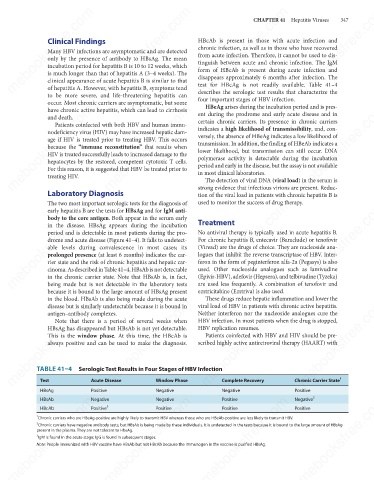
describes the serologic test results that characterize the
to be more severe, and life-threatening hepatitis can
four important stages of HBV infection.
occur. Most chronic carriers are asymptomatic, but some test for HBcAg is not readily available. Table 41–4
mebooksfree.com mebooksfree.com mebooksfree.com indicates a high likelihood of transmissibility, and, con- mebooksfree.com
HBeAg arises during the incubation period and is pres-
mebooksfree.com
mebooksfree.com
have chronic active hepatitis, which can lead to cirrhosis
ent during the prodrome and early acute disease and in
and death.
certain chronic carriers. Its presence in chronic carriers
Patients coinfected with both HBV and human immu-
nodeficiency virus (HIV) may have increased hepatic dam-
versely, the absence of HBeAg indicates a low likelihood of
age if HIV is treated prior to treating HBV. This occurs
transmission. In addition, the finding of HBeAb indicates a
because the “immune reconstitution” that results when
lower likelihood, but transmission can still occur. DNA
HIV is treated successfully leads to increased damage to the
polymerase activity is detectable during the incubation
hepatocytes by the restored, competent cytotoxic T cells.
period and early in the disease, but the assay is not available
For this reason, it is suggested that HBV be treated prior to
in most clinical laboratories.
treating HIV.
The detection of viral DNA (viral load) in the serum is
strong evidence that infectious virions are present. Reduc-
Laboratory Diagnosis
tion of the viral load in patients with chronic hepatitis B is
The two most important serologic tests for the diagnosis of
mebooksfree.com
mebooksfree.com mebooksfree.com mebooksfree.com used to monitor the success of drug therapy. mebooksfree.com mebooksfree.com
early hepatitis B are the tests for HBsAg and for IgM anti-
body to the core antigen. Both appear in the serum early
Treatment
in the disease. HBsAg appears during the incubation
No antiviral therapy is typically used in acute hepatitis B.
period and is detectable in most patients during the pro-
For chronic hepatitis B, entecavir (Baraclude) or tenofovir
drome and acute disease (Figure 41–4). It falls to undetect-
(Viread) are the drugs of choice. They are nucleoside ana-
able levels during convalescence in most cases; its
logues that inhibit the reverse transcriptase of HBV. Inter-
prolonged presence (at least 6 months) indicates the car-
feron in the form of peginterferon alfa-2a (Pegasys) is also
rier state and the risk of chronic hepatitis and hepatic car-
used. Other nucleoside analogues such as lamivudine
cinoma. As described in Table 41–4, HBsAb is not detectable
in the chronic carrier state. Note that HBsAb is, in fact,
are used less frequently. A combination of tenofovir and
being made but is not detectable in the laboratory tests
emtricitabine (Emtriva) is also used.
because it is bound to the large amount of HBsAg present (Epivir-HBV), adefovir (Hepsera), and telbivudine (Tyzeka)
These drugs reduce hepatic inflammation and lower the
in the blood. HBsAb is also being made during the acute
mebooksfree.com
mebooksfree.com mebooksfree.com mebooksfree.com HBV infection. In most patients when the drug is stopped, mebooksfree.com
mebooksfree.com
viral load of HBV in patients with chronic active hepatitis.
disease but is similarly undetectable because it is bound in
Neither interferon nor the nucleoside analogues cure the
antigen–antibody complexes.
Note that there is a period of several weeks when
HBV replication resumes.
HBsAg has disappeared but HBsAb is not yet detectable.
Patients coinfected with HBV and HIV should be pre-
This is the window phase. At this time, the HBcAb is
scribed highly active antiretroviral therapy (HAART) with
always positive and can be used to make the diagnosis.
TABLE 41–4 Serologic Test Results in Four Stages of HBV Infection
Test
HBsAg Acute Disease Window Phase Complete Recovery Chronic Carrier State 1
Positive
Negative
Positive
Negative
mebooksfree.com mebooksfree.com mebooksfree.com mebooksfree.com mebooksfree.com mebooksfree.com
2
Negative
Positive
Negative
Negative
HBsAb
3
Positive
HBcAb
Positive
Positive
Positive
1
Chronic carriers who are HBeAg-positive are highly likely to transmit HBV whereas those who are HBeAb-positive are less likely to transmit HBV.
2
Chronic carriers have negative antibody tests, but HBsAb is being made by these individuals. It is undetected in the tests because it is bound to the large amount of HBsAg
present in the plasma. They are not tolerant to HbsAg.
3
IgM is found in the acute stage; IgG is found in subsequent stages.
Note: People immunized with HBV vaccine have HBsAb but not HBcAb because the immunogen in the vaccine is purified HBsAg.
mebooksfree.com mebooksfree.com mebooksfree.com mebooksfree.com mebooksfree.com mebooksfree.com

