


Page 427 - Review of Medical Microbiology and Immunology ( PDFDrive )
P. 427
mebooksfree.com


            mebooksfree.com
                                                                                                            mebooksfree.com
                                                                            mebooksfree.com
                                            mebooksfree.com
                                                                                                                                           mebooksfree.com
 mebooksfree.com  mebooksfree.com           mebooksfree.com                 mebooksfree.com                 mebooksfree.com                mebooksfree.com
                 416
                       PART V  Mycology


 mebooksfree.com  mebooksfree.com           mebooksfree.com                 mebooksfree.com                 mebooksfree.com                mebooksfree.com


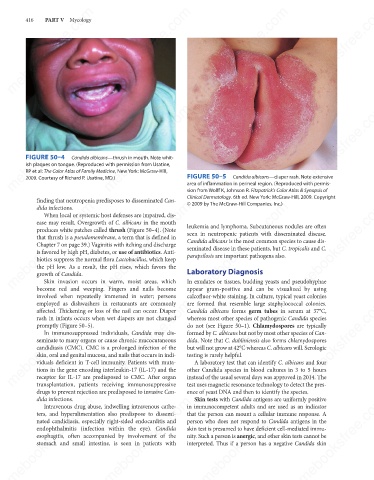
                 FIGURE 50–4
                                Candida albicans—thrush in mouth. Note whit-
                 ish plaques on tongue. (Reproduced with permission from Usatine,
                 RP et al: The Color Atlas of Family Medicine, New York: McGraw-Hill,
                 2009. Courtesy of Richard P. Usatine, MD.)
                                                                     area of inflammation in perineal region. (Reproduced with permis-
                                                                     sion from Wolff K, Johnson R. Fitzpatrick’s Color Atlas & Synopsis of
                                                                     Clinical Dermatology. 6th ed. New York: McGraw-Hill, 2009. Copyright
                    finding that neutropenia predisposes to disseminated Can-  FIGURE 50–5   Candida albicans—diaper rash. Note extensive
                                                                                                            mebooksfree.com
 mebooksfree.com  mebooksfree.com           mebooksfree.com          leukemia and lymphoma. Subcutaneous nodules are often                 mebooksfree.com
                                                                            mebooksfree.com
                                                                     © 2009 by The McGraw-Hill Companies, Inc.)
                    dida infections.
                       When local or systemic host defenses are impaired, dis-
                    ease may result. Overgrowth of C. albicans in the mouth
                    produces white patches called thrush (Figure 50–4). (Note
                                                                     seen in neutropenic patients with disseminated disease.
                    that thrush is a pseudomembrane, a term that is defined in
                                                                     Candida albicans is the most common species to cause dis-
                    Chapter 7 on page 39.) Vaginitis with itching and discharge
                                                                     seminated disease in these patients, but C. tropicalis and C.
                    is favored by high pH, diabetes, or use of antibiotics. Anti-
                                                                     parapsilosis are important pathogens also.
                    biotics suppress the normal flora Lactobacillus, which keep
                    the pH low. As a result, the pH rises, which favors the
                    growth of Candida.
                       Skin invasion occurs in warm, moist areas, which
                                                                     In exudates or tissues, budding yeasts and pseudohyphae
                    become red and weeping. Fingers and nails become
                                                                     appear gram-positive and can be visualized by using
                    involved when repeatedly immersed in water; persons   Laboratory Diagnosis
                                                                     calcofluor-white staining. In culture, typical yeast colonies
 mebooksfree.com  mebooksfree.com           mebooksfree.com          do not (see Figure 50–1).  Chlamydospores are typically               mebooksfree.com
                                                                                                            mebooksfree.com
                                                                            mebooksfree.com
                    employed as dishwashers in restaurants are commonly
                                                                     are formed that resemble large staphylococcal colonies.
                    affected. Thickening or loss of the nail can occur. Diaper
                                                                     Candida albicans forms  germ tubes in serum at 37°C,
                    rash in infants occurs when wet diapers are not changed
                                                                     whereas most other species of pathogenic Candida species
                    promptly (Figure 50–5).
                       In immunosuppressed individuals,  Candida may dis-
                                                                     formed by C. albicans but not by most other species of Can-
                    seminate to many organs or cause chronic mucocutaneous
                                                                     dida. Note that C. dubliniensis also forms chlamydospores
                    candidiasis (CMC). CMC is a prolonged infection of the
                                                                     but will not grow at 42°C whereas C. albicans will. Serologic
                    skin, oral and genital mucosa, and nails that occurs in indi-
                                                                     testing is rarely helpful.
                    viduals deficient in T-cell immunity. Patients with muta-
                                                                        A laboratory test that can identify C. albicans and four
                    tions in the gene encoding interleukin-17 (IL-17) and the
                    receptor for IL-17 are predisposed to CMC. After organ
                                                                     instead of the usual several days was approved in 2014. The
                    transplantation, patients receiving immunosuppressive
                                                                     test uses magnetic resonance technology to detect the pres-
                    drugs to prevent rejection are predisposed to invasive Can-  other  Candida  species  in  blood  cultures  in  3  to  5  hours
                                                                     ence of yeast DNA and then to identify the species.
 mebooksfree.com  mebooksfree.com           mebooksfree.com          person who does not respond to Candida antigens in the                mebooksfree.com
                                                                            mebooksfree.com
                    dida infections.
                                                                                                            mebooksfree.com
                                                                        Skin tests with Candida antigens are uniformly positive
                       Intravenous drug abuse, indwelling intravenous cathe-
                                                                     in immunocompetent adults and are used as an indicator
                    ters, and hyperalimentation also predispose to dissemi-
                                                                     that the person can mount a cellular immune response. A
                    nated candidiasis, especially right-sided endocarditis and
                    endophthalmitis (infection within the eye).  Candida
                                                                     skin test is presumed to have deficient cell-mediated immu-
                    esophagitis, often accompanied by involvement of the
                                                                     nity. Such a person is anergic, and other skin tests cannot be
                    stomach and small intestine, is seen in patients with
                                                                     interpreted. Thus if a person has a negative Candida skin
 mebooksfree.com  mebooksfree.com           mebooksfree.com                 mebooksfree.com                 mebooksfree.com                mebooksfree.com

