


Page 431 - Review of Medical Microbiology and Immunology ( PDFDrive )
P. 431
mebooksfree.com
 mebooksfree.com


            mebooksfree.com
                                            mebooksfree.com
                                                                            mebooksfree.com
                                                                                                                                           mebooksfree.com
 mebooksfree.com  mebooksfree.com           mebooksfree.com          PNEUMOCYSTIS                           mebooksfree.com                mebooksfree.com
                                                                                                            mebooksfree.com
                 420
                       PART V  Mycology
                                                                     Pneumocystis jiroveci is classified as a yeast on the basis of
                                                                     molecular analysis, but it has many characteristics of a pro-
                                                                     tozoan. Some regard it as an “unclassified” organism. A
                                                                     summary of the important clinical information is presented
                                                                     here and a more detailed description is presented in
                                                                     Chapter 52 with the blood and tissue protozoa. In 2002,
                                                                     taxonomists renamed the human species of Pneumocystis
                                                                     as P. jiroveci and recommended that P. carinii be used only
 mebooksfree.com  mebooksfree.com           mebooksfree.com          organisms into the lungs. An inflammatory exudate com-                mebooksfree.com
                                                                                                            mebooksfree.com
                                                                            mebooksfree.com
                                                                     to describe the rat species of Pneumocystis.
                                                                        Pneumocystis is acquired by inhalation of airborne
                                                                     posed primarily of plasma cells occurs, oxygen exchange is
                                                                     reduced, and dyspnea occurs. A reduced number of CD
                                                                     4-postive T lymphocytes, such as occurs in AIDS, predis-
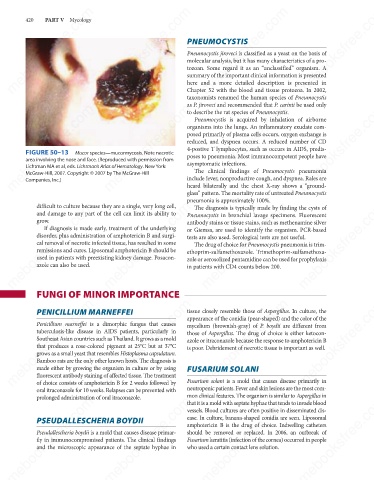
                 FIGURE 50–13
                                 Mucor species—mucormycosis. Note necrotic
                                                                     poses to pneumonia. Most immunocompetent people have
                 area involving the nose and face. (Reproduced with permission from
                                                                     asymptomatic infections.
                 Lichtman MA et al, eds. Lichtman’s Atlas of Hematology. New York:
                                                                        The clinical findings of  Pneumocystis pneumonia
                 McGraw-Hill, 2007. Copyright © 2007 by The McGraw-Hill
                                                                     include fever, nonproductive cough, and dyspnea. Rales are
                 Companies, Inc.)
                                                                     heard bilaterally and the chest X-ray shows a “ground-
                                                                     glass” pattern. The mortality rate of untreated Pneumocystis
                                                                     pneumonia is approximately 100%.
                                                                            mebooksfree.com
 mebooksfree.com  mebooksfree.com           mebooksfree.com          or Giemsa, are used to identify the organism. PCR-based               mebooksfree.com
                                                                                                            mebooksfree.com
                    difficult to culture because they are a single, very long cell,
                                                                        The diagnosis is typically made by finding the cysts of
                    and damage to any part of the cell can limit its ability to
                                                                     Pneumocystis in bronchial lavage specimens. Fluorescent
                    grow.
                                                                     antibody stains or tissue stains, such as methenamine silver
                       If diagnosis is made early, treatment of the underlying
                    disorder, plus administration of amphotericin B and surgi-
                                                                     tests are also used. Serological tests are not useful.
                    cal removal of necrotic infected tissue, has resulted in some
                                                                        The drug of choice for Pneumocystis pneumonia is trim-
                    remissions and cures. Liposomal amphotericin B should be
                                                                     ethoprim-sulfamethoxazole. Trimethoprim-sulfamethoxa-
                    used in patients with preexisting kidney damage. Posacon-
                                                                     zole or aerosolized pentamidine can be used for prophylaxis
                    azole can also be used.
                                                                     in patients with CD4 counts below 200.
                    FUNGI OF MINOR IMPORTANCE                        tissue closely resemble those of Aspergillus. In culture, the
 mebooksfree.com  mebooksfree.com           mebooksfree.com          mycelium (brownish-gray) of  P. boydii are different from             mebooksfree.com
                                                                            mebooksfree.com
                                                                                                            mebooksfree.com
                    PENICILLIUM MARNEFFEI
                                                                     appearance of the conidia (pear-shaped) and the color of the
                    Penicillium marneffei is a dimorphic fungus that causes
                    tuberculosis-like disease in AIDS patients, particularly in
                                                                     those of Aspergillus. The drug of choice is either ketocon-
                    Southeast Asian countries such as Thailand. It grows as a mold
                                                                     azole or itraconazole because the response to amphotericin B
                    that produces a rose-colored pigment at 25°C but at 37°C
                                                                     is poor. Debridement of necrotic tissue is important as well.
                    grows as a small yeast that resembles Histoplasma capsulatum.
                    Bamboo rats are the only other known hosts. The diagnosis is
                    made either by growing the organism in culture or by using
                    fluorescent antibody staining of affected tissue. The treatment
                                                                     Fusarium solani is a mold that causes disease primarily in
                    of choice consists of amphotericin B for 2 weeks followed by
                                                                     neutropenic patients. Fever and skin lesions are the most com-
                    oral itraconazole for 10 weeks. Relapses can be prevented with   FUSARIUM SOLANI
                                                                     mon clinical features. The organism is similar to Aspergillus in
                    prolonged administration of oral itraconazole.
 mebooksfree.com  mebooksfree.com           mebooksfree.com          ease. In culture, banana-shaped conidia are seen. Liposomal           mebooksfree.com
                                                                                                            mebooksfree.com
                                                                            mebooksfree.com
                                                                     that it is a mold with septate hyphae that tends to invade blood
                                                                     vessels. Blood cultures are often positive in disseminated dis-
                    PSEUDALLESCHERIA BOYDII
                                                                     amphotericin B is the drug of choice. Indwelling catheters
                    Pseudallescheria boydii is a mold that causes disease primar-
                                                                     should  be removed  or  replaced.  In  2006, an  outbreak  of
                    ily in immunocompromised patients. The clinical findings
                                                                     Fusarium keratitis (infection of the cornea) occurred in people
                                                                     who used a certain contact lens solution.
                    and  the microscopic appearance of  the  septate hyphae in
 mebooksfree.com  mebooksfree.com           mebooksfree.com                 mebooksfree.com                 mebooksfree.com                mebooksfree.com

