


Page 429 - Review of Medical Microbiology and Immunology ( PDFDrive )
P. 429
mebooksfree.com
                                                                            mebooksfree.com
 mebooksfree.com

                                            mebooksfree.com
                                                                            mebooksfree.com
                                                                                                            mebooksfree.com
                                                                                                                                           mebooksfree.com
            mebooksfree.com
 mebooksfree.com  mebooksfree.com           mebooksfree.com          Liposomal amphotericin B should be used in patients with              mebooksfree.com
                       PART V  Mycology
                 418
                    This phenomenon is called immune reconstitution inflam-
                    matory syndrome (IRIS). The explanation of the exacerba-
                                                                     preexisting kidney damage. There are no specific means of
                    tion of symptoms is that HAART increases the number of
                                                                     prevention. Fluconazole is used in AIDS patients for long-
                    CD4 cells, which increases the inflammatory response.
                                                                     term suppression of cryptococcal meningitis. Cryptococcus
                                                                     gattii is less responsive to antifungal drugs than is  C.
                    Some patients have died as a result of cryptococcal IRIS. To
                    prevent IRIS, patients should be treated for the underlying
                    infection before starting HAART.
                       Cryptococcus gattii causes human disease less frequently
                                                                     ASPERGILLUS
                    but is more capable of causing disease in an immunocom-  neoformans.
                                                                            mebooksfree.com
 mebooksfree.com  mebooksfree.com           mebooksfree.com          infections of the skin, eyes, ears, and other organs; “fungus         mebooksfree.com
                    petent person than  C.  neoformans.  Cryptococcus  gattii is
                                                                                                            mebooksfree.com
                                                                     Disease
                    more likely to cause cryptococcomas (granulomas), espe-
                                                                     Aspergillus species, especially Aspergillus fumigatus, cause
                    cially in the brain, than C. neoformans.
                                                                     ball” in the lungs; and allergic bronchopulmonary
                    Laboratory Diagnosis
                                                                     aspergillosis.
                    In spinal fluid mixed with India ink, the yeast cell is seen
                    microscopically surrounded by a wide, unstained capsule.
                                                                     Properties
                    Appearance of the organism in Gram stain is unreliable,
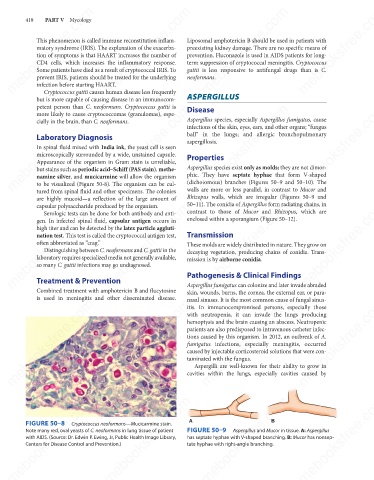
                                                                     Aspergillus species exist only as molds; they are not dimor-
                    but stains such as periodic acid–Schiff (PAS stain), methe-
                    namine silver, and mucicarmine will allow the organism
                                                                     (dichotomous) branches (Figures 50–9 and 50–10). The
                    to be visualized (Figure 50-8). The organism can be cul-
                                                                     walls are more or less parallel, in contrast to Mucor and
                    tured from spinal fluid and other specimens. The colonies
                                                                     Rhizopus walls, which are irregular (Figures 50–9 and
                    are  highly  mucoid—a  reflection  of  the  large  amount  of   phic.  They  have  septate hyphae  that form V-shaped
                                                                     50–11). The conidia of Aspergillus form radiating chains, in
 mebooksfree.com  mebooksfree.com           mebooksfree.com          Transmission                           mebooksfree.com                mebooksfree.com
                                                                            mebooksfree.com
                    capsular polysaccharide produced by the organism.
                                                                     contrast to those of  Mucor and  Rhizopus, which are
                       Serologic tests can be done for both antibody and anti-
                                                                     enclosed within a sporangium (Figure 50–12).
                    gen. In infected spinal fluid,  capsular antigen occurs in
                    high titer and can be detected by the latex particle aggluti-
                    nation test. This test is called the cryptococcal antigen test,
                    often abbreviated as “crag.”
                                                                     These molds are widely distributed in nature. They grow on
                       Distinguishing between C. neoformans and C. gattii in the
                                                                     decaying vegetation, producing chains of conidia. Trans-
                    laboratory requires specialized media not generally available,
                                                                     mission is by airborne conidia.
                    so many C. gattii infections may go undiagnosed.
                    Treatment & Prevention
                                                                     Aspergillus fumigatus can colonize and later invade abraded
                    Combined treatment with amphotericin B and flucytosine
                                                                     skin, wounds, burns, the cornea, the external ear, or para-
                    is  used in  meningitis and other disseminated  disease.   Pathogenesis & Clinical Findings
                                                                     nasal sinuses. It is the most common cause of fungal sinus-
                                                                                                            mebooksfree.com
                                                                            mebooksfree.com
 mebooksfree.com  mebooksfree.com           mebooksfree.com          hemoptysis and the brain causing an abscess. Neutropenic              mebooksfree.com
                                                                     itis.  In  immunocompromised  persons,  especially  those
                                                                     with neutropenia, it can invade the lungs producing
                                                                     patients are also predisposed to intravenous catheter infec-
                                                                     tions caused by this organism. In 2012, an outbreak of A.
                                                                     fumigatus infections, especially meningitis, occurred
                                                                     caused by injectable corticosteroid solutions that were con-
                                                                     taminated with the fungus.
                                                                        Aspergilli are well-known for their ability to grow in
                                                                     cavities  within  the  lungs,  especially cavities  caused by
                                                                            mebooksfree.com
                                                                                                            mebooksfree.com
 mebooksfree.com  mebooksfree.com           mebooksfree.com          FIGURE 50–9    Aspergillus and Mucor in tissue. A: Aspergillus        mebooksfree.com
                                                                                                 B
                                                                      A
                 FIGURE 50–8
                                Cryptococcus neoformans—Mucicarmine stain.
                 Note many red, oval yeasts of C. neoformans in lung tissue of patient
                                                                     has septate hyphae with V-shaped branching. B: Mucor has nonsep-
                 with AIDS. (Source: Dr. Edwin P. Ewing, Jr, Public Health Image Library,
                                                                     tate hyphae with right-angle branching.
                 Centers for Disease Control and Prevention.)


 mebooksfree.com  mebooksfree.com           mebooksfree.com                 mebooksfree.com                 mebooksfree.com                mebooksfree.com

