Page 430 - Review of Medical Microbiology and Immunology ( PDFDrive )
P. 430
mebooksfree.com


                                                                            mebooksfree.com
                                                                                                            mebooksfree.com
            mebooksfree.com
 mebooksfree.com  mebooksfree.com           mebooksfree.com                 mebooksfree.com                 mebooksfree.com                mebooksfree.com
                                            mebooksfree.com
                                                                                                                                           mebooksfree.com
                                                                                       CHAPTER 50  Opportunistic Mycoses
                                                                                                                        419


                                                                                                   B
                                                                             A
                                                                         FIGURE 50–12
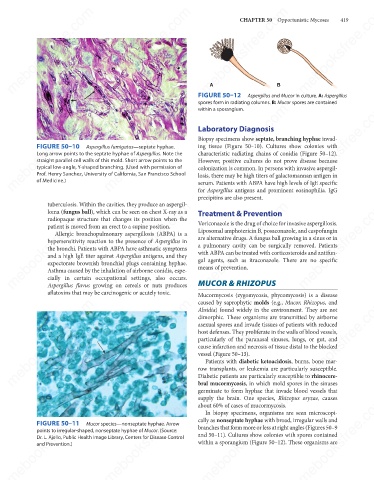
                                                                                         Aspergillus and Mucor in culture. A: Aspergillus
                                                                         spores form in radiating columns. B: Mucor spores are contained
                                            mebooksfree.com
 mebooksfree.com  mebooksfree.com   Aspergillus fumigatus—septate hyphae.   Laboratory Diagnosis            mebooksfree.com                mebooksfree.com
                                                                            mebooksfree.com
                                                                         within a sporangium.

                                                                         Biopsy specimens show septate, branching hyphae invad-
                    FIGURE 50–10
                                                                         ing tissue (Figure 50–10). Cultures show colonies with
                                                                         characteristic radiating chains of conidia (Figure 50–12).
                    Long arrow points to the septate hyphae of Aspergillus. Note the
                    straight parallel cell walls of this mold. Short arrow points to the
                                                                         However,  positive  cultures  do  not  prove  disease  because
                    typical low-angle, Y-shaped branching. (Used with permission of
                                                                         colonization is common. In persons with invasive aspergil-
                    Prof. Henry Sanchez, University of California, San Francisco School
                                                                         losis, there may be high titers of galactomannan antigen in
                    of Medicine.)
                                                                         serum. Patients with ABPA have high levels of IgE specific
                                                                         for  Aspergillus antigens and prominent eosinophilia. IgG
                                                                         precipitins are also present.
                                                                                                            mebooksfree.com
                                                                            mebooksfree.com
 mebooksfree.com  mebooksfree.com           mebooksfree.com              Voriconazole is the drug of choice for invasive aspergillosis.    mebooksfree.com
                        tuberculosis. Within the cavities, they produce an aspergil-
                        loma (fungus ball), which can be seen on chest X-ray as a
                                                                         Treatment & Prevention
                        radiopaque structure that changes its position when the
                        patient is moved from an erect to a supine position.
                                                                         Liposomal amphotericin B, posaconazole, and caspofungin
                          Allergic bronchopulmonary aspergillosis (ABPA) is a
                                                                         are alternative drugs. A fungus ball growing in a sinus or in
                        hypersensitivity reaction to the presence of Aspergillus in
                                                                         a  pulmonary  cavity  can  be  surgically  removed.  Patients
                        the bronchi. Patients with ABPA have asthmatic symptoms
                                                                         with ABPA can be treated with corticosteroids and antifun-
                        and a high IgE titer against Aspergillus antigens, and they
                                                                         gal agents, such as itraconazole. There are no specific
                        expectorate brownish bronchial plugs containing hyphae.
                                                                         means of prevention.
                        Asthma caused by the inhalation of airborne conidia, espe-
                        cially in certain occupational settings, also occurs.
                        Aspergillus flavus growing on cereals or nuts produces
                        aflatoxins that may be carcinogenic or acutely toxic.  MUCOR & RHIZOPUS
                                                                         Mucormycosis (zygomycosis, phycomycosis) is a disease
                                                                                                            mebooksfree.com
                                                                            mebooksfree.com
 mebooksfree.com  mebooksfree.com           mebooksfree.com              asexual spores and invade tissues of patients with reduced        mebooksfree.com
                                                                         caused by saprophytic molds (e.g., Mucor, Rhizopus, and
                                                                         Absidia) found widely in the environment. They are not
                                                                         dimorphic. These organisms are transmitted by airborne
                                                                         host defenses. They proliferate in the walls of blood vessels,
                                                                         particularly  of  the  paranasal  sinuses,  lungs,  or  gut,  and
                                                                         cause infarction and necrosis of tissue distal to the blocked
                                                                         vessel (Figure 50–13).
                                                                           Patients with diabetic ketoacidosis, burns, bone mar-
                                                                         row transplants, or leukemia are particularly susceptible.
                                                                         Diabetic patients are particularly susceptible to rhinocere-
                                                                         bral mucormycosis, in which mold spores in the sinuses
                                                                         germinate to form hyphae that invade blood vessels that
                                                                         supply the brain. One species,  Rhizopus oryzae, causes
                                                                            mebooksfree.com
                                                                                                            mebooksfree.com
 mebooksfree.com  mebooksfree.com   Mucor species—nonseptate hyphae. Arrow   cally as nonseptate hyphae with broad, irregular walls and    mebooksfree.com
                                            mebooksfree.com
                                                                         about 60% of cases of mucormycosis.
                                                                           In biopsy specimens, organisms are seen microscopi-
                    FIGURE 50–11
                                                                         branches that form more or less at right angles (Figures 50–9
                    points to irregular-shaped, nonseptate hyphae of Mucor. (Source:
                                                                         and 50–11). Cultures show colonies with spores contained
                    Dr. L. Ajello, Public Health Image Library, Centers for Disease Control
                                                                         within a sporangium (Figure 50–12). These organisms are
                    and Prevention.)


 mebooksfree.com  mebooksfree.com           mebooksfree.com                 mebooksfree.com                 mebooksfree.com                mebooksfree.com
   425   426   427   428   429   430   431   432   433   434   435