


Page 438 - Review of Medical Microbiology and Immunology ( PDFDrive )
P. 438
mebooksfree.com


                                                                                                            mebooksfree.com
            mebooksfree.com
                                                                            mebooksfree.com
 mebooksfree.com  mebooksfree.com           mebooksfree.com                 mebooksfree.com                 mebooksfree.com                mebooksfree.com
                                                                                                                                           mebooksfree.com
                                            mebooksfree.com
                                                                                                                        427
                                                                               CHAPTER 51  Intestinal & Urogenital—Protozoa
                                   Amebiasis
                               (Entamoeba histolytica )
                                                               2
                               KEY
                                I
                                D
                                  Diagnostic stage
                                A  Infective stage                             I
                                  Intestinal Disease in Colon
                                B
 mebooksfree.com  mebooksfree.com           mebooksfree.com                 mebooksfree.com                 mebooksfree.com                mebooksfree.com
                                  Extraintestinal Disease


                                                                                 B


                                                                                    A
                                                                                    D
                                                             1

 mebooksfree.com  mebooksfree.com           mebooksfree.com             D   mebooksfree.com                 mebooksfree.com                mebooksfree.com


                                                 I
                                                    D
                                                   Cysts and tophozoites
                                                      passed in feces

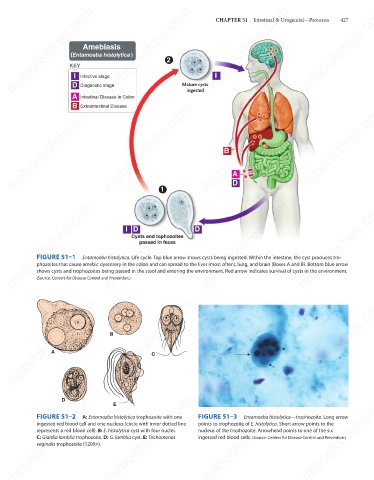
                    FIGURE 51–1
                                   Entamoeba histolytica. Life cycle. Top blue arrow shows cysts being ingested. Within the intestine, the cyst produces tro-
                    phozoites that cause amebic dysentery in the colon and can spread to the liver (most often), lung, and brain (Boxes A and B). Bottom blue arrow
                    shows cysts and trophozoites being passed in the stool and entering the environment. Red arrow indicates survival of cysts in the environment.
                    (Source: Centers for Disease Control and Prevention.)


 mebooksfree.com  mebooksfree.com           mebooksfree.com                 mebooksfree.com                 mebooksfree.com                mebooksfree.com


                                            B


                         A
                                                          C


 mebooksfree.com  mebooksfree.com           mebooksfree.com              FIGURE 51–3    Entamoeba histolytica—trophozoite. Long arrow      mebooksfree.com
                                                                                                            mebooksfree.com
                                                                            mebooksfree.com
                            D
                                             E
                    FIGURE 51–2
                                   A: Entamoeba histolytica trophozoite with one
                                                                         points to trophozoite of E. histolytica. Short arrow points to the
                    ingested red blood cell and one nucleus (circle with inner dotted line
                                                                         nucleus of the trophozoite. Arrowhead points to one of the six
                    represents a red blood cell). B: E. histolytica cyst with four nuclei.
                    C: Giardia lamblia trophozoite. D: G. lamblia cyst. E: Trichomonas
                                                                         ingested red blood cells. (Source: Centers for Disease Control and Prevention.)
                    vaginalis trophozoite (1200×).


 mebooksfree.com  mebooksfree.com           mebooksfree.com                 mebooksfree.com                 mebooksfree.com                mebooksfree.com

