


Page 434 - Review of Medical Microbiology and Immunology ( PDFDrive )
P. 434
mebooksfree.com


                                                                                                                                           mebooksfree.com
                                                                                                            mebooksfree.com
            mebooksfree.com
                                            mebooksfree.com
 mebooksfree.com  mebooksfree.com           mebooksfree.com                 mebooksfree.com                 mebooksfree.com                mebooksfree.com
                                                                            mebooksfree.com


                      PART VI  PARASITOLOGY


                                                                                                            mebooksfree.com
                                                                            mebooksfree.com
 mebooksfree.com  mebooksfree.com           mebooksfree.com              egg to larva to adult. The egg contains an embryo that,           mebooksfree.com


                                                                           Many helminths have a life cycle that progresses from
                        Parasites occur in two distinct forms: single-celled proto-
                        zoa and multicellular metazoa called helminths or worms.
                        For  medical  purposes,  protozoa  can  be  subdivided  into
                                                                         matures into the adult form that produces the eggs.
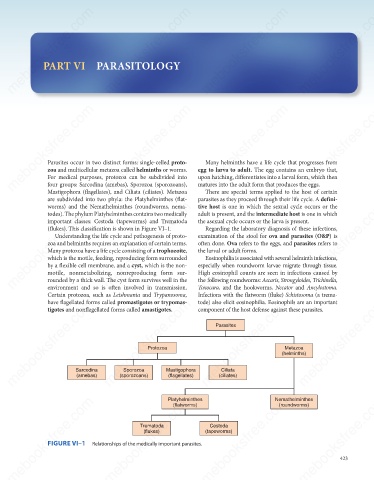
                        four groups: Sarcodina (amebas), Sporozoa (sporozoans),
                        Mastigophora (flagellates), and Ciliata (ciliates). Metazoa
                                                                           There are special terms applied to the host of certain
                                                                         parasites as they proceed through their life cycle. A defini-
                        are subdivided into two phyla: the Platyhelminthes (flat-  upon hatching, differentiates into a larval form, which then
                                                                                                            mebooksfree.com
 mebooksfree.com  mebooksfree.com           mebooksfree.com              examination of the stool for ova and parasites (O&P) is           mebooksfree.com
                                                                            mebooksfree.com
                                                                         tive  host is one in which the sexual cycle occurs or the
                        worms) and the Nemathelminthes (roundworms, nema-
                        todes). The phylum Platyhelminthes contains two medically
                                                                         adult is present, and the intermediate host is one in which
                        important classes: Cestoda (tapeworms) and Trematoda
                                                                         the asexual cycle occurs or the larva is present.
                        (flukes). This classification is shown in Figure VI–1.
                                                                           Regarding the laboratory diagnosis of these infections,
                          Understanding the life cycle and pathogenesis of proto-
                        zoa and helminths requires an explanation of certain terms.
                                                                         often done. Ova refers to the eggs, and parasites refers to
                                                                         the larval or adult forms.
                        Many protozoa have a life cycle consisting of a trophozoite,
                        which is the motile, feeding, reproducing form surrounded
                                                                           Eosinophilia is associated with several helminth infections,
                                                                         especially when roundworm larvae migrate through tissue.
                        by a flexible cell membrane, and a cyst, which is the non-
                        motile, nonmetabolizing, nonreproducing form sur-
                        rounded by a thick wall. The cyst form survives well in the
                                                                         the following roundworms: Ascaris, Strongyloides, Trichinella,
                                                                         Toxocara, and the hookworms,  Necator and  Ancylostoma.
                        environment and so is often involved in transmission.
                                                                         Infections with the flatworm (fluke) Schistosoma (a trema-
                        Certain protozoa, such as  Leishmania and  Trypanosoma,   High eosinophil counts are seen in infections caused by
 mebooksfree.com  mebooksfree.com           mebooksfree.com                 mebooksfree.com         (helminths) mebooksfree.com            mebooksfree.com
                        have flagellated forms called promastigotes or trypomas-
                                                                         tode) also elicit eosinophilia. Eosinophils are an important
                                                                         component of the host defense against these parasites.
                        tigotes and nonflagellated forms called amastigotes.
                                                                               Parasites
                                                                                                          o
                                                                                                           a
                                                                                                         z
                                                                                                     M
                                                                                                        a t e
                                                             o
                                                              a
                                                           o t o r P
                                                            z
                                 Sarcodina
                                                 Sporozoa
                                                                                 Ciliata
                                                               Mastigophora
                                                                                (ciliates)
                                 (amebas)
                                               (sporozoans)
                                                               (flagellates)
                                            mebooksfree.com
 mebooksfree.com  mebooksfree.com     Relationships of the medically important parasites.  (tapeworms)  Nemathelminthes  423               mebooksfree.com
                                                                                                            mebooksfree.com
                                                                            mebooksfree.com
                                                               Platyhelminthes
                                                                 (flatworms)
                                                                                                   (roundworms)
                                                                             Cestoda
                                                      Trematoda
                                                       (flukes)
                        FIGURE VI–1
 mebooksfree.com  mebooksfree.com           mebooksfree.com                 mebooksfree.com                 mebooksfree.com                mebooksfree.com

