


Page 436 - Review of Medical Microbiology and Immunology ( PDFDrive )
P. 436
mebooksfree.com
mebooksfree.com
mebooksfree.com
mebooksfree.com
mebooksfree.com
mebooksfree.com
mebooksfree.com mebooksfree.com Species mebooksfree.com most frequently in tropical countries, especially in areas 425 mebooksfree.com
mebooksfree.com
mebooksfree.com
CHAPTER 51 Intestinal & Urogenital—Protozoa
Infection by E. histolytica is found worldwide but occurs
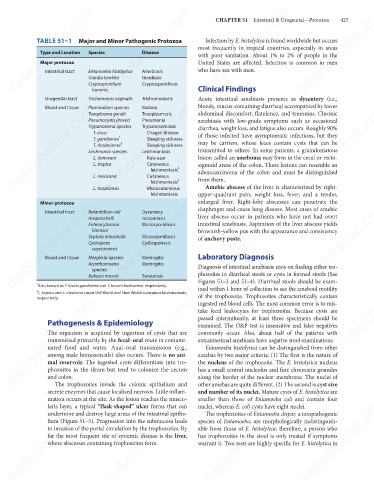
TABLE 51–1 Major and Minor Pathogenic Protozoa
Type and Location
Disease
with poor sanitation. About 1% to 2% of people in the
United States are affected. Infection is common in men
Major protozoa
who have sex with men.
Entamoeba histolytica
Intestinal tract
Amebiasis
Cryptosporidiosis
Cryptosporidium
hominis
Acute intestinal amebiasis presents as dysentery (i.e.,
Trichomoniasis
Urogenital tract Giardia lamblia Giardiasis Clinical Findings
Trichomonas vaginalis
bloody, mucus-containing diarrhea) accompanied by lower
mebooksfree.com
mebooksfree.com mebooksfree.com Trypanosoma species Trypanosomiasis 2 diarrhea, weight loss, and fatigue also occurs. Roughly 90% mebooksfree.com
mebooksfree.com
mebooksfree.com
Blood and tissue
Plasmodium species
Malaria
abdominal discomfort, flatulence, and tenesmus. Chronic
Toxoplasmosis
Toxoplasma gondii
amebiasis with low-grade symptoms such as occasional
Pneumocystis jiroveci
Pneumonia
Chagas’ disease
T. cruzi
of those infected have asymptomatic infections, but they
1
Sleeping sickness
T. gambiense
may be carriers, whose feces contain cysts that can be
1
Sleeping sickness
T. rhodesiense
transmitted to others. In some patients, a granulomatous
Leishmaniasis
Leishmania species
lesion called an ameboma may form in the cecal or recto-
L. donovani
Kala-azar
sigmoid areas of the colon. These lesions can resemble an
Cutaneous
L. tropica
leishmaniasis
Cutaneous
L. mexicana
from them.
leishmaniasis
Amebic abscess of the liver is characterized by right-
L. braziliensis
Mucocutaneous
upper-quadrant pain, weight loss, fever, and a tender,
leishmaniasis 2 adenocarcinoma of the colon and must be distinguished
enlarged liver. Right-lobe abscesses can penetrate the
mebooksfree.com mebooksfree.com Enterocytozoon Microsporidiosis intestinal amebiasis. Aspiration of the liver abscess yields mebooksfree.com
mebooksfree.com
mebooksfree.com
Minor protozoa
mebooksfree.com
diaphragm and cause lung disease. Most cases of amebic
Balantidium coli
Intestinal tract
Dysentery
liver abscess occur in patients who have not had overt
Isosporiasis
Isospora belli
brownish-yellow pus with the appearance and consistency
bieneusi
Microsporidiosis
Septata intestinalis
of anchovy paste.
Cyclosporiasis
Cyclospora
cayetanensis
Laboratory Diagnosis
Blood and tissue
Meningitis
Naegleria species
Acanthamoeba
Meningitis
Diagnosis of intestinal amebiasis rests on finding either tro-
species
Babesia microti
Babesiosis
Figures 51–3 and 51–4). Diarrheal stools should be exam-
ined within 1 hour of collection to see the ameboid motility
2 1 Also known as T. brucei gambiense and T. brucei rhodesiense, respectively. phozoites in diarrheal stools or cysts in formed stools (See
L. tropica and L. mexicana cause Old World and New World cutaneous leishmaniasis, of the trophozoite. Trophozoites characteristically contain
respectively.
mebooksfree.com
mebooksfree.com
mebooksfree.com mebooksfree.com mebooksfree.com examined. The O&P test is insensitive and false negatives mebooksfree.com
ingested red blood cells. The most common error is to mis-
take fecal leukocytes for trophozoites. Because cysts are
passed intermittently, at least three specimens should be
Pathogenesis & Epidemiology
commonly occur. Also, about half of the patients with
The organism is acquired by ingestion of cysts that are
extraintestinal amebiasis have negative stool examinations.
transmitted primarily by the fecal–oral route in contami-
Entamoeba histolytica can be distinguished from other
nated food and water. Anal–oral transmission (e.g.,
among male homosexuals) also occurs. There is no ani-
amebas by two major criteria: (1) The first is the nature of
mal reservoir. The ingested cysts differentiate into tro-
the nucleus of the trophozoite. The E. histolytica nucleus
phozoites in the ileum but tend to colonize the cecum
along the border of the nuclear membrane. The nuclei of
and colon.
The trophozoites invade the colonic epithelium and
other amebas are quite different. (2) The second is cyst size
and number of its nuclei. Mature cysts of E. histolytica are
secrete enzymes that cause localized necrosis. Little inflam- has a small central nucleolus and fine chromatin granules
mation occurs at the site. As the lesion reaches the muscu-
mebooksfree.com
smaller than those of Entamoeba coli and contain four
mebooksfree.com
mebooksfree.com mebooksfree.com mebooksfree.com species of Entamoeba, are morphologically indistinguish- mebooksfree.com
laris layer, a typical “flask-shaped” ulcer forms that can
nuclei, whereas E. coli cysts have eight nuclei.
undermine and destroy large areas of the intestinal epithe-
The trophozoites of Entamoeba dispar, a nonpathogenic
lium (Figure 51–5). Progression into the submucosa leads
to invasion of the portal circulation by the trophozoites. By
able from those of E. histolytica; therefore, a person who
far the most frequent site of systemic disease is the liver,
has trophozoites in the stool is only treated if symptoms
where abscesses containing trophozoites form.
warrant it. Two tests are highly specific for E. histolytica in
mebooksfree.com mebooksfree.com mebooksfree.com mebooksfree.com mebooksfree.com mebooksfree.com

