


Page 441 - Review of Medical Microbiology and Immunology ( PDFDrive )
P. 441
mebooksfree.com
                                                                            mebooksfree.com
 mebooksfree.com

 mebooksfree.com  mebooksfree.com           mebooksfree.com          animal sources, for example, cattle (occasionally). The               mebooksfree.com
            mebooksfree.com
                                                                            mebooksfree.com
                                            mebooksfree.com
                                                                                                                                           mebooksfree.com
                                                                                                            mebooksfree.com
                       PART VI  Parasitology
                 430
                    with acquired immunodeficiency syndrome [AIDS]).
                    Cryptosporidium parvum is the former name that is no
                                                                     oocysts excyst in the small intestine, where the trophozo-
                                                                     ites (and other forms) attach to the gut wall. Invasion does
                    longer used.
                                                                     not occur. The jejunum is the site most heavily infested.
                                                                     The pathogenesis of the diarrhea is uncertain; no toxin has
                    Important Properties
                                                                     been identified.
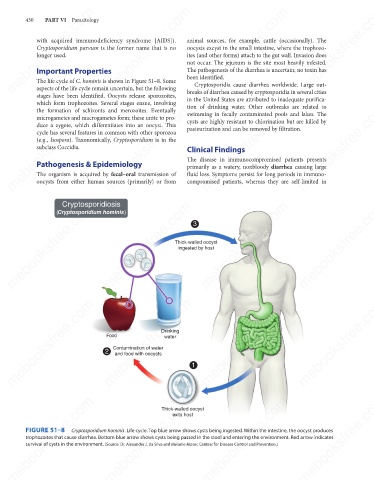
                    The life cycle of C. hominis is shown in Figure 51–8. Some
                                                                        Cryptosporidia  cause  diarrhea  worldwide.  Large  out-
                    aspects of the life cycle remain uncertain, but the following
                    stages have been identified. Oocysts release sporozoites,
                                                                     in the United States are attributed to inadequate purifica-
                    which form trophozoites. Several stages ensue, involving   breaks of diarrhea caused by cryptosporidia in several cities
                                                                     tion of drinking water. Other outbreaks are related to
 mebooksfree.com  mebooksfree.com           mebooksfree.com          pasteurization and can be removed by filtration. mebooksfree.com      mebooksfree.com
                                                                            mebooksfree.com
                    the formation of schizonts and merozoites. Eventually
                                                                     swimming in fecally contaminated pools and lakes. The
                    microgametes and macrogametes form; these unite to pro-
                                                                     cysts are highly resistant to chlorination but are killed by
                    duce a zygote, which differentiates into an oocyst. This
                    cycle has several features in common with other sporozoa
                    (e.g.,  Isospora). Taxonomically,  Cryptosporidium is  in the
                    subclass Coccidia.
                                                                     Clinical Findings
                                                                     The disease in immunocompromised patients presents
                    Pathogenesis & Epidemiology
                                                                     primarily as a watery, nonbloody  diarrhea causing large
                    The organism is acquired by  fecal–oral transmission of
                                                                     fluid loss. Symptoms persist for long periods in immuno-
                                                                     compromised patients, whereas they are self-limited in
                    oocysts from either human sources (primarily) or from
 mebooksfree.com  mebooksfree.com           mebooksfree.com            3    mebooksfree.com                 mebooksfree.com                mebooksfree.com
                             Cryptosporidiosis
                           (Cryptosporidium hominis)

                                                                 Thick-walled oocyst
                                                                   ingested by host


 mebooksfree.com  mebooksfree.com          2 Food and food with oocysts Drinking  1 mebooksfree.com         mebooksfree.com                mebooksfree.com
                                            mebooksfree.com


                                                              water

                                             Contamination of water


 mebooksfree.com  mebooksfree.com           mebooksfree.com                 mebooksfree.com                 mebooksfree.com                mebooksfree.com
                                                             Thick-walled oocyst
                                                                 exits host

                 FIGURE 51–8
                                Cryptosporidium hominis. Life cycle. Top blue arrow shows cysts being ingested. Within the intestine, the oocyst produces
                 trophozoites that cause diarrhea. Bottom blue arrow shows cysts being passed in the stool and entering the environment. Red arrow indicates
                 survival of cysts in the environment. (Source: Dr. Alexander J. da Silva and Melanie Moser, Centers for Disease Control and Prevention.)


 mebooksfree.com  mebooksfree.com           mebooksfree.com                 mebooksfree.com                 mebooksfree.com                mebooksfree.com

