Page 534 - Review of Medical Microbiology and Immunology ( PDFDrive )
P. 534
mebooksfree.com
 mebooksfree.com


            mebooksfree.com
                                            mebooksfree.com
                                                                                                            mebooksfree.com
 mebooksfree.com  mebooksfree.com           mebooksfree.com           1 1 mebooksfree.com            lgD    mebooksfree.com                mebooksfree.com
                                                                                                                                           mebooksfree.com
                                                                                                                        523
                                                                                                CHAPTER 59  Antibodies
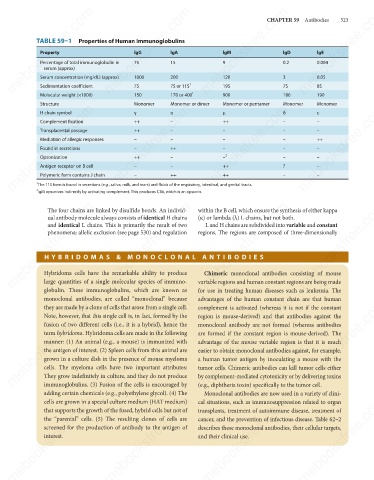
                    TABLE 59–1  Properties of Human Immunoglobulins
                                                                                 lgM
                     Property
                                                                lgA
                                                                                                                lgE
                                                    lgG
                                                                15
                                                                                                                0.004
                     Percentage of total immunoglobulin in
                                                    75
                                                                                                     0.2
                                                                                 9
                       serum (approx)
                                                                                                     3
                                                                                 120
                                                                200
                     Serum concentration (mg/dL) (approx)
                                                    1000
                                                                                                                0.05
                                                                                                     7S
                                                                                 19S
                                                    7S
                                                                7S or 11S
                     Sedimentation coefficient
                                                                                                                8S
                                                                                 900
                                                                170 or 400
                                                    150
                                                                                                     180
                                                                                                                190
                     Molecular weight (×1000)
                                                                Monomer or dimer
                     Structure
                                                                                                                Monomer
                                                    Monomer
 mebooksfree.com  mebooksfree.com           mebooksfree.com                      Monomer or pentamer  Monomer mebooksfree.com              mebooksfree.com
                     IgM opsonizes indirectly by activating complement. This produces C3b, which is an opsonin. mebooksfree.com
                     H chain symbol
                                                    γ
                                                                                                                ε
                                                                                                     δ
                                                                                 μ
                                                                α
                                                                                                                –
                                                                                 ++
                                                    ++
                     Complement fixation
                                                                –
                                                                                                     –
                                                                –
                                                                                                     –
                                                                                                                –
                                                                                 –
                                                    ++
                     Transplacental passage
                                                    –
                     Mediation of allergic responses
                                                                –
                                                                                                                ++
                                                                                                     –
                                                                                 –
                                                                                                     –
                                                                                                                –
                                                                ++
                                                    –
                                                                                 –
                     Found in secretions
                                                                                  2
                                                                –
                     Opsonization
                                                    ++
                                                                                 –
                                                                                                                –
                                                                                                     –
                                                                                                     ?
                                                                                 ++
                                                                                                                –
                                                                –
                                                    –
                     Antigen receptor on B cell
                                                                                                                –
                                                                                 ++
                                                    –
                                                                                                     –
                                                                ++
                     Polymeric form contains J chain
                    1
                     The 11S form is found in secretions (e.g., saliva, milk, and tears) and fluids of the respiratory, intestinal, and genital tracts.
                    2
                                                                                                            mebooksfree.com
                                                                            mebooksfree.com
 mebooksfree.com  mebooksfree.com           mebooksfree.com              within the B cell, which ensure the synthesis of either kappa     mebooksfree.com
                        The four chains are linked by disulfide bonds. An individ-
                                                                         (κ) or lambda (λ) L chains, but not both.
                        ual antibody molecule always consists of identical H chains
                        and identical L chains. This is primarily the result of two
                                                                           L and H chains are subdivided into variable and constant
                        phenomena: allelic exclusion (see page 530) and regulation
                                                                         regions. The regions are composed of three-dimensionally
                       H Y BRIDOM AS   &  MONOCL ONAL  ANTIBODIES
                       Hybridoma cells have the remarkable ability to produce
                                                                           Chimeric monoclonal antibodies consisting of mouse
                       large quantities of a single molecular species of immuno-
                                                                         variable regions and human constant regions are being made
                       globulin.  These  immunoglobulins,  which  are  known  as
                                                                         for  use in  treating human  diseases  such  as leukemia. The
                       monoclonal antibodies, are called “monoclonal” because
                                                                                                            mebooksfree.com
 mebooksfree.com  mebooksfree.com           mebooksfree.com              advantages of the human constant chain are that human             mebooksfree.com
                                                                            mebooksfree.com
                       they are made by a clone of cells that arose from a single cell.
                                                                         complement is activated (whereas it is not if the constant
                                                                         region is mouse-derived) and that antibodies against the
                       Note, however, that this single cell is, in fact, formed by the
                                                                         monoclonal antibody are not formed (whereas antibodies
                       fusion of two different cells (i.e., it is a hybrid), hence the
                                                                         are formed if the constant region is mouse-derived). The
                       term hybridoma. Hybridoma cells are made in the following
                       manner: (1) An animal (e.g., a mouse) is immunized with
                                                                         advantage of the mouse variable region is that it is much
                       the antigen of interest. (2) Spleen cells from this animal are
                                                                         easier to obtain monoclonal antibodies against, for example,
                                                                         a human tumor antigen by inoculating a mouse with the
                       grown in a culture dish in the presence of mouse myeloma
                                                                         tumor cells. Chimeric antibodies can kill tumor cells either
                       cells. The myeloma  cells  have two important attributes:
                       They grow indefinitely in culture, and they do not produce
                       immunoglobulins. (3) Fusion of the cells is encouraged by
                                                                         (e.g., diphtheria toxin) specifically to the tumor cell.
                                                                           Monoclonal antibodies are now used in a variety of clini-
                       adding certain chemicals (e.g., polyethylene glycol). (4) The   by complement-mediated cytotoxicity or by delivering toxins
                                                                                                            mebooksfree.com
 mebooksfree.com  mebooksfree.com           mebooksfree.com              cancer, and the prevention of infectious disease. Table 62–2      mebooksfree.com
                                                                            mebooksfree.com
                                                                         cal situations, such as immunosuppression related to organ
                       cells are grown in a special culture medium (HAT medium)
                                                                         transplants, treatment of autoimmune disease, treatment of
                       that supports the growth of the fused, hybrid cells but not of
                       the  “parental”  cells.  (5)  The  resulting  clones  of  cells  are
                       screened for the production of antibody to the antigen of
                                                                         describes these monoclonal antibodies, their cellular targets,
                                                                         and their clinical use.
                       interest.
 mebooksfree.com  mebooksfree.com           mebooksfree.com                 mebooksfree.com                 mebooksfree.com                mebooksfree.com
   529   530   531   532   533   534   535   536   537   538   539