


Page 539 - Review of Medical Microbiology and Immunology ( PDFDrive )
P. 539
mebooksfree.com


            mebooksfree.com
                                                                            mebooksfree.com
                                            mebooksfree.com
                                                                                                            mebooksfree.com
                                                                                                                                           mebooksfree.com
 mebooksfree.com  mebooksfree.com           mebooksfree.com          ab c x mebooksfree.com           C     mebooksfree.com                mebooksfree.com
                       PART VII  Immunology
                 528
                             Embryonic/germ line
                             Heavy-chain gene
                                                                                              IVS
                                                                                   1 23 456
                                                        V Hn
                                   V H1
                                              V H2
                                                                        D H
                                                                                      J H
                                                                          DNA
                                                                          rearrangement
                                       Rearranged heavy-chain gene DNA  V H2 b2 3 45 6  IVS  C
 mebooksfree.com  mebooksfree.com           mebooksfree.com               Transcription                     mebooksfree.com                mebooksfree.com
                                                                            mebooksfree.com
                                                                           J
                                                                       D
                                                                          RNA splicing

                                                         IgM mRNA
                                                                          C
                                                                   V H DJ

                                                                          Translation


                                                         IgM protein
                                                                   V H DJ C
                                                                                                            mebooksfree.com
                                                                            mebooksfree.com
 mebooksfree.com  mebooksfree.com           mebooksfree.com          chain [κL], lambda light chain [λL], and the five heavy               mebooksfree.com
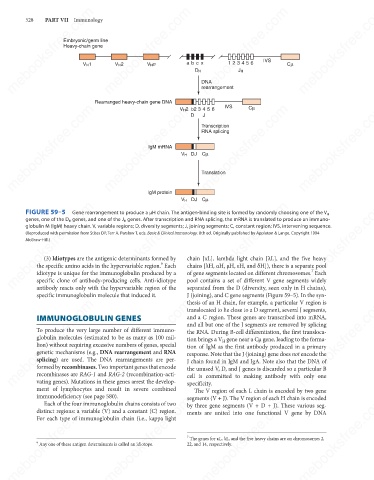
                 FIGURE 59–5
                                Gene rearrangement to produce a μH chain. The antigen-binding site is formed by randomly choosing one of the V H
                 genes, one of the D H  genes, and one of the J H  genes. After transcription and RNA splicing, the mRNA is translated to produce an immuno-
                 globulin M (IgM) heavy chain. V, variable regions; D, diversity segments; J, joining segments; C, constant region; IVS, intervening sequence.
                 (Reproduced with permission from Stites DP, Terr A, Parslow T, eds. Basic & Clinical Immunology. 8th ed. Originally published by Appleton & Lange. Copyright 1994
                 McGraw-Hill.)

                       (3) Idiotypes are the antigenic determinants formed by
                                                             6
                                                                     chains [λH, αH, μH, εH, and δH]), there is a separate pool
                    the specific amino acids in the hypervariable region.  Each
                                                                                                              7
                    idiotype is unique for the immunoglobulin produced by a
                    specific clone of antibody-producing cells. Anti-idiotype
                                                                     pool contains a set of different V gene segments widely
                                                                     separated from the D (diversity, seen only in H chains),
                    antibody reacts only with the hypervariable region of the
                                                                     J (joining), and C gene segments (Figure 59–5). In the syn-
                    specific immunoglobulin molecule that induced it.  of gene segments located on different chromosomes.  Each
                                                                            mebooksfree.com
 mebooksfree.com  mebooksfree.com           mebooksfree.com          and all but one of the J segments are removed by splicing             mebooksfree.com
                                                                                                            mebooksfree.com
                                                                     thesis of an H chain, for example, a particular V region is
                                                                     translocated to lie close to a D segment, several J segments,
                    IMMUNOGLOBULIN GENES
                                                                     and a C region. These genes are transcribed into mRNA,
                    To produce the very large number of different immuno-
                                                                     the RNA. During B-cell differentiation, the first transloca-
                    globulin molecules (estimated to be as many as 100 mil-
                                                                     tion brings a V  gene near a Cμ gene, leading to the forma-
                                                                                 H
                    lion) without requiring excessive numbers of genes, special
                                                                     tion of IgM as the first antibody produced in a primary
                    genetic mechanisms (e.g., DNA rearrangement and RNA
                                                                     response. Note that the J (joining) gene does not encode the
                    splicing) are used. The DNA rearrangements are per-
                                                                     J chain found in IgM and IgA. Note also that the DNA of
                    formed by recombinases. Two important genes that encode
                    recombinases are RAG-1 and RAG-2 (recombination-acti-
                                                                     cell is committed to making antibody with only one
                    vating genes). Mutations in these genes arrest the develop-
                                                                     specificity.
                    ment of lymphocytes and result in severe combined   the unused V, D, and J genes is discarded so a particular B
                                                                        The V region of each L chain is encoded by two gene
                    immunodeficiency (see page 580).
                                                                     segments (V + J). The V region of each H chain is encoded
 mebooksfree.com  mebooksfree.com           mebooksfree.com          7 22, and 14, respectively.            mebooksfree.com                mebooksfree.com
                                                                            mebooksfree.com
                       Each of the four immunoglobulin chains consists of two
                                                                     by three gene segments (V + D + J). These various seg-
                    distinct regions: a variable (V) and a constant (C) region.
                                                                     ments are united into one functional V gene by DNA
                    For each type of immunoglobulin chain (i.e., kappa light
                                                                       The genes for κL, λL, and the five heavy chains are on chromosomes 2,
                    6
                      Any one of these antigen determinants is called an idiotope.
 mebooksfree.com  mebooksfree.com           mebooksfree.com                 mebooksfree.com                 mebooksfree.com                mebooksfree.com

