


Page 557 - Review of Medical Microbiology and Immunology ( PDFDrive )
P. 557
mebooksfree.com


                                                                                                                                           mebooksfree.com
                                                                                                            mebooksfree.com
                                                                            mebooksfree.com
            mebooksfree.com
                                            mebooksfree.com
 mebooksfree.com  mebooksfree.com           mebooksfree.com                 mebooksfree.com         H   A  P mebooksfree.com               mebooksfree.com
                                                                                                64
                                                                                                 C
                                                                                                                     R
                                                                                                               T
                                                                                                                  E
                 Antigen–Antibody Reactions


                 in the Laboratory


 mebooksfree.com  mebooksfree.com           mebooksfree.com              Hemagglutination Tests             mebooksfree.com                mebooksfree.com
                                                                            mebooksfree.com


                   CHAPTER  C ONTENT S


                   Introduction
                                                                         Antiglobulin (Coombs) Test
                   Types Of Diagnostic Tests
                                                                         Western Blot (Immunoblot)
                       Agglutination
                       Precipitation (Precipitin)
                                                                         Fluorescence-Activated Cell Sorting (Flow Cytometry)
                       Radioimmunoassay (RIA)
                                                                     Antigens
                       Enzyme-Linked Immunosorbent Assay (ELISA)
                                                                         The ABO Blood Groups & Transfusion Reactions
                       Immunofluorescence (Fluorescent Antibody)     Antigen–Antibody Reactions Involving Red Blood Cell
                                                                         Rh Blood Type & Hemolytic Disease of the Newborn
                       Complement Fixation
 mebooksfree.com  mebooksfree.com           mebooksfree.com           titer) than a serum with a titer of, for example, 1/4. mebooksfree.com  mebooksfree.com
                                                                            mebooksfree.com
                                                                     Self-Assessment Questions
                       Neutralization Tests
                                                                     Practice Questions: USMLE & Course Examinations
                       Immune Complexes
                    INTRODUCTION
                                                                        The results of many immunologic tests are expressed as
                                                                      a titer, which is defined as the highest dilution of the speci-
                    Reactions of antigens and antibodies are highly specific. An
                                                                      men (e.g., serum) that gives a positive reaction in the test.
                    antibody will react only with the antigen that induced it or
                    with a closely related antigen. Because of the great specificity,
                                                                      example, 1/64 contains  more antibodies (i.e., is a higher
                    reactions between antigens and antibodies are suitable for
                    identifying one by using the other. This is the basis of serologic   Note that a patient’s serum with an antibody titer of, for
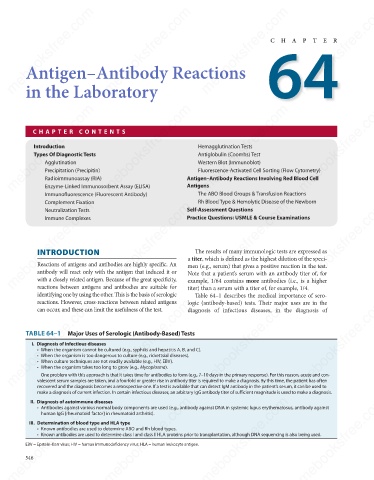
                                                                        Table 64–1 describes the medical importance of sero-
 mebooksfree.com  mebooksfree.com           mebooksfree.com                 mebooksfree.com                 mebooksfree.com                mebooksfree.com
                    reactions. However, cross-reactions between related antigens
                                                                      logic (antibody-based)  tests.  Their  major uses are  in the
                    can occur, and these can limit the usefulness of the test.
                                                                      diagnosis of infectious diseases, in the diagnosis of
                 TABLE 64–1  Major Uses of Serologic (Antibody-Based) Tests
                    I.  Diagnosis of infectious diseases
                    •  When the organism cannot be cultured (e.g., syphilis and hepatitis A, B, and C).
                    •  When the organism is too dangerous to culture (e.g., rickettsial diseases).
                    •  When culture techniques are not readily available (e.g., HIV, EBV).
                    •  When the organism takes too long to grow (e.g., Mycoplasma).
                      One problem with this approach is that it takes time for antibodies to form (e.g., 7–10 days in the primary response). For this reason, acute and con-
                    valescent serum samples are taken, and a fourfold or greater rise in antibody titer is required to make a diagnosis. By this time, the patient has often
                    recovered and the diagnosis becomes a retrospective one. If a test is available that can detect IgM antibody in the patient’s serum, it can be used to
                    make a diagnosis of current infection. In certain infectious diseases, an arbitrary IgG antibody titer of sufficient magnitude is used to make a diagnosis.
 mebooksfree.com  mebooksfree.com           mebooksfree.com                 mebooksfree.com                 mebooksfree.com                mebooksfree.com
                   II.  Diagnosis of autoimmune diseases
                    •   Antibodies against various normal body components are used (e.g., antibody against DNA in systemic lupus erythematosus, antibody against
                      human IgG [rheumatoid factor] in rheumatoid arthritis).
                  III.  Determination of blood type and HLA type
                    •  Known antibodies are used to determine ABO and Rh blood types.
                    •   Known antibodies are used to determine class I and class II HLA proteins prior to transplantation, although DNA sequencing is also being used.
                 EBV = Epstein–Barr virus; HIV = human immunodeficiency virus; HLA = human leukocyte antigen.

                 546


 mebooksfree.com  mebooksfree.com           mebooksfree.com                 mebooksfree.com                 mebooksfree.com                mebooksfree.com

