


Page 559 - Review of Medical Microbiology and Immunology ( PDFDrive )
P. 559
mebooksfree.com
                                                                            mebooksfree.com
 mebooksfree.com

                                            mebooksfree.com
 mebooksfree.com  mebooksfree.com         Antigen  Zone of   equivalence  antibody  Antibody                mebooksfree.com                mebooksfree.com
                                                                                                                                           mebooksfree.com
                                                                                                            mebooksfree.com
                                                                            mebooksfree.com
            mebooksfree.com
                       PART VII  Immunology
                 548
                                                                          Zone of
                                                              Zone of
                                                   antigen
                                                                                    in well
                                                    excess
                                           in well
                                                                          excess


                                                                Agar plate
                                                                            mebooksfree.com
 mebooksfree.com  mebooksfree.com           mebooksfree.com          antigen diffuses with time, precipitation rings form                  mebooksfree.com
                                                                                                            mebooksfree.com
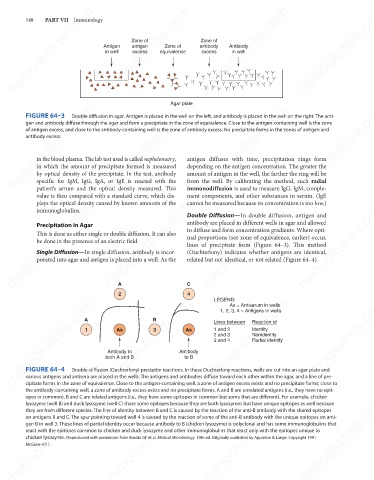
                 FIGURE 64–3
                                Double diffusion in agar. Antigen is placed in the well on the left, and antibody is placed in the well on the right. The anti-
                 gen and antibody diffuse through the agar and form a precipitate in the zone of equivalence. Close to the antigen-containing well is the zone
                 of antigen excess, and close to the antibody-containing well is the zone of antibody excess. No precipitate forms in the zones of antigen and
                 antibody excess.

                    in the blood plasma. The lab test used is called nephelometry,
                                                                     depending on the antigen concentration. The greater the
                    in which the amount of precipitate formed is measured
                    by optical density of the precipitate. In the test, antibody
                                                                     from the well. By calibrating the method, such  radial
                    specific for IgM, IgG, IgA, or IgE is reacted with the
                    patient’s serum and the optical density measured. This
                                                                     immunodiffusion is used to measure IgG, IgM, comple-
                                                                     ment components, and other substances in serum. (IgE
                    value is then compared with a standard curve, which dis-  amount of antigen in the well, the farther the ring will be
                    plays the optical density caused by known amounts of the
                                                                     cannot be measured because its concentration is too low.)
                                                                                                            mebooksfree.com
 mebooksfree.com  mebooksfree.com           mebooksfree.com          antibody are placed in different wells in agar and allowed            mebooksfree.com
                                                                            mebooksfree.com
                    immunoglobulins.
                                                                     Double Diffusion—In double diffusion, antigen and
                    Precipitation in Agar
                                                                     to diffuse and form concentration gradients. Where opti-
                    This is done as either single or double diffusion. It can also
                                                                     mal proportions (see zone of equivalence, earlier) occur,
                    be done in the presence of an electric field.
                                                                     lines of precipitate form (Figure 64–3). This method
                    Single Diffusion—In single diffusion, antibody is incor-
                                                                     (Ouchterlony) indicates whether antigens are identical,
                                                                     related but not identical, or not related (Figure 64–4).
                    porated into agar and antigen is placed into a well. As the
                                               A
                                               2                     C        LEGEND:
                                                                      4
                                            mebooksfree.com
 mebooksfree.com  mebooksfree.com   1      both A and B   B        Antibody mebooksfree.com                 mebooksfree.com                mebooksfree.com
                                                                                   As = Antiserum in wells
                                                                                1, 2, 3, 4 = Antigens in wells
                                    A
                                                                                           Reaction of
                                                                              Lines between
                                                                                           Identity
                                                                              1 and 2
                                                          3
                                              As
                                                                     As
                                                                                           Nonidentity
                                                                              2 and 3
                                                                                           Partial identity
                                                                              3 and 4
                                           Antibody to
                                                                     to B
                 FIGURE 64–4
                                Double-diffusion (Ouchterlony) precipitin reactions. In these Ouchterlony reactions, wells are cut into an agar plate and
                 various antigens and antisera are placed in the wells. The antigens and antibodies diffuse toward each other within the agar, and a line of pre-
                 cipitate forms in the zone of equivalence. Close to the antigen-containing well, a zone of antigen excess exists and no precipitate forms; close to
                 the antibody-containing well, a zone of antibody excess exists and no precipitate forms. A and B are unrelated antigens (i.e., they have no epit-
                 opes in common). B and C are related antigens (i.e., they have some epitopes in common but some that are different). For example, chicken
 mebooksfree.com  mebooksfree.com           mebooksfree.com                 mebooksfree.com                 mebooksfree.com                mebooksfree.com
                 lysozyme (well B) and duck lysozyme (well C) share some epitopes because they are both lysozymes but have unique epitopes as well because
                 they are from different species. The line of identity between B and C is caused by the reaction of the anti-B antibody with the shared epitopes
                 on antigens B and C. The spur pointing toward well 4 is caused by the reaction of some of the anti-B antibody with the unique epitopes on anti-
                 gen B in well 3. These lines of partial identity occur because antibody to B (chicken lysozyme) is polyclonal and has some immunoglobulins that
                 react with the epitopes common to chicken and duck lysozyme and other immunoglobulins that react only with the epitopes unique to
                 chicken lysozyme. (Reproduced with permission from Brooks GF et al. Medical Microbiology. 19th ed. Originally published by Appleton & Lange. Copyright 1991
                 McGraw-Hill.)


 mebooksfree.com  mebooksfree.com           mebooksfree.com                 mebooksfree.com                 mebooksfree.com                mebooksfree.com

