Page 562 - Review of Medical Microbiology and Immunology ( PDFDrive )
P. 562
mebooksfree.com
                                                                            mebooksfree.com
 mebooksfree.com

            mebooksfree.com
                                            mebooksfree.com
                                                                            mebooksfree.com
                                                                                                                                           mebooksfree.com
                                                                                                            mebooksfree.com
 mebooksfree.com  mebooksfree.com           mebooksfree.com          CHAPTER 64  Antigen–Antibody Reactions in the Laboratory  551         mebooksfree.com
                                                                           Negative reaction
                              Positive reaction


                              First stage
                                                                           First stage


                                Ag
                                                        Ag
                                                                                                     Ag
                                     +
                                       Ab
                                                            Ab
                                     Antibody in the  Complement             Ag   + No antibody in   Complement
                                                                                                 is not fixed
                                                     is fixed
                                     patient’s serum
                                                                                   patient’s serum
                                                                            mebooksfree.com
                                            mebooksfree.com
 mebooksfree.com  mebooksfree.com   Ab  + complement  No lysis  Ab         Second stage  +          Lysis  Ab mebooksfree.com              mebooksfree.com
                              Second stage
                                                                                  Ab
                                             No
                                           remaining
                                                                           Sensitized
                             Sensitized
                             red cells
                                                                           red cells
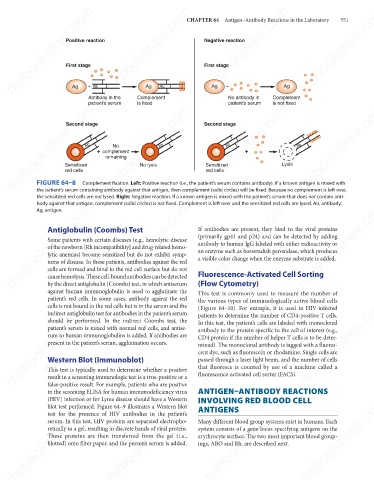
                    FIGURE 64–8
                                   Complement fixation. Left: Positive reaction (i.e., the patient’s serum contains antibody). If a known antigen is mixed with
                    the patient’s serum containing antibody against that antigen, then complement (solid circles) will be fixed. Because no complement is left over,
                    the sensitized red cells are not lysed. Right: Negative reaction. If a known antigen is mixed with the patient’s serum that does not contain anti-
 mebooksfree.com  mebooksfree.com           mebooksfree.com              If  antibodies are present, they bind to the viral proteins       mebooksfree.com
                    body against that antigen, complement (solid circles) is not fixed. Complement is left over and the sensitized red cells are lysed. Ab, antibody;
                                                                            mebooksfree.com
                                                                                                            mebooksfree.com
                    Ag, antigen.
                        Antiglobulin (Coombs) Test
                                                                         (primarily gp41 and p24) and can be detected by adding
                        Some patients with certain diseases (e.g., hemolytic disease
                                                                         antibody to human IgG labeled with either radioactivity or
                        of the newborn [Rh incompatibility] and drug-related hemo-
                                                                         an enzyme such as horseradish peroxidase, which produces
                        lytic anemias) become sensitized but do not exhibit symp-
                                                                         a visible color change when the enzyme substrate is added.
                        toms of disease. In these patients, antibodies against the red
                        cells are formed and bind to the red cell surface but do not
                                                                         Fluorescence-Activated Cell Sorting
                        cause hemolysis. These cell-bound antibodies can be detected
                                                                         (Flow Cytometry)
                        by the direct antiglobulin (Coombs) test, in which antiserum
                        against human immunoglobulin is used to agglutinate the
                                                                         This test is commonly used to measure the number of
                        patient’s red cells. In some cases, antibody against the red
 mebooksfree.com  mebooksfree.com           mebooksfree.com              the various types of immunologically active blood cells           mebooksfree.com
                                                                            mebooksfree.com
                                                                                                            mebooksfree.com
                        cells is not bound to the red cells but is in the serum and the
                                                                         (Figure  64–10).  For example, it  is used  in HIV-infected
                        indirect antiglobulin test for antibodies in the patient’s serum
                                                                         patients to determine the number of CD4-positive T cells.
                        should be  performed. In  the indirect Coombs test, the
                                                                         In this test, the patient’s cells are labeled with monoclonal
                        patient’s serum is mixed with normal red cells, and antise-
                                                                         antibody to the protein specific to the cell of interest (e.g.,
                        rum to human immunoglobulins is added. If antibodies are
                                                                         CD4 protein if the number of helper T cells is to be deter-
                        present in the patient’s serum, agglutination occurs.
                                                                         mined). The monoclonal antibody is tagged with a fluores-
                                                                         cent dye, such as fluorescein or rhodamine. Single cells are
                        Western Blot (Immunoblot)
                                                                         passed through a laser light beam, and the number of cells
                                                                         that fluoresce is counted by use of a machine called a
                        This test is typically used to determine whether a positive
                        result in a screening immunologic test is a true-positive or a
                        false-positive result. For example, patients who are positive
                                                                         ANTIGEN–ANTIBODY REACTIONS
                        in the screening ELISA for human immunodeficiency virus   fluorescence-activated cell sorter (FACS).
 mebooksfree.com  mebooksfree.com           mebooksfree.com              Many different blood group systems exist in humans. Each          mebooksfree.com
                                                                            mebooksfree.com
                                                                                                            mebooksfree.com
                                                                         INVOLVING RED BLOOD CELL
                        (HIV) infection or for Lyme disease should have a Western
                        blot test performed. Figure 64–9 illustrates a Western blot
                                                                         ANTIGENS
                        test for the presence of HIV antibodies in the patient’s
                        serum. In this test, HIV proteins are separated electropho-
                        retically in a gel, resulting in discrete bands of viral protein.
                                                                         system consists of a gene locus specifying antigens on the
                        These proteins  are then  transferred from  the gel  (i.e.,
                                                                         erythrocyte surface. The two most important blood group-
                        blotted) onto filter paper, and the person’s serum is added.
                                                                         ings, ABO and Rh, are described next.
 mebooksfree.com  mebooksfree.com           mebooksfree.com                 mebooksfree.com                 mebooksfree.com                mebooksfree.com
   557   558   559   560   561   562   563   564   565   566   567