Page 565 - Review of Medical Microbiology and Immunology ( PDFDrive )
P. 565
mebooksfree.com
                                                                            mebooksfree.com
 mebooksfree.com

                                            mebooksfree.com
                                                                            mebooksfree.com
                                                                                                            mebooksfree.com
                                                                                                                                           mebooksfree.com
            mebooksfree.com
 mebooksfree.com  mebooksfree.com           mebooksfree.com          TABLE 64–4  Rh Status and Hemolytic Disease of the                    mebooksfree.com
                       PART VII  Immunology
                 554
                    that type O blood has A and B antibodies. Therefore when
                    type O blood is given to a person with type A, B, or AB
                                                                     Newborn
                    blood, you might expect a reaction to occur. A clinically
                                                                       Rh Status
                    detectable reaction does not occur because the donor anti-
                    body is rapidly diluted below a significant level. Persons
                                                                                                       1
                                                                                                Hemolysis
                                                                       Father
                                                                                       Child
                                                                              Mother
                    with group AB blood have neither A nor B antibody and
                    thus are universal recipients.
                                                                                                No (1st child)
                                                                       ++
                                                                              –
                                                                                       ++
                       In addition to red blood cells, the A and B antigens
                                                                                                Yes (2nd child and subsequent
                                                                                        
                    appear on the cells of many tissues. Furthermore, these   ++  ++   ++ or –  No children)
                                                                        
                                                                               
 mebooksfree.com  mebooksfree.com           mebooksfree.com          1 hemolytic disease will therefore not occur. Yes indicates that hemolysis of the new-  mebooksfree.com
                                                                                                            mebooksfree.com
                    antigens can be secreted in saliva and other body fluids.
                                                                            mebooksfree.com
                                                                                                No
                                                                       ++
                                                                              –
                                                                                       –
                    Secretion is controlled by a secretor gene. Approximately
                    85% of people carry the dominant form of the gene, which
                                                                                       ++ or –
                                                                                                No
                                                                       –
                                                                              +++
                    allows secretion to occur.
                                                                              –
                                                                       –
                                                                                                No
                                                                                       –
                       ABO blood group differences can lead to neonatal jaun-
                                                                      No indicates that hemolysis of the newborn’s red cells will not occur and that
                    dice and anemia, but the effects on the fetus are usually less
                    severe than those seen in Rh incompatibility (see next sec-
                                                                     born’s red cells is likely to occur and that symptoms of hemolytic disease will there-
                                                                     fore probably occur.
                    tion). For example, mothers with blood group O have anti-
                    bodies against both A and B antigens. These IgG antibodies
                    can pass the placenta and, if the fetus is blood group A or
                                                                     they lack the gene for the Rh(D) protein.
                    B, cause lysis of fetal red cells. Mothers with either blood
                                                                        The Rh status of parents is clinically important because
                    group A or B have a lower risk of having a neonate with
                                                                     a specific combination can result in hemolytic disease of
                    jaundice because these mothers produce antibodies to   Rh-positive. The remaining 15% are Rh-negative, that is,
                                                                     the newborn (erythroblastosis fetalis). When an Rh-
                    either B or A antigens, respectively, that are primarily IgM,
                                                                            mebooksfree.com
                                                                                                            mebooksfree.com
 mebooksfree.com  mebooksfree.com           mebooksfree.com          fetal red blood cells will stimulate the development of anti-         mebooksfree.com
                                                                     negative woman has an Rh-positive fetus (the D gene
                    and IgM does not pass the placenta.
                                                                     being inherited from the father), the Rh(D) antigen on the
                    Rh Blood Type & Hemolytic Disease of
                                                                     bodies in the mother (Table 64–4). This occurs most often
                    the Newborn
                                                                     when the Rh(D) erythrocytes of the fetus leak into the
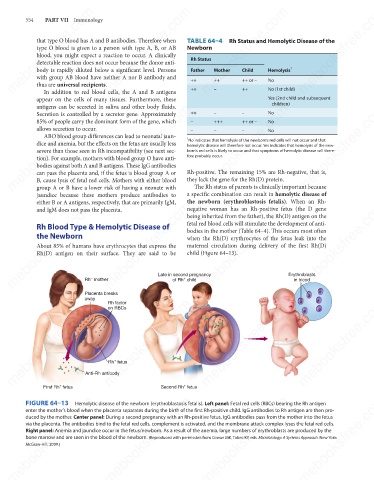
                                                                     maternal circulation during delivery of the first Rh(D)
                    About 85% of humans have erythrocytes that express the
                                                                     child (Figure 64–13).
                    Rh(D) antigen on their surface. They are said to be
                                      –
                                                                    +
                                    Rh  mother
                                                                                                        in blood
                                                                 of Rh  child
                                    Placenta breaks         Late in second pregnancy                   Erythroblasts
                                    away
                                            mebooksfree.com
 mebooksfree.com  mebooksfree.com   Anti-Rh antibody         Second Rh  fetus mebooksfree.com               mebooksfree.com                mebooksfree.com
                                            Rh factor
                                            on RBCs
                                              +
                                            Rh  fetus
                            +
                                                                    +
                      First Rh  fetus
 mebooksfree.com  mebooksfree.com           mebooksfree.com                 mebooksfree.com                 mebooksfree.com                mebooksfree.com
                 FIGURE 64–13
                                 Hemolytic disease of the newborn (erythroblastosis fetalis). Left panel: Fetal red cells (RBCs) bearing the Rh antigen
                 enter the mother’s blood when the placenta separates during the birth of the first Rh-positive child. IgG antibodies to Rh antigen are then pro-
                 duced by the mother. Center panel: During a second pregnancy with an Rh-positive fetus, IgG antibodies pass from the mother into the fetus
                 via the placenta. The antibodies bind to the fetal red cells, complement is activated, and the membrane attack complex lyses the fetal red cells.
                 Right panel: Anemia and jaundice occur in the fetus/newborn. As a result of the anemia, large numbers of erythroblasts are produced by the
                 bone marrow and are seen in the blood of the newborn. (Reproduced with permission from Cowan MK, Talaro KP, eds. Microbiology: A Systems Approach. New York:
                 McGraw-Hill; 2009.)
 mebooksfree.com  mebooksfree.com           mebooksfree.com                 mebooksfree.com                 mebooksfree.com                mebooksfree.com
   560   561   562   563   564   565   566   567   568   569   570