


Page 568 - Review of Medical Microbiology and Immunology ( PDFDrive )
P. 568
mebooksfree.com


                                                                            mebooksfree.com
                                                                                                                                           mebooksfree.com
            mebooksfree.com
                                                                                                            mebooksfree.com
 mebooksfree.com  mebooksfree.com           mebooksfree.com                 mebooksfree.com         C   H   mebooksfree.com                mebooksfree.com
                                            mebooksfree.com
                    Hypersensitivity (Allergy) 65
                                                                                                                         R
                                                                                                                  T
                                                                                                               P
                                                                                                                      E
                                                                                                            A


                                                                                                            mebooksfree.com
 mebooksfree.com  mebooksfree.com           mebooksfree.com              Type IV: Delayed (Cell-Mediated) Hypersensitivity                 mebooksfree.com
                                                                            mebooksfree.com


                       CHAPTER  C ONTENT S

                       Introduction
                                                                             Immune Complex Diseases
                       Type I: Immediate (Anaphylactic) Hypersensitivity
                                                                             Rheumatoid Arthritis
                          Atopy
                          Drug Hypersensitivity
                                                                             Clinically Important Delayed Hypersensitivity Reactions
                          Desensitization
                                                                         Practice Questions: USMLE & Course Examinations
                          Treatment & Prevention
                       Type II: Cytotoxic Hypersensitivity               Self-Assessment Questions
                       Type III: Immune Complex Hypersensitivity
 mebooksfree.com  mebooksfree.com           mebooksfree.com              in a given individual and occur on contact with the specific      mebooksfree.com
                                                                            mebooksfree.com
                                                                                                            mebooksfree.com
                          Arthus Reaction
                          Serum Sickness


                        INTRODUCTION
                                                                           The clinical manifestations of these reactions are typical
                        Hypersensitivity is the term used when an immune response
                                                                         antigen to which the individual is hypersensitive. The first
                        results in exaggerated or inappropriate reactions harmful to
                        the host. Generally speaking, hypersensitivity reactions
                                                                         induces the antibody), and subsequent contacts elicit the
                        occur in response to  external stimuli (antigens) whereas
                                                                         allergic response.
                        autoimmune reactions (see Chapter 66) occur in response to   contact of the individual with the antigen sensitizes (i.e.,
                                                                           Hypersensitivity reactions can be subdivided into four
                                                                            mebooksfree.com
 mebooksfree.com  mebooksfree.com       Antibody or      Immunologic Reaction mediated by IgG. The immunologic reactions are               mebooksfree.com
                                            mebooksfree.com
                                                                                                            mebooksfree.com
                        internal stimuli (antigens). The term allergy is often equated
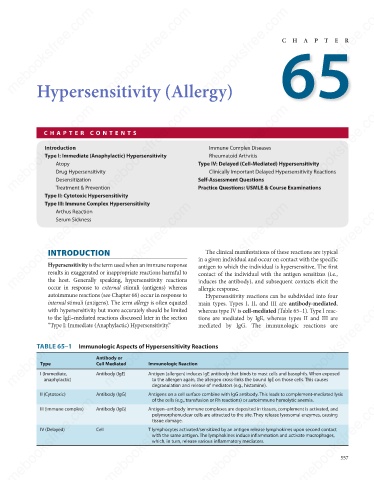
                                                                         main types. Types I, II, and III are  antibody-mediated,
                        with hypersensitivity but more accurately should be limited
                                                                         whereas type IV is cell-mediated (Table 65–1). Type I reac-
                                                                         tions are mediated by IgE, whereas types II and III are
                        to the IgE–mediated reactions discussed later in the section
                        “Type I: Immediate (Anaphylactic) Hypersensitivity.”
                    TABLE 65–1  Immunologic Aspects of Hypersensitivity Reactions
                     Type
                                        Cell Mediated
                     I (Immediate,
                       anaphylactic)
                                                          to the allergen again, the allergen cross-links the bound IgE on those cells. This causes
                                                          degranulation and release of mediators (e.g., histamine).
                                                         Antigens on a cell surface combine with IgG antibody. This leads to complement-mediated lysis
                     II (Cytotoxic)     Antibody (IgE)   Antigen (allergen) induces IgE antibody that binds to mast cells and basophils. When exposed
                                        Antibody (IgG)
 mebooksfree.com  mebooksfree.com       Cell mebooksfree.com                mebooksfree.com                 mebooksfree.com                mebooksfree.com
                                                          of the cells (e.g., transfusion or Rh reactions) or autoimmune hemolytic anemia.
                                                         Antigen–antibody immune complexes are deposited in tissues, complement is activated, and
                                        Antibody (IgG)
                     III (Immune complex)
                                                          polymorphonuclear cells are attracted to the site. They release lysosomal enzymes, causing
                                                          tissue damage.
                     IV (Delayed)
                                                         T lymphocytes activated/sensitized by an antigen release lymphokines upon second contact
                                                          with the same antigen. The lymphokines induce inflammation and activate macrophages,
                                                          which, in turn, release various inflammatory mediators.
                                                                                                                        557


 mebooksfree.com  mebooksfree.com           mebooksfree.com                 mebooksfree.com                 mebooksfree.com                mebooksfree.com

