


Page 572 - Review of Medical Microbiology and Immunology ( PDFDrive )
P. 572
mebooksfree.com
mebooksfree.com
mebooksfree.com
mebooksfree.com
mebooksfree.com
mebooksfree.com
mebooksfree.com
mebooksfree.com
mebooksfree.com mebooksfree.com mebooksfree.com conjunctivitis, eye drops containing antihistamines or 561 mebooksfree.com
CHAPTER 65 Hypersensitivity (Allergy)
Desensitization
vasoconstrictors are effective. Avoidance of the inciting
Major manifestations of anaphylaxis occur when large
allergens, such as pollens, is helpful in prophylaxis. Desen-
amounts of mediators are suddenly released as a result of a
sitization can also be helpful.
massive dose of antigen abruptly combining with IgE on
many mast cells. This is systemic anaphylaxis, which is
potentially fatal. Desensitization can prevent systemic
anaphylaxis.
HYPERSENSITIVITY
Acute desensitization involves the administration of
very small amounts of antigen at 15-minute intervals. TYPE II: CYTOTOXIC
mebooksfree.com
mebooksfree.com
mebooksfree.com mebooksfree.com attack complex (see Chapter 63), which damages the cell mebooksfree.com
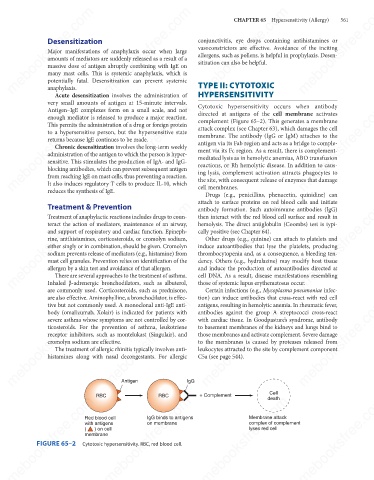
Cytotoxic hypersensitivity occurs when antibody
reduces the synthesis of IgE. mebooksfree.com
Antigen–IgE complexes form on a small scale, and not
directed at antigens of the cell membrane activates
enough mediator is released to produce a major reaction.
complement (Figure 65–2). This generates a membrane
This permits the administration of a drug or foreign protein
to a hypersensitive person, but the hypersensitive state
membrane. The antibody (IgG or IgM) attaches to the
returns because IgE continues to be made.
antigen via its Fab region and acts as a bridge to comple-
Chronic desensitization involves the long-term weekly
ment via its Fc region. As a result, there is complement-
administration of the antigen to which the person is hyper-
mediated lysis as in hemolytic anemias, ABO transfusion
sensitive. This stimulates the production of IgA- and IgG-
reactions, or Rh hemolytic disease. In addition to caus-
blocking antibodies, which can prevent subsequent antigen
ing lysis, complement activation attracts phagocytes to
from reaching IgE on mast cells, thus preventing a reaction.
the site, with consequent release of enzymes that damage
It also induces regulatory T cells to produce IL-10, which
cell membranes.
Drugs (e.g., penicillins, phenacetin, quinidine) can
attach to surface proteins on red blood cells and initiate
mebooksfree.com
mebooksfree.com mebooksfree.com mebooksfree.com hemolysis. The direct antiglobulin (Coombs) test is typi- mebooksfree.com
mebooksfree.com
Treatment & Prevention
antibody formation. Such autoimmune antibodies (IgG)
then interact with the red blood cell surface and result in
Treatment of anaphylactic reactions includes drugs to coun-
teract the action of mediators, maintenance of an airway,
and support of respiratory and cardiac function. Epineph-
cally positive (see Chapter 64).
rine, antihistamines, corticosteroids, or cromolyn sodium,
Other drugs (e.g., quinine) can attach to platelets and
induce autoantibodies that lyse the platelets, producing
either singly or in combination, should be given. Cromolyn
sodium prevents release of mediators (e.g., histamine) from
thrombocytopenia and, as a consequence, a bleeding ten-
dency. Others (e.g., hydralazine) may modify host tissue
mast cell granules. Prevention relies on identification of the
allergen by a skin test and avoidance of that allergen.
and induce the production of autoantibodies directed at
There are several approaches to the treatment of asthma.
those of systemic lupus erythematosus occur.
Inhaled β-adrenergic bronchodilators, such as albuterol,
are commonly used. Corticosteroids, such as prednisone,
Certain infections (e.g., Mycoplasma pneumoniae infec-
tion) can induce antibodies that cross-react with red cell
are also effective. Aminophylline, a bronchodilator, is effec- cell DNA. As a result, disease manifestations resembling
mebooksfree.com
mebooksfree.com mebooksfree.com mebooksfree.com IgG to basement membranes of the kidneys and lungs bind to mebooksfree.com
mebooksfree.com
antigens, resulting in hemolytic anemia. In rheumatic fever,
tive but not commonly used. A monoclonal anti-IgE anti-
body (omalizumab, Xolair) is indicated for patients with
antibodies against the group A streptococci cross-react
with cardiac tissue. In Goodpasture’s syndrome, antibody
severe asthma whose symptoms are not controlled by cor-
ticosteroids. For the prevention of asthma, leukotriene
those membranes and activate complement. Severe damage
receptor inhibitors, such as montelukast (Singulair), and
cromolyn sodium are effective.
to the membranes is caused by proteases released from
The treatment of allergic rhinitis typically involves anti-
leukocytes attracted to the site by complement component
histamines along with nasal decongestants. For allergic
C5a (see page 544).
Antigen
Cell
RBC
RBC
mebooksfree.com
mebooksfree.com
mebooksfree.com mebooksfree.com Red blood cell IgG binds to antigens + Complement Membrane attack mebooksfree.com mebooksfree.com
death
complex of complement
on membrane
with antigens
lyses red cell
( ) on cell
membrane
FIGURE 65–2
Cytotoxic hypersensitivity. RBC, red blood cell.
mebooksfree.com mebooksfree.com mebooksfree.com mebooksfree.com mebooksfree.com mebooksfree.com

