


Page 90 - Review of Medical Microbiology and Immunology ( PDFDrive )
P. 90
mebooksfree.com
mebooksfree.com
mebooksfree.com
mebooksfree.com
mebooksfree.com
mebooksfree.com
mebooksfree.com
mebooksfree.com
mebooksfree.com mebooksfree.com mebooksfree.com CHAPTER 10 Antimicrobial Drugs: Mechanism of Action 79 mebooksfree.com
1. Inhibition of Precursor Synthesis
and gram-negative bacteria (including macrolide-resistant
pneumococci) and is used in the treatment of community-
Sulfonamides
acquired pneumonia, bronchitis, and sinusitis.
Either alone or in combination with trimethoprim, sulfon-
Streptogramins
amides are useful in a variety of bacterial diseases such as
A combination of two streptogramins, quinupristin, and
caused by S. pneumoniae or H. influenzae in children, shig-
dalfopristin (Synercid), is used for the treatment of
ellosis, nocardiosis, and chancroid. In combination, they
bloodstream infections caused by vancomycin-resistant
are also the drugs of choice for two additional diseases,
Enterococcus faecium (but not vancomycin-resistant urinary tract infections caused by E. coli, otitis media
mebooksfree.com
mebooksfree.com mebooksfree.com mebooksfree.com pound, sulfanilamide, became the first clinically effective mebooksfree.com
mebooksfree.com
toxoplasmosis and Pneumocystis pneumonia. The sulfon-
Enterococcus faecalis). It is also approved for use in infec-
amides are a large family of bacteriostatic drugs that are
tions caused by Streptococcus pyogenes, penicillin-resistant
produced by chemical synthesis. In 1935, the parent com-
S. pneumoniae, methicillin-resistant S. aureus, and methicillin-
resistant S. epidermidis.
antimicrobial agent.
Streptogramins cause premature release of the growing
The mode of action of sulfonamides is to block the syn-
peptide chain from the 50S ribosomal subunit. The struc-
thesis of tetrahydrofolic acid, which is required as a methyl
ture and mode of action of streptogramins is different from
donor in the synthesis of the nucleic acid precursors ade-
all other drugs that inhibit protein synthesis, and there is
nine, guanine, and thymine. Sulfonamides are structural
no cross-resistance between streptogramins and these
analogues of p-aminobenzoic acid (PABA). PABA con-
other drugs.
Retapamulin
acid, a precursor of tetrahydrofolic acid (Figure 10–9).
Sulfonamides compete with PABA for the active site of the
Retapamulin (Altabax) is the first clinically available mem- denses with a pteridine compound to form dihydropteroic
enzyme dihydropteroate synthetase. This competitive inhi-
mebooksfree.com
mebooksfree.com
mebooksfree.com mebooksfree.com mebooksfree.com bacteria is that many bacteria synthesize their folic acid mebooksfree.com
ber of a new class of antibiotics called pleuromutilins.
bition can be overcome by an excess of PABA.
These drugs inhibit bacterial protein synthesis by binding
The basis of the selective action of sulfonamides on
to the 23S RNA of the 50S subunit and blocking attachment
of the donor tRNA. Retapamulin is a topical antibiotic used
from PABA-containing precursors, whereas human cells
in the treatment of skin infections, such as impetigo, caused
require preformed folic acid as an exogenous nutrient
by S. pyogenes and methicillin-sensitive S. aureus.
because they lack the enzymes to synthesize it. Human
cells therefore bypass the step at which sulfonamides act.
Bacteria that can use preformed folic acid are similarly
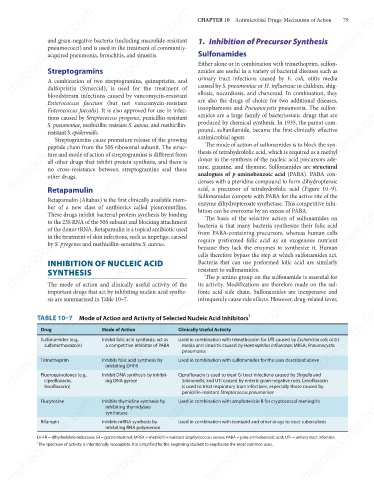
INHIBITION OF NUCLEIC ACID
SYNTHESIS
The p-amino group on the sulfonamide is essential for
its activity. Modifications are therefore made on the sul-
The mode of action and clinically useful activity of the
fonic acid side chain. Sulfonamides are inexpensive and
important drugs that act by inhibiting nucleic acid synthe- resistant to sulfonamides.
infrequently cause side effects. However, drug-related fever,
sis are summarized in Table 10–7.
mebooksfree.com
mebooksfree.com mebooksfree.com Mode of Action Clinically Useful Activity mebooksfree.com mebooksfree.com
mebooksfree.com
1
TABLE 10–7 Mode of Action and Activity of Selected Nucleic Acid Inhibitors
Drug
Used in combination with trimethoprim for UTI caused by Escherichia coli; otitis
Sulfonamides (e.g.,
Inhibit folic acid synthesis; act as
sulfamethoxazole)
a competitive inhibitor of PABA
media and sinusitis caused by Haemophilus influenzae; MRSA; Pneumocystis
pneumonia
Trimethoprim
Used in combination with sulfonamides for the uses described above
Inhibits folic acid synthesis by
inhibiting DHFR
Ciprofloxacin is used to treat GI tract infections caused by Shigella and
Fluoroquinolones (e.g.,
Inhibit DNA synthesis by inhibit-
Salmonella, and UTI caused by enteric gram-negative rods. Levofloxacin
ing DNA gyrase
ciprofloxacin,
levofloxacin)
is used to treat respiratory tract infections, especially those caused by
penicillin-resistant Streptococcus pneumoniae
mebooksfree.com
mebooksfree.com
mebooksfree.com
mebooksfree.com mebooksfree.com Inhibits mRNA synthesis by Used in combination with isoniazid and other drugs to treat tuberculosis mebooksfree.com
Flucytosine
Used in combination with amphotericin B for cryptococcal meningitis
Inhibits thymidine synthesis by
inhibiting thymidylate
synthetase
Rifampin
inhibiting RNA polymerase
DHFR = dihydrofolate reductase; GI = gastrointestinal; MRSA = methicillin-resistant Staphylococcus aureus; PABA = para-aminobenzoic acid; UTI = urinary tract infection.
1
The spectrum of activity is intentionally incomplete. It is simplified for the beginning student to emphasize the most common uses.
mebooksfree.com mebooksfree.com mebooksfree.com mebooksfree.com mebooksfree.com mebooksfree.com

