


Page 89 - Review of Medical Microbiology and Immunology ( PDFDrive )
P. 89
mebooksfree.com
mebooksfree.com
mebooksfree.com
mebooksfree.com
mebooksfree.com
mebooksfree.com
mebooksfree.com
mebooksfree.com mebooksfree.com OH CH OH O CHCl 2 Q-T interval that may increase the risk of cardiac death. mebooksfree.com mebooksfree.com
mebooksfree.com
PART I Basic Bacteriology
78
Erythromycin has a similar spectrum of activity but has a
shorter half-life and so must be taken more frequently and
2
has more adverse effects, especially on the gastrointestinal
C
O N
C
C
N
2
tract. Clarithromycin is used primarily in the treatment of
H
H
H
Helicobacter infections and in the treatment and prevention
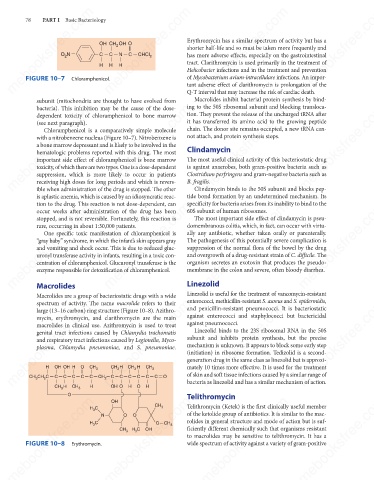
FIGURE 10–7
Chloramphenicol.
tant adverse effect of clarithromycin is prolongation of the
Macrolides inhibit bacterial protein synthesis by bind-
subunit (mitochondria are thought to have evolved from of Mycobacterium avium-intracellulare infections. An impor-
ing to the 50S ribosomal subunit and blocking transloca-
mebooksfree.com mebooksfree.com mebooksfree.com chain. The donor site remains occupied, a new tRNA can- mebooksfree.com
mebooksfree.com
mebooksfree.com
bacteria). This inhibition may be the cause of the dose-
tion. They prevent the release of the uncharged tRNA after
dependent toxicity of chloramphenicol to bone marrow
it has transferred its amino acid to the growing peptide
(see next paragraph).
Chloramphenicol is a comparatively simple molecule
not attach, and protein synthesis stops.
with a nitrobenzene nucleus (Figure 10–7). Nitrobenzene is
a bone marrow depressant and is likely to be involved in the
Clindamycin
hematologic problems reported with this drug. The most
The most useful clinical activity of this bacteriostatic drug
important side effect of chloramphenicol is bone marrow
is against anaerobes, both gram-positive bacteria such as
toxicity, of which there are two types. One is a dose-dependent
suppression, which is more likely to occur in patients
B. fragilis.
receiving high doses for long periods and which is revers-
Clindamycin binds to the 50S subunit and blocks pep-
ible when administration of the drug is stopped. The other
tide bond formation by an undetermined mechanism. Its
is aplastic anemia, which is caused by an idiosyncratic reac- Clostridium perfringens and gram-negative bacteria such as
specificity for bacteria arises from its inability to bind to the
tion to the drug. This reaction is not dose-dependent, can
mebooksfree.com mebooksfree.com mebooksfree.com domembranous colitis, which, in fact, can occur with virtu- mebooksfree.com
mebooksfree.com
mebooksfree.com
60S subunit of human ribosomes.
occur weeks after administration of the drug has been
The most important side effect of clindamycin is pseu-
stopped, and is not reversible. Fortunately, this reaction is
rare, occurring in about 1:30,000 patients.
ally any antibiotic, whether taken orally or parenterally.
One specific toxic manifestation of chloramphenicol is
The pathogenesis of this potentially severe complication is
“gray baby” syndrome, in which the infant’s skin appears gray
suppression of the normal flora of the bowel by the drug
and vomiting and shock occur. This is due to reduced gluc-
and overgrowth of a drug-resistant strain of C. difficile. The
uronyl transferase activity in infants, resulting in a toxic con-
organism secretes an exotoxin that produces the pseudo-
centration of chloramphenicol. Glucuronyl transferase is the
membrane in the colon and severe, often bloody diarrhea.
enzyme responsible for detoxification of chloramphenicol.
Macrolides
Linezolid is useful for the treatment of vancomycin-resistant
Macrolides are a group of bacteriostatic drugs with a wide Linezolid
enterococci, methicillin-resistant S. aureus and S. epidermidis,
mebooksfree.com
mebooksfree.com mebooksfree.com CH 3 OH O mebooksfree.com against pneumococci. mebooksfree.com mebooksfree.com
spectrum of activity. The name macrolide refers to their
and penicillin-resistant pneumococci. It is bacteriostatic
large (13–16 carbon) ring structure (Figure 10–8). Azithro-
against enterococci and staphylococci but bactericidal
mycin, erythromycin, and clarithromycin are the main
macrolides in clinical use. Azithromycin is used to treat
Linezolid binds to the 23S ribosomal RNA in the 50S
genital tract infections caused by Chlamydia trachomatis
subunit and inhibits protein synthesis, but the precise
and respiratory tract infections caused by Legionella, Myco-
mechanism is unknown. It appears to block some early step
plasma, Chlamydia pneumoniae, and S. pneumoniae.
(initiation) in ribosome formation. Tedizolid is a second-
generation drug in the same class as linezolid but is approxi-
mately 10 times more effective. It is used for the treatment
H
O
CH
CH H
CH H
OH OH H
3
3
3
CH CH C
C
C
2
3
bacteria as linezolid and has a similar mechanism of action.
H
CH H
CH
H
O
H
3
Telithromycin
O C 3 C C 3 CH 2 C C O C O C C C 3 O of skin and soft tissue infections caused by a similar range of
mebooksfree.com mebooksfree.com H C mebooksfree.com rolides in general structure and mode of action but is suf- mebooksfree.com
mebooksfree.com
mebooksfree.com
OH
Telithromycin (Ketek) is the first clinically useful member
CH
H C
of the ketolide group of antibiotics. It is similar to the mac-
N
CH
O
3
3
ficiently different chemically such that organisms resistant
H C
OH
CH
3
3
to macrolides may be sensitive to telithromycin. It has a
FIGURE 10–8
wide spectrum of activity against a variety of gram-positive
Erythromycin.
mebooksfree.com mebooksfree.com mebooksfree.com mebooksfree.com mebooksfree.com mebooksfree.com

