


Page 18 - Textbook of Pathology, 6th Edition
P. 18
2 mankind, there has been desire as well as need to know more
           about the causes, mechanisms and nature of diseases. The
           answers to these questions have evolved over the centuries—
           from supernatural beliefs to the present state of our
           knowledge of modern pathology. However, pathology is not
           separable from other multiple disciplines of medicine and
           owes its development to interaction and interdependence on
           advances in diverse neighbouring branches of science, in
           addition to the strides made in medical technology. As we
     SECTION I
           shall see in the pages that follow, pathology has evolved over
           the years as a distinct discipline from anatomy, medicine and
           surgery, in that sequence.
              The brief review of fascinating history of pathology and
           its many magnificent personalities with their outstanding
           contribution in the opening pages of the book is meant to pay
           our obeisance to those great personalities who have laid
           glorious foundations of our speciality. Life and works of those
           whose names are mentioned below are linked to some disease
           or process—the aim being to stimulate the inquisitive beginner
           in pathology as to how this colourful specialty has emerged.

           FROM RELIGIOUS BELIEFS AND
           MAGIC TO RATIONAL APPROACH
           (PREHISTORIC TIME TO AD 1500)
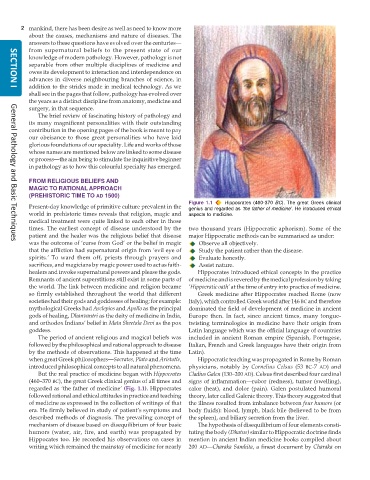
                                                               Figure 1.1  Hippocrates (460-370 BC). The great Greek clinical
           Present-day knowledge of primitive culture prevalent in the  genius and regarded as ‘the father of medicine’. He introduced ethical
           world in prehistoric times reveals that religion, magic and  aspects to medicine.
           medical treatment were quite linked to each other in those
           times. The earliest concept of disease understood by the  two thousand years (Hippocratic aphorism). Some of the
           patient and the healer was the religious belief that disease  major Hippocratic methods can be summarised as under:
           was the outcome of ‘curse from God’ or the belief in magic  Observe all objectively.
     General Pathology and Basic Techniques
           that the affliction had supernatural origin from ‘evil eye of  Study the patient rather than the disease.
           spirits.’ To ward them off, priests through prayers and  Evaluate honestly.
           sacrifices, and magicians by magic power used to act as faith-  Assist nature.
           healers and invoke supernatural powers and please the gods.  Hippocrates introduced ethical concepts in the practice
           Remnants of ancient superstitions still exist in some parts of  of medicine and is revered by the medical profession by taking
           the world. The link between medicine and religion became  ‘Hippocratic oath’ at the time of entry into practice of medicine.
           so firmly established throughout the world that different  Greek medicine after Hippocrates reached Rome (now
           societies had their gods and goddesses of healing; for example:  Italy), which controlled Greek world after 146 BC and therefore
           mythological Greeks had Asclepios and Apollo as the principal  dominated the field of development of medicine in ancient
           gods of healing, Dhanvantri as the deity of medicine in India,  Europe then. In fact, since ancient times, many tongue-
           and orthodox Indians’ belief in Mata Sheetala Devi as the pox  twisting terminologies in medicine have their origin from
           goddess.                                            Latin language which was the official language of countries
              The period of ancient religious and magical beliefs was  included in ancient Roman empire (Spanish, Portugese,
           followed by the philosophical and rational approach to disease  Italian, French and Greek languages have their origin from
           by the methods of observations. This happened at the time  Latin).
           when great Greek philosophers—Socrates, Plato and Aristotle,  Hippocratic teaching was propagated in Rome by Roman
           introduced philosophical concepts to all natural phenomena.  physicians, notably by  Cornelius Celsus (53  BC-7  AD) and
              But the real practice of medicine began with Hippocrates  Cladius Galen (130–200 AD). Celsus first described four cardinal
           (460–370 BC), the great Greek clinical genius of all times and  signs of inflammation—rubor (redness), tumor (swelling),
           regarded as ‘the father of medicine’ (Fig. 1.1). Hippocrates  calor (heat), and dolor (pain). Galen postulated humoral
           followed rational and ethical attitudes in practice and teaching  theory, later called Galenic theory. This theory suggested that
           of medicine as expressed in the collection of writings of that  the illness resulted from imbalance between four humors (or
           era. He firmly believed in study of patient’s symptoms and  body fluids): blood, lymph, black bile (believed to be from
           described methods of diagnosis. The prevailing concept of  the spleen), and biliary secretion from the liver.
           mechanism of disease based on disequilibrium of four basic  The hypothesis of disequilibrium of four elements consti-
           humors (water, air, fire, and earth) was propagated by  tuting the body (Dhatus) similar to Hippocratic doctrine finds
           Hippocates too. He recorded his observations on cases in  mention in ancient Indian medicine books compiled about
           writing which remained the mainstay of medicine for nearly  200 AD—Charaka Samhita, a finest document by Charaka on

