


Page 22 - Textbook of Pathology, 6th Edition
P. 22
6     Another pioneering contribution in pathology in the
           20th century was by an eminent teacher-author,  William
           Boyd (1885–1979), psychiatrist-turned pathologist, whose
           textbooks—‘Pathology for Surgeons’ (first edition 1925) and
           ‘Textbook of Pathology’ (first edition 1932), dominated and
           inspired the students of pathology all over the world due
           to his flowery language and lucid style for about 50 years
           till 1970s (Fig.  1.9). M.M. Wintrobe (1901–1986), a pupil of
           Boyd who discovered haematocrit technique, regarded him
     SECTION I
           as a very stimulating teacher with keen interest in the
           development of museum.

           MODERN PATHOLOGY (1950s TO PRESENT TIMES)
           The strides made in the latter half of 20th century until the
           beginning of 21st century have made it possible to study
           diseases at molecular level, and provide an evidence-based
           and objective diagnosis and enable the physician to institute
           appropriate therapy. The major impact of advances in
           molecular biology are in the field of diagnosis and treatment
           of genetic disorders, immunology and in cancer. Some of
           the revolutionary discoveries during this time are as under
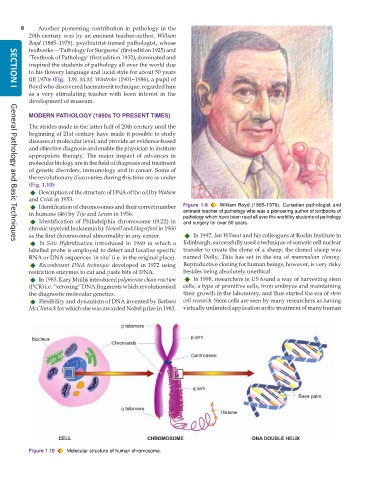
           (Fig. 1.10):
              Description of the structure of DNA of the cell by Watson
           and Crick in 1953.
              Identification of chromosomes and their correct number  Figure 1.9  William Boyd (1885-1979). Canadian pathologist and
           in humans (46) by Tijo and Levan in 1956.          eminent teacher of pathology who was a pioneering author of textbooks of
                                                              pathology which have been read all over the world by students of pathology
              Identification of Philadelphia chromosome t(9;22) in  and surgery for over 50 years.
           chronic myeloid leukaemia by Nowell and Hagerford in 1960
           as the first chromosomal abnormality in any cancer.   In 1997, Ian Wilmut and his colleagues at Roslin Institute in
              In Situ Hybridization introduced in 1969 in which a  Edinburgh, successfully used a technique of somatic cell nuclear
     General Pathology and Basic Techniques
           labelled probe is employed to detect and localize specific  transfer to create the clone of a sheep; the cloned sheep was
           RNA or DNA sequences ‘in situ’ (i.e. in the original place).  named Dolly. This has set in the era of  mammalian cloning.
              Recombinant DNA technique developed in 1972 using  Reproductive cloning for human beings, however, is very risky
           restriction enzymes to cut and paste bits of DNA.  besides being absolutely unethical.
              In 1983, Kary Mullis introduced polymerase chain reaction  In 1998, researchers in US found a way of harvesting stem
           (PCR) i.e. “xeroxing” DNA fragments which revolutionised  cells, a type of primitive cells, from embryos and maintaining
           the diagnostic molecular genetics.                 their growth in the laboratory, and thus started the era of stem
              Flexibility and dynamism of DNA invented by Barbara  cell research. Stem cells are seen by many researchers as having
           McClintock for which she was awarded Nobel prize in 1983.  virtually unlimited application in the treatment of many human


           Figure 1.10  Molecular structure of human chromosome.

