


Page 20 - Textbook of Pathology, 6th Edition
P. 20
4           FATHER OF CPCs              FATHER OF MUSEUM IN PATHOLOGY       FATHER OF CLINICAL PATHOLOGY


     SECTION I


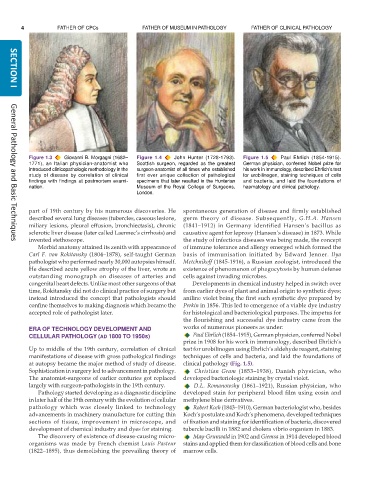
           Figure 1.3  Giovanni B. Morgagni (1682–  Figure 1.4  John Hunter (1728-1793).  Figure 1.5  Paul Ehrlich (1854-1915).
           1771), an Italian physician-anatomist who  Scottish surgeon, regarded as the greatest  German physician, conferred Nobel prize for
           introduced clinicopathologic methodology in the  surgeon-anatomist of all times who established  his work in immunology, described Ehrlich’s test
           study of disease by correlation of clinical  first ever unique collection of pathological  for urobilinogen, staining techniques of cells
           findings with findings at postmortem exami-  specimens that later resulted in the Hunterian  and bacteria, and laid the foundations of
           nation.                            Museum of the Royal College of Surgeons,  haematology and clinical pathology.
                                              London.


           part of 19th century by his numerous discoveries. He  spontaneous generation of disease and firmly established
           described several lung diseases (tubercles, caseous lesions,  germ theory of disease. Subsequently,  G.H.A. Hansen
           miliary lesions, pleural effusion, bronchiectasis), chronic  (1841–1912) in Germany identified Hansen’s bacillus as
           sclerotic liver disease (later called Laennec’s cirrhosis) and  causative agent for leprosy (Hansen’s disease) in 1873. While
           invented stethoscope.                              the study of infectious diseases was being made, the concept
     General Pathology and Basic Techniques
              Morbid anatomy attained its zenith with appearance of  of immune tolerance and allergy emerged which formed the
           Carl F. von Rokitansky (1804–1878), self-taught German  basis of immunisation initiated by Edward Jenner.  Ilya
           pathologist who performed nearly 30,000 autopsies himself.  Metchnikoff (1845-1916), a Russian zoologist, introduced the
           He described acute yellow atrophy of the liver, wrote an  existence of phenomenon of phagocytosis by human defense
           outstanding monograph on diseases of arteries and  cells against invading microbes.
           congenital heart defects. Unlike most other surgeons of that  Developments in chemical industry helped in switch over
           time, Rokitansky did not do clinical practice of surgery but  from earlier dyes of plant and animal origin to synthetic dyes;
           instead introduced the concept that pathologists should  aniline violet being the first such synthetic dye prepared by
           confine themselves to making diagnosis which became the  Perkin in 1856. This led to emergence of a viable dye industry
           accepted role of pathologist later.                for histological and bacteriological purposes. The impetus for
                                                              the flourishing and successful dye industry came from the
           ERA OF TECHNOLOGY DEVELOPMENT AND                  works of numerous pioneers as under:
           CELLULAR PATHOLOGY (AD 1800 TO 1950s)                 Paul Ehrlich (1854–1915), German physician, conferred Nobel
                                                              prize in 1908 for his work in immunology, described Ehrlich’s
           Up to middle of the 19th century, correlation of clinical  test for urobilinogen using Ehrlich’s aldehyde reagent, staining
           manifestations of disease with gross pathological findings  techniques of cells and bacteria, and laid the foundations of
           at autopsy became the major method of study of disease.  clinical pathology (Fig. 1.5).
           Sophistication in surgery led to advancement in pathology.  Christian Gram (1853–1938), Danish physician, who
           The anatomist-surgeons of earlier centuries got replaced  developed bacteriologic staining by crystal violet.
           largely with surgeon-pathologists in the 19th century.  D.L. Romanowsky  (1861–1921), Russian physician, who
              Pathology started developing as a diagnostic discipline  developed stain for peripheral blood film using eosin and
           in later half of the 19th century with the evolution of cellular  methylene blue derivatives.
           pathology which was closely linked to technology      Robert Koch (1843–1910), German bacteriologist who, besides
           advancements in machinery manufacture for cutting thin  Koch’s postulate and Koch’s phenomena, developed techniques
           sections of tissue, improvement in microscope, and  of fixation and staining for identification of bacteria, discovered
           development of chemical industry and dyes for staining.  tubercle bacilli in 1882 and cholera vibrio organism in 1883.
              The discovery of existence of disease-causing micro-  May-Grunwald in 1902 and Giemsa in 1914 developed blood
           organisms was made by French chemist  Louis Pasteur  stains and applied them for classification of blood cells and bone
           (1822–1895), thus demolishing the prevailing theory of  marrow cells.

