


Page 243 - Textbook of Pathology, 6th Edition
P. 243
Specific RNA Oncogenic Viruses of neoplastic transformation (‘slow’). Slow transforming 227
viruses cause neoplastic transformation by insertional
RNA oncogenic viruses are retroviruses i.e. they contain the mutagenesis i.e. viral DNA synthesised by viral RNA via
enzyme reverse transcriptase (RT), though all retroviruses reverse transcriptase is inserted or integrated near the
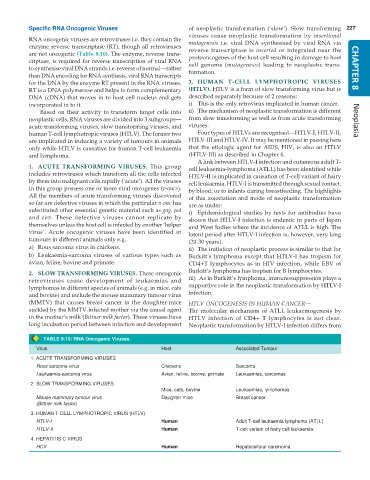
are not oncogenic (Table 8.10). The enzyme, reverse trans- protooncogenes of the host cell resulting in damage to host
criptase, is required for reverse transcription of viral RNA cell genome (mutagenesis) leading to neoplastic trans-
to synthesise viral DNA strands i.e. reverse of normal—rather formation. CHAPTER 8
than DNA encoding for RNA synthesis, viral RNA transcripts
for the DNA by the enzyme RT present in the RNA viruses. 3. HUMAN T-CELL LYMPHOTROPIC VIRUSES
RT is a DNA polymerase and helps to form complementary (HTLV). HTLV is a form of slow transforming virus but is
DNA (cDNA) that moves in to host cell nucleus and gets described separately because of 2 reasons:
incorporated in to it. i) This is the only retrovirus implicated in human cancer.
Based on their activity to transform target cells into ii) The mechanism of neoplastic transformation is different
neoplastic cells, RNA viruses are divided into 3 subgroups— from slow transforming as well as from acute transforming Neoplasia
acute transforming viruses, slow transforming viruses, and viruses.
human T-cell lymphotropic viruses (HTLV). The former two Four types of HTLVs are recognised—HTLV-I, HTLV-II,
are implicated in inducing a variety of tumours in animals HTLV-III and HTLV-IV. It may be mentioned in passing here
only while HTLV is causative for human T-cell leukaemia that the etiologic agent for AIDS, HIV, is also an HTLV
and lymphoma. (HTLV-III) as described in Chapter 4.
A link between HTLV-I infection and cutaneous adult T-
1. ACUTE TRANSFORMING VIRUSES. This group cell leukaemia-lymphoma (ATLL) has been identified while
includes retroviruses which transform all the cells infected HTLV-II is implicated in causation of T-cell variant of hairy
by them into malignant cells rapidly (‘acute’). All the viruses cell leukaemia. HTLV-I is transmitted through sexual contact,
in this group possess one or more viral oncogenes (v-oncs). by blood, or to infants during breastfeeding. The highlights
All the members of acute transforming viruses discovered of this association and mode of neoplastic transformation
so far are defective viruses in which the particular v-onc has are as under:
substituted other essential genetic material such as gag, pol i) Epidemiological studies by tests for antibodies have
and env. These defective viruses cannot replicate by shown that HTLV-I infection is endemic in parts of Japan
themselves unless the host cell is infected by another ‘helper and West Indies where the incidence of ATLL is high. The
virus’. Acute oncogenic viruses have been identified in latent period after HTLV-I infection is, however, very long
tumours in different animals only e.g. (20-30 years).
a) Rous sarcoma virus in chickens. ii) The initiation of neoplastic process is similar to that for
b) Leukaemia-sarcoma viruses of various types such as Burkitt’s lymphoma except that HTLV-I has tropism for
avian, feline, bovine and primate. CD4+T lymphocytes as in HIV infection, while EBV of
2. SLOW TRANSFORMING VIRUSES. These oncogenic Burkitt’s lymphoma has tropism for B lymphocytes.
retroviruses cause development of leukaemias and iii) As in Burkitt’s lymphoma, immunosuppression plays a
lymphomas in different species of animals (e.g. in mice, cats supportive role in the neoplastic transformation by HTLV-I
and bovine) and include the mouse mammary tumour virus infection.
(MMTV) that causes breast cancer in the daughter-mice HTLV ONCOGENESIS IN HUMAN CANCER—
suckled by the MMTV-infected mother via the causal agent The molecular mechanism of ATLL leukaemogenesis by
in the mother’s milk (Bittner milk factor). These viruses have HTLV infection of CD4+ T lymphocytes is not clear.
long incubation period between infection and development Neoplastic transformation by HTLV-I infection differs from
TABLE 8.10: RNA Oncogenic Viruses.
Virus Host Associated Tumour
1. ACUTE TRANSFORMING VIRUSES
Rous sarcoma virus Chickens Sarcoma
Leukaemia-sarcoma virus Avian, feline, bovine, primate Leukaemias, sarcomas
2. SLOW TRANSFORMING VIRUSES
Mice, cats, bovine Leukaemias, lymphomas
Mouse mammary tumour virus Daughter mice Breast cancer
(Bittner milk factor)
3. HUMAN T-CELL LYMPHOTROPIC VIRUS (HTLV)
HTLV-I Human Adult T-cell leukaemia lymphoma (ATLL)
HTLV-II Human T-cell variant of hairy cell leukaemia
4. HEPATITIS C VIRUS
HCV Human Hepatocellular carcinoma

