


Page 247 - Textbook of Pathology, 6th Edition
P. 247
3. FEVER. Fever of unexplained origin may be presenting characterised by hyperuricaemia, hyperkalaemia, 231
feature in some malignancies such as in Hodgkin’s disease, hyperphosphataemia and hypocalcaemia, all of which may
adenocarcinoma kidney, osteogenic sarcoma and many other result in acidosis and renal failure.
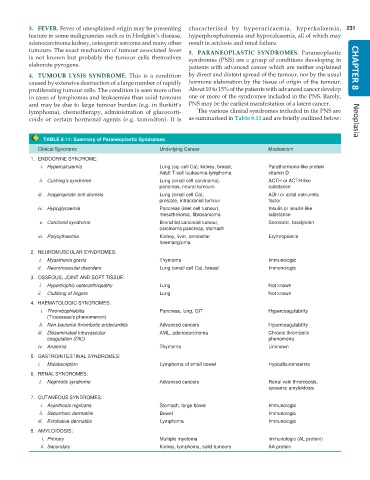
tumours. The exact mechanism of tumour associated fever 5. PARANEOPLASTIC SYNDROMES. Paraneoplastic
is not known but probably the tumour cells themselves syndromes (PNS) are a group of conditions developing in
elaborate pyrogens. patients with advanced cancer which are neither explained CHAPTER 8
4. TUMOUR LYSIS SYNDROME. This is a condition by direct and distant spread of the tumour, nor by the usual
caused by extensive destruction of a large number of rapidly hormone elaboration by the tissue of origin of the tumour.
proliferating tumour cells. The condition is seen more often About 10 to 15% of the patients with advanced cancer develop
in cases of lymphomas and leukaemias than solid tumours one or more of the syndromes included in the PNS. Rarely,
and may be due to large tumour burden (e.g. in Burkitt’s PNS may be the earliest manifestation of a latent cancer.
lymphoma), chemotherapy, administration of glucocorti- The various clinical syndromes included in the PNS are
coids or certain hormonal agents (e.g. tamoxifen). It is as summarised in Table 8.11 and are briefly outlined below: Neoplasia
TABLE 8.11: Summary of Paraneoplastic Syndromes.
Clinical Syndrome Underlying Cancer Mechanism
1. ENDOCRINE SYNDROME:
i. Hypercalcaemia Lung (sq. cell Ca), kidney, breast, Parathormone-like protein
Adult T-cell leukaemia-lymphoma vitamin D
ii. Cushing’s syndrome Lung (small cell carcinoma), ACTH or ACTH-like
pancreas, neural tumours substance
iii. Inappropriate anti-diuresis Lung (small cell Ca), ADH or atrial natriuretic
prostate, intracranial tumour factor
iv. Hypoglycaemia Pancreas (islet cell tumour), Insulin or insulin-like
mesothelioma, fibrosarcoma substance
v. Carcinoid syndrome Bronchial carcinoid tumour, Serotonin, bradykinin
carcinoma pancreas, stomach
vi. Polycythaemia Kidney, liver, cerebellar Erythropoietin
haemangioma
2. NEUROMUSCULAR SYNDROMES:
i. Myasthenia gravis Thymoma Immunologic
ii. Neuromuscular disorders Lung (small cell Ca), breast Immunologic
3. OSSEOUS, JOINT AND SOFT TISSUE:
i. Hypertrophic osteoarthropathy Lung Not known
ii. Clubbing of fingers Lung Not known
4. HAEMATOLOGIC SYNDROMES:
i. Thrombophlebitis Pancreas, lung, GIT Hypercoagulability
(Trousseau’s phenomenon)
ii. Non-bacterial thrombotic endocarditis Advanced cancers Hypercoagulability
iii. Disseminated intravascular AML, adenocarcinoma Chronic thrombotic
coagulation (DIC) phenomena
iv. Anaemia Thymoma Unknown
5. GASTROINTESTINAL SYNDROMES:
i. Malabsorption Lymphoma of small bowel Hypoalbuminaemia
6. RENAL SYNDROMES:
i. Nephrotic syndrome Advanced cancers Renal vein thrombosis,
systemic amyloidosis
7. CUTANEOUS SYNDROMES:
i. Acanthosis nigricans Stomach, large bowel Immunologic
ii. Seborrheic dermatitis Bowel Immunologic
iii. Exfoliative dermatitis Lymphoma Immunologic
8. AMYLOIDOSIS:
i. Primary Multiple myeloma Immunologic (AL protein)
ii. Secondary Kidney, lymphoma, solid tumours AA protein

